

The Second Coming - Class 11 West Bengal Board English
Watch Video


Study smarter with Pi Lens
Get Notes, PYQs, Quiz and more for any Youtube video!
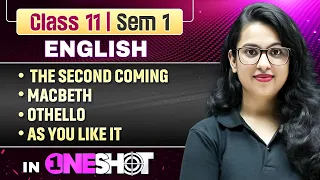
The Second Coming - Class 11 West Bengal Board English
98 views

PW Bangla
Notes
Video Summary
The Second Coming, Macbeth, Othello, As You Like It – Key Concepts and Exam Points
The Second Coming: Context and Central Theme
"The Second Coming" by W.B. Yeats is a symbolic and complex poem written after World War I, reflecting the chaos and moral decline of the era. The poem contrasts earlier periods of spiritual renewal, such as the birth of Krishna or Christ, with the present state of disorder and loss of humanity. Yeats uses the idea of a "second coming" not as a hopeful rebirth, but as the arrival of a destructive force.
- The poem…
The Second Coming, Macbeth, Othello, As You Like It – Key Concepts and Exam Points
The Second Coming: Context and Central Theme
"The Second Coming" by W.B. Yeats is a symbolic and complex poem written after World War I, reflecting the chaos and moral decline of the era. The poem contrasts earlier periods of spiritual renewal, such as the birth of Krishna or Christ, with the present state of disorder and loss of humanity. Yeats uses the idea of a "second coming" not as a hopeful rebirth, but as the arrival of a destructive force.
- The poem was written in the aftermath of World War I, capturing a world spiraling into chaos.
- Yeats draws parallels between historical spiritual rebirths and the current absence of hope or order.
- The "second coming" in the poem does not signify the return of Christ, but the emergence of a "rough beast" symbolizing destruction.
Symbolism and Imagery in The Second Coming
Yeats employs powerful symbols to depict the breakdown of order and the rise of chaos. The "widening gyre" and the falcon-falconer imagery illustrate the loss of control and the disintegration of traditional values.
- Widening gyre: Represents the expanding chaos and loss of central control.
- Falcon and falconer: Symbolize the disconnect between humanity and its moral center.
- Blood-dimmed tide: Indicates widespread violence and the drowning of innocence.
- Spiritus Mundi: The collective unconscious from which the image of the "rough beast" arises.
- Sphinx-like beast: Suggests a new, ominous era is beginning, not a peaceful rebirth.
Historical Influences and References
The poem is deeply rooted in the historical context of its time, referencing major events that contributed to the sense of disorder.
- World War I: The primary catalyst for the poem's themes of chaos and moral decay.
- European and Russian Revolutions: Additional sources of upheaval and the collapse of old orders.
- Irish Independence: Part of the broader context of shifting power structures and instability.
Key Lines and Interpretations
Several lines from the poem encapsulate its central ideas and are frequently referenced in exam questions.
- "Turning and turning in the widening gyre": Illustrates the uncontrollable spread of chaos.
- "The centre cannot hold": The core of society or morality is no longer able to maintain order.
- "The best lack all conviction, while the worst are full of passionate intensity": Good people are passive, while the wicked are zealous.
- "A shape with lion body and the head of a man": The emergence of a monstrous new force.
Exam-Focused Question Types for The Second Coming
Questions often focus on symbolism, historical context, and the meaning of specific phrases.
- First publication: The poem was first published in "The Dial" magazine.
- Historical context: Includes World War I, European Revolution, and Irish Independence.
- Symbol for deteriorating order: Falcon and falconer.
- Meaning of "ceremony of innocence": Child-like purity, not religious ritual or social custom.
- "Widening gyre": Suggests spiraling into chaos, not return to order or peaceful resolution.
- Nature of the poem: Apocalyptic, not optimistic or joyful.
Macbeth: Plot Structure and Tragic Elements
"Macbeth" is a tragedy by William Shakespeare, focusing on the rise and fall of the Scottish nobleman Macbeth. The play explores ambition, moral corruption, and the consequences of unchecked desire for power.
- Macbeth is initially a respected hero, the Thane of Glamis, and a brave soldier.
- After encountering three witches who prophesy his rise to kingship, Macbeth's ambition is ignited.
- Lady Macbeth manipulates him into murdering King Duncan to seize the throne.
- Macbeth's guilt and paranoia lead to further murders, including Banquo and attempted murder of Fleance.
- The witches' prophecies are fulfilled in unexpected ways, leading to Macbeth's downfall at the hands of Macduff, who was "untimely ripped" from his mother's womb (born by Caesarean section).
Key Characters and Relationships in Macbeth
The play features a network of relationships that drive the plot and highlight themes of loyalty, betrayal, and fate.
- Macbeth: Tragic hero whose ambition leads to his ruin.
- Lady Macbeth: Ambitious and manipulative, pushes Macbeth to commit regicide.
- King Duncan: The virtuous king murdered by Macbeth.
- Banquo: Macbeth's friend, whose descendants are prophesied to be kings.
- Fleance: Banquo's son, escapes Macbeth's murder plot.
- Macduff: Macbeth's nemesis, ultimately kills Macbeth.
- Malcolm and Donalbain: Duncan's sons, flee after their father's murder.
Symbolism and Supernatural Elements in Macbeth
Supernatural elements and symbols play a crucial role in the development of the plot and Macbeth's psychological decline.
- The three witches: Represent fate and the supernatural, their prophecies drive Macbeth's actions.
- Visions and hallucinations: Macbeth sees Banquo's ghost and hears voices, symbolizing guilt.
- Blood: Symbolizes guilt and the consequences of violence.
Exam-Oriented Questions for Macbeth
Exam questions often focus on plot events, character motivations, and the interpretation of prophecies.
- Who did Macbeth hire murderers to kill? Banquo and Fleance (though only Banquo is killed).
- What did Macbeth see at the banquet? Banquo's ghost sitting in his chair.
- How was Macduff born? He was "untimely ripped" from his mother's womb (not born naturally).
- Who became king after Macbeth? Malcolm.
Othello: Plot Overview and Central Conflict
"Othello" is a tragedy by Shakespeare centered on the themes of jealousy, manipulation, and trust. Othello, a Moorish general, is manipulated by Iago into believing his wife Desdemona is unfaithful.
- Othello secretly marries Desdemona, a Venetian noblewoman.
- Iago, envious of Cassio's promotion, plots to destroy Othello by insinuating Desdemona's infidelity with Cassio.
- Othello, consumed by jealousy, kills Desdemona and then learns of her innocence.
- Iago's manipulation is exposed, leading to Othello's suicide.
Key Characters and Roles in Othello
The tragedy is driven by the interactions and motivations of its main characters.
- Othello: Moorish general, tragic hero manipulated by Iago.
- Desdemona: Othello's loyal wife, victim of false accusations.
- Iago: Antagonist, master manipulator driven by jealousy.
- Cassio: Othello's trusted lieutenant, target of Iago's schemes.
- Emilia: Iago's wife, attendant to Desdemona, exposes Iago's plot.
Exam-Focused Points for Othello
Questions typically address character relationships, motivations, and key plot developments.
- Who was Iago jealous of? Cassio.
- Who was Desdemona's father? Brabantio.
- Who was Emilia? Iago's wife and Desdemona's attendant.
- What position did Othello hold? General.
- What did Desdemona value most? The nature of a man, not outward appearance.
As You Like It: Plot and Character Dynamics
"As You Like It" is a Shakespearean comedy set in the Forest of Arden, focusing on themes of love, identity, and reconciliation. The story involves political exile, disguise, and romantic entanglements.
- The rightful Duke is exiled by his brother Frederick and takes refuge in the Forest of Arden.
- Rosalind, the Duke's daughter, is also banished and disguises herself as a boy, Ganymede.
- Celia, Frederick's daughter and Rosalind's cousin, accompanies her disguised as Aliena.
- Orlando, mistreated by his brother Oliver, flees to the forest, where he and Rosalind fall in love.
- The play concludes with multiple marriages and the restoration of rightful order.
Key Relationships and Disguises in As You Like It
The plot relies on mistaken identities and the development of relationships in the forest setting.
- Rosalind and Celia: Cousins with a strong bond, both go into exile.
- Orlando and Oliver: Brothers with a strained relationship, reconciled by the end.
- Disguises: Rosalind as Ganymede (shepherd), Celia as Aliena (shepherdess).
- Touchstone: The court jester, provides comic relief.
Exam-Targeted Questions for As You Like It
Exam questions focus on character roles, relationships, and plot events.
- Who wrote love poems on trees? Orlando, for Rosalind.
- What did Rosalind and Celia disguise themselves as? Shepherd and shepherdess.
- Who was Adam? Old servant of Sir Rowland de Boys, helps Orlando.
- What reward did Orlando receive after wrestling? Gold chain from Rosalind.
- Who was the rightful Duke? The exiled Duke, Rosalind's father.
Common Exam Traps and Strategies
Students often make mistakes by misreading options or confusing character relationships. Careful reading and elimination of incorrect options are essential.
- Always check if a question requires multiple correct options (e.g., "both A and B").
- Pay attention to character disguises and relationships, as these are frequent sources of confusion.
- For symbolic questions, focus on the imagery and its meaning as discussed in the text.
Summary Table: Key Character Connections
| Character | Relationship/Role |
|---|---|
| Macbeth | Tragic hero, Thane of Glamis |
| Lady Macbeth | Macbeth's wife, instigator |
| Banquo | Macbeth's friend, father of future kings |
| Othello | Moorish general, tragic hero |
| Desdemona | Othello's wife, victim |
| Iago | Antagonist, manipulator |
| Rosalind | Exiled Duke's daughter, disguised as boy |
| Celia | Frederick's daughter, Rosalind's cousin |
| Orlando | Young nobleman, in love with Rosalind |
| Adam | Loyal servant to Orlando |
This table summarizes the main characters and their roles or relationships as explicitly discussed.
Quiz
20 QuestionsClick on an option to find the answer
Question 1 of 20
Solution
Solution
Solution
Flashcards
6 CardsClick to reveal answerTap the card to see answer

