

30 May 2026 Editorial Discussion - UPSC Social Justice
Watch Video


Study smarter with Pi Lens
Get Notes, PYQs, Quiz and more for any Youtube video!
30 May 2026 Editorial Discussion - UPSC Social Justice
8 views

PW OnlyIAS
Notes
Video Summary
Poverty, Digital Politics, International Law: Contemporary Issues and Analysis
Measuring Poverty in India
Poverty measurement in India has evolved through various committees and methodologies, with the poverty line serving as the primary benchmark. The poverty line is determined by calculating the minimum expenditure required for a basket of essential goods and services, including food, clothing, shelter, health, and education.
- Basket of Goods Approach: The poverty line is set based on the monthly per capita consumer expenditure required to purchase a basket of essential items.
- Calculation Method: For example, if the monthly expenditure is ₹3000, dividing by…
Poverty, Digital Politics, International Law: Contemporary Issues and Analysis
Measuring Poverty in India
Poverty measurement in India has evolved through various committees and methodologies, with the poverty line serving as the primary benchmark. The poverty line is determined by calculating the minimum expenditure required for a basket of essential goods and services, including food, clothing, shelter, health, and education.
- Basket of Goods Approach: The poverty line is set based on the monthly per capita consumer expenditure required to purchase a basket of essential items.
- Calculation Method: For example, if the monthly expenditure is ₹3000, dividing by 30 gives the per day expenditure. Those earning below this threshold are considered poor.
- Committees: Key committees include the Lakdawala Committee (1979), Tendulkar Committee (2009), and Rangarajan Committee (2014).
- Rangarajan Method: The poverty line is set at 68% of the average monthly per capita consumer expenditure for rural areas and 54% for urban areas.
- Latest Estimates: Applying the Rangarajan method to current data, the rural poverty line is ₹2802/month and urban is ₹3778/month. In 2011-12, these were ₹972 and ₹1407 respectively.
Discrepancies in Poverty Data
There is significant variation in poverty estimates due to differing methodologies and inclusion/exclusion of welfare benefits. The government claims a much lower poverty rate compared to independent estimates using updated methods.
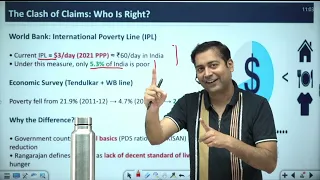
- Current Estimates: Using the latest data and Rangarajan’s method, 27% of India’s population (about 37 crore people) are poor.
- Government Claims: Official figures suggest only 5.3% are poor, and recent surveys claim as low as 2.3%.
- International Poverty Line: Defined as 3 in the US is equivalent to ₹60 in India, leading to a much lower poverty estimate (5.3%).
- Reason for Mismatch: Government includes benefits like free ration (PDS), PM-Kisan, etc., in poverty reduction, while independent estimates often do not.
Regional Distribution and Characteristics of Poverty
Poverty in India is unevenly distributed, with certain states and regions bearing a disproportionate burden. The persistence of poverty in these areas is linked to structural and economic factors.
- High Poverty States: Uttar Pradesh, Bihar, Madhya Pradesh, and West Bengal account for 40% of the population but 48% of the poor.
- Extreme Poverty States: Jharkhand, Chhattisgarh, and Odisha have over 45% of their population below the poverty line.
- Concentration: 80% of the poor reside in just 10 states.
- Low Poverty States: Punjab, Haryana, southern states, Sikkim, Goa, and Tripura have only 8% of their population below the poverty line.
- Sticky Poverty: States with high poverty often have subsistence agriculture, high dependency ratios, and low non-farm employment.
Causes and Persistence of Poverty
Several factors contribute to the persistence of poverty, especially in resource-rich but economically backward states. These include structural issues, resource misallocation, and lack of industrialization.
- Subsistence Agriculture: Low productivity means families produce only enough for their own consumption, with little surplus for sale or investment.
- Resource Curse: States like Odisha and Jharkhand, despite abundant resources, remain poor because resource wealth benefits governments and corporations, not local populations. Locals often suffer from pollution and poor health.
- High Dependency Ratio: More dependents per working adult increases economic strain.
- Low Non-Farm Employment: Industrial and service sector jobs are scarce in poor states, reinforcing poverty.
- Low Wealth Inequality: Gini coefficient (income inequality measure) is lower in poor states because overall wealth is low.
Solutions and Policy Recommendations for Poverty Reduction
Addressing poverty requires targeted interventions, structural reforms, and effective use of existing resources and schemes. Migration is not a sustainable solution due to social and economic barriers.
- Effective Use of District Mineral Foundation Funds: Mining companies pay royalties, which should be used for local development—improving schools, healthcare, nutrition, and skill development.
- Skill Development and Upskilling: Local populations should be trained and upskilled according to market needs.
- Value Addition and Processing Industries: Establish local processing units for agricultural and mineral products to increase income.
- CSR Funds: Corporate Social Responsibility funds should be directed towards local development goals.
- Agricultural Reforms: Improve productivity through better seeds, cooperative farming, and shift to high-value crops (horticulture, floriculture, cash crops).
- Price Stabilization Mechanisms: Ensure farmers receive fair prices through mechanisms like MSP and compensation for price gaps.
- Migration Limitations: Migration is not a viable solution due to language barriers, discrimination, and family separation.
Poverty and Inequality: Key Concepts and Data
Understanding poverty also involves examining inequality and the effectiveness of poverty alleviation programs. The Gini coefficient is a key measure of income inequality.
- Gini Coefficient: Ranges from 0 (perfect equality) to 1 (maximum inequality). Poor states have lower Gini coefficients due to uniformly low incomes.
- Standard of Living: Poverty is not just about hunger but also includes health, education, and overall living standards.
- Program Impact: Despite numerous government schemes and the Sustainable Development Goal of eradicating poverty, significant challenges remain.
International Law: Relevance and Challenges
International law, including the United Nations system and conventions, faces a crisis of relevance due to selective compliance and lack of enforcement mechanisms. Major powers often ignore international law when it conflicts with their interests.
- Nature of International Law: Unlike domestic law, international law lacks enforcement. There is no global police force to ensure compliance.
- Selective Compliance: Major powers (US, Russia, China) follow international law when convenient and ignore it otherwise.
- Examples of Violations:
- Russia’s use of force against Ukraine.
- US interventions in Venezuela and Iran.
- China’s rejection of the Permanent Court of Arbitration’s ruling on the South China Sea.
- Turkey’s incursion into North Syria, Ethiopia’s intervention in Sudan, Azerbaijan-Armenia conflict.
- Use of force against civilians (e.g., Syria, Yemen, Myanmar).
- Collapse of Treaties: Key treaties like the Intermediate-Range Nuclear Forces Treaty, Open Skies Treaty, and Iran Nuclear Deal have collapsed or are under strain.
- UN Security Council: The five permanent members use veto power to block resolutions against themselves, undermining accountability.
- International Criminal Court: Accused of bias; major powers are not members.
- Voluntary Compliance: International bodies lack the power to enforce their decisions.
Theoretical Perspectives and Reform Proposals in International Law
The current state of international law reflects the dominance of powerful states and the weakness of multilateral institutions. Idealistic reforms are proposed but face practical challenges.
- Thucydides’ Principle: The strong do what they can, the weak suffer what they must.
- Historical Context: Despite efforts over 150 years to create conventions for peaceful coexistence (e.g., Geneva, Hague Conventions), these are increasingly ignored.
- Reform Suggestions:
- Strengthen multilateral institutions (UN, ICC).
- Establish accountability mechanisms and international monitoring.
- Impose transparent sanctions and encourage diplomatic norms.
- Activate civil society for greater oversight.
- Key Terms for Essays: Edifice of norms, rule-based world order, impunity.
Digital Politics and Political Participation
The rise of digital activism has transformed political participation, but it often lacks the depth and impact of ground-level mobilization. Social media platforms and algorithms shape political discourse, sometimes at the expense of substantive engagement.
- Viral Digital Participation: Online actions like following a meme party can attract millions quickly, but do not equate to meaningful political participation.
- Ground Mobilization: Real change requires on-the-ground efforts, such as awareness campaigns and direct engagement with communities.
- Case Example: Jay Maurya and his group cycled across villages to raise awareness about MGNREGA, unemployment, and migration, impacting people directly despite having few social media followers.
- Digital Activism Limitations: Social media companies control what goes viral, often prioritizing sensational or emotional content. Ground realities, especially in rural or marginalized communities, are underrepresented online.
- Digital Divide: Many Indians, especially the poor, lack internet access and are excluded from digital political discourse.
- Algorithmic Control: Influencers create content that is likely to go viral, not necessarily what reflects ground realities.
Media, Culture, and the Corporatization of Democracy
Modern media has shifted political discourse towards entertainment, often sidelining serious issues. The corporatization of democracy and the influence of algorithms have significant implications for public debate and awareness.
- Media Power: Media has the capacity to educate but often prioritizes entertainment and sensationalism for higher viewership (TRP).
- Cultural Differences: Social norms, such as tipping practices in Japan versus the US, illustrate how culture shapes behavior and expectations.
- Echo Chambers: Social media creates echo chambers, reinforcing existing beliefs and limiting exposure to diverse perspectives.
- Corporatization: Democracy is increasingly influenced by corporate interests and digital platforms, affecting the quality of political engagement.
- Key Terms: Echo chambers, digital divide, corporatization of democracy.
Exam-Oriented Practice Questions
Several questions have been asked in previous years and are likely to be repeated, focusing on poverty, international law, and digital politics.
- Poverty: Why does poverty persist in India despite numerous government programs and the Sustainable Development Goal to eradicate poverty?
- International Law: Why are international laws becoming irrelevant? Discuss with examples.
- Digital Politics: How does digital activism differ from ground-level political mobilization? What are the implications for democracy?
These questions require critical analysis using the frameworks, data, and examples discussed above.
Quiz
10 QuestionsClick on an option to find the answer
Question 1 of 10
Solution
Solution
Solution
Flashcards
5 CardsClick to reveal answerTap the card to see answer

