

Night Study 10th Maths 1st - Tamil Nadu Board Mathematics
Watch Video


Study smarter with Pi Lens
Get Notes, PYQs, Quiz and more for any Youtube video!

Night Study 10th Maths 1st - Tamil Nadu Board Mathematics
4 views

PW Tamil Nadu 8, 9 &10
Notes
Video Summary
Key 5-Mark Questions in Class 10 Mathematics (TN Board)
Cartesian Product and Set Operations
The Cartesian product of sets and operations like union, intersection, and difference are foundational for set theory questions. Understanding how to convert between set-builder and roster forms, and performing operations stepwise, is essential for full marks.
- Cartesian Product (): Pair each element of with every element of .
- Union (): Combine all unique elements from both sets.
- Intersection (): List only elements common to both sets.
- Difference (): List elements in…
Key 5-Mark Questions in Class 10 Mathematics (TN Board)
Cartesian Product and Set Operations
The Cartesian product of sets and operations like union, intersection, and difference are foundational for set theory questions. Understanding how to convert between set-builder and roster forms, and performing operations stepwise, is essential for full marks.
- Cartesian Product (): Pair each element of with every element of .
- Union (): Combine all unique elements from both sets.
- Intersection (): List only elements common to both sets.
- Difference (): List elements in not in .
Example Steps:
- Write sets in roster form if given in set-builder form.
- For , first find , then pair each element with each in .
- For , find both products, then take their union.
- For , find both products, then list common pairs.
Representation of Relations and Functions
Relations and functions can be represented in multiple forms: roster, arrow diagram, table, and graph. For exam questions, be able to convert between these forms and plot ordered pairs.
- Roster Form: List all ordered pairs explicitly.
- Arrow Diagram: Draw arrows from each in domain to corresponding in codomain.
- Table Form: List and values in columns.
- Graph: Plot each pair on coordinate axes.
Example: For with , :
- Substitute values to find valid pairs: and .
- Arrow diagram: Draw arrows from 2 to 1, 4 to 2.
- Table: in one column, in another.
- Graph: Plot points and .
Piecewise Functions and Number Line Interpretation
Piecewise functions assign different expressions to different intervals. Use the number line to determine which expression to use for a given input.
- For defined as:
- for
- for
- for
- To find :
- Sum:
Key Steps:
- Draw the number line and mark intervals.
- Identify which interval the input falls into.
- Substitute and compute.
Composition of Functions
Composition involves applying one function to the result of another. For , substitute stepwise from innermost to outermost.
- If , , :
Proof Structure:
- Compute and separately.
- Show both simplify to the same expression.
Euclid’s Division Algorithm and HCF
Euclid’s Division Algorithm is used to find the Highest Common Factor (HCF) of two or more numbers by repeated division.
- For numbers and (): , .
- Repeat with and until remainder is .
- The last non-zero remainder is the HCF.
Example:
- HCF is .
For three numbers, find HCF of first two, then with the third.
Fundamental Theorem of Arithmetic and Prime Factorization
Every integer greater than 1 can be expressed as a product of primes in ascending order.
- Example:
- List all prime factors with their exponents.
Table Example:
| Prime () | Exponent () |
|---|---|
| 2 | 3 |
| 3 | 4 |
| 5 | 2 |
| 7 | 1 |
Greatest 6-Digit Number Divisible by Given Numbers
To find the greatest 6-digit number exactly divisible by , , and :
- Find LCM of , , :
- LCM:
- Divide by , find remainder.
- Subtract remainder from to get the required number.
Arithmetic Progression (AP): nth Term and Sum
The th term of an AP: .
- For th term , th term , th term :
- For sum of first terms: or .
Special Result: For four consecutive terms :
- Their sum:
- Sum of squares:
- The four terms: or
Application Problem: House Number Puzzle
Given house numbers from to , find the house number such that the sum of numbers before equals the sum after .
- Sum before :
- Sum after :
- Equate and solve:
Geometric Progression (GP): nth Term and Application
The th term of a GP: .
- If th term , th term :
- ,
- Divide:
- Find :
- th term:
Special Series and Summation
For series like up to terms:
- Express each term as for to .
- Sum:
- Use GP sum formula for :
Simultaneous Linear Equations in Three Variables
To solve three equations in :
- Write all equations in standard form.
- Use elimination or substitution to reduce to two variables, then one.
- Example:
- Solve stepwise to find , , .
Exam-Focused Takeaways
- Practice converting between set forms and performing set operations stepwise.
- Master all representations of relations and functions.
- For piecewise functions, always check the interval before substituting.
- In AP/GP, memorize and apply the nth term and sum formulas as given.
- For HCF, strictly follow Euclid’s algorithm steps.
- For prime factorization, write all exponents and primes in ascending order.
- For word problems, translate statements into equations before solving.
- For simultaneous equations, elimination and substitution methods are both valid—choose based on the question structure.
- Always write final answers with clear justification and all steps for full marks.
Quiz
40 QuestionsClick on an option to find the answer
Question 1 of 40
The solution of the pair of linear equations and is:
Solution
x = 2, y = 3
The number of terms in the A.P. is :
Solution
A line intersects the y-axis and x-axis at points P and Q, respectively. If (2, -5) is the midpoint of the line segment PQ, then find the coordinates of P and Q.
Solution
(0,-10) and (4,0)
PYQs
19 QuestionsClick on an option to find the answer
Question 1 of 19
Shreya collects the following data on the number of movies watched by her friends in the month of June.
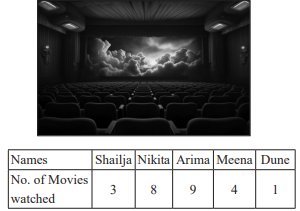
What is the average number of movies watched by Shreya’s friends in that particular month? (Ap)
Solution
5
The table below depicts the weight of the students of class 6 of Red Bricks Public School. There are 18 students in the class that weigh above the median weight.
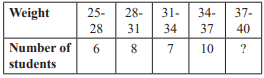
If there are no students with the same weight as median weight, how many students weigh between the range of 37-40 kgs?
Solution
5
Shown below are number line representations of the medians of two different data sets.
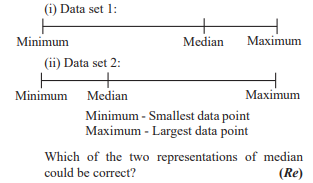
Solution
both (i) and (ii)
Flashcards
6 CardsClick to reveal answerTap the card to see answer

