

Biotechnology: Principles And Process - State TET Science
Watch Video


Study smarter with Pi Lens
Get Notes, PYQs, Quiz and more for any Youtube video!
Biotechnology: Principles And Process - State TET Science
100 views

NCERT Wallah
Notes
Video Summary
Biotechnology: Principles and Processes
Introduction and Definition of Biotechnology
Biotechnology involves the use of living organisms, their cells, or molecular analogs to develop products and processes for human benefit. It is defined by the European Federation of Biotechnology as the integration of natural science and organisms, cells, their parts, and molecular analogs to produce goods and services. The field includes both traditional methods (like making curd and bread) and modern techniques (such as genetic engineering and IVF).
- Key definition (EFB): Integration of natural science and organisms/cells/parts/molecular analogs for products and services.
- Traditional biotechnology: Uses whole organisms…
Biotechnology: Principles and Processes
Introduction and Definition of Biotechnology
Biotechnology involves the use of living organisms, their cells, or molecular analogs to develop products and processes for human benefit. It is defined by the European Federation of Biotechnology as the integration of natural science and organisms, cells, their parts, and molecular analogs to produce goods and services. The field includes both traditional methods (like making curd and bread) and modern techniques (such as genetic engineering and IVF).
- Key definition (EFB): Integration of natural science and organisms/cells/parts/molecular analogs for products and services.
- Traditional biotechnology: Uses whole organisms (e.g., curd, bread, alcohol).
- Modern biotechnology: Focuses on genetic material (e.g., vaccines, IVF, test-tube babies).
Fundamental Concepts: Host, Vector, Enzymes, and GMO
Understanding basic terms is essential for mastering biotechnology. The host is the organism into which recombinant DNA is introduced, the vector carries the gene of interest, and specific enzymes are used for cutting and joining DNA.
- Host: Organism receiving recombinant DNA (commonly E. coli).
- Vector: Vehicle for transferring gene of interest (e.g., plasmid).
- Restriction enzyme: Cuts DNA at specific sites (molecular scissors).
- DNA ligase: Joins DNA fragments (molecular glue).
- GMO: Genetically modified organism with manipulated genes.
Types of DNA and Plasmids
Cells contain chromosomal DNA and, in prokaryotes, plasmid DNA. Plasmids are extra-chromosomal, self-replicating DNA molecules, often carrying special genes like antibiotic resistance.
- Chromosomal DNA: Found in both prokaryotes and eukaryotes, carries essential genes.
- Plasmid DNA: Found only in prokaryotes, carries non-essential but advantageous genes (e.g., antibiotic resistance), self-replicating, crucial for recombinant DNA technology.
Principles of Biotechnology: Genetic and Biochemical Engineering
Biotechnology operates on two main principles: genetic engineering and biochemical engineering. Genetic engineering involves creating recombinant DNA, transferring it to a host, and cloning the gene. Biochemical engineering ensures sterile, contamination-free environments for large-scale production.
- Genetic engineering: Construction of recombinant DNA, gene transfer, and cloning.
- Biochemical engineering: Maintenance of sterile conditions for optimal growth and product yield.
Steps in Recombinant DNA Technology
The process of creating and utilizing recombinant DNA involves several key steps, each critical for successful genetic manipulation and product formation.
- Identification and isolation of DNA: Select and extract the gene of interest from any cell (plant, fungal, bacterial).
- Fragmentation of DNA: Use restriction enzymes to cut DNA at specific sites.
- Separation of fragments: Employ gel electrophoresis to separate DNA fragments by size.
- Amplification: Multiply the gene of interest using PCR (Polymerase Chain Reaction).
- Ligation with vector: Join the gene of interest to a vector using DNA ligase.
- Transfer to host: Introduce recombinant DNA into a competent host cell.
- Culturing: Grow the host in bioreactors for large-scale product formation.
- Downstream processing: Purify and test the product for market use.
Restriction Enzymes: Types, Naming, and Mechanism
Restriction enzymes are nucleases that cleave DNA at specific recognition sites, often palindromic sequences. They are classified as exonucleases (cut from ends) and endonucleases (cut within the strand). The first restriction enzyme characterized was Hind II.
- Types:
- Exonuclease: Removes nucleotides from DNA ends.
- Endonuclease: Cuts at internal sites (e.g., restriction endonuclease).
- Naming convention: Based on genus, species, strain, and order of discovery (e.g., EcoRI: Escherichia coli RY13, first enzyme).
- Recognition site: Palindromic sequence (e.g., GAATTC for EcoRI).
- Cutting pattern: Produces sticky (overhanging) or blunt ends.
Gel Electrophoresis and DNA Fragment Separation
Gel electrophoresis separates DNA fragments based on size and molecular weight using an agarose gel matrix. DNA, being negatively charged, migrates from the cathode to the anode under an electric field.
- Principle: Separation by molecular weight and size.
- Materials: Agarose gel (from red algae), ethidium bromide stain, UV light, electrodes.
- Process:
- Load DNA at cathode side.
- Apply electric field; smaller fragments move faster toward anode.
- Visualize bands under UV after staining.
- Elution: Extraction of the desired DNA fragment from the gel.
Polymerase Chain Reaction (PCR) for DNA Amplification
PCR is a technique to amplify specific DNA sequences rapidly. It involves cycles of denaturation, annealing, and extension, using thermostable Taq polymerase.
- Steps:
- Denaturation: 92–95°C, DNA strands separate.
- Annealing: ~55°C, primers bind to target sequence.
- Extension: ~72°C, Taq polymerase synthesizes new DNA.
- Materials: PCR machine, oligonucleotide primers, Taq polymerase.
- Result: Billions of copies of the target DNA after 30 cycles.
Vectors: Structure, Features, and Selectable Markers
Vectors like plasmids (e.g., pBR322, pUC8) are engineered to carry foreign genes. Essential features include an origin of replication, recognition sites, and selectable markers.
- pBR322 structure: Contains ampicillin (Amp^R) and tetracycline (Tet^R) resistance genes, origin of replication (ori), and multiple restriction sites.
- Selectable markers: Allow differentiation between recombinant and non-recombinant cells (e.g., antibiotic resistance, lacZ gene for blue-white screening).
- Insertional inactivation: Inserting a gene into a marker site inactivates it, aiding selection.
Methods of Gene Transfer into Host Cells
Recombinant DNA cannot enter host cells directly due to its hydrophilic and negatively charged nature. Several methods are used to facilitate gene transfer.
- Competency induction: Treat host with divalent cations (e.g., Ca^2+) to increase DNA uptake.
- Heat shock: Alternate cold and 42°C heat to promote DNA entry.
- Gene gun (biolistics): DNA-coated gold/tungsten particles shot into plant cells.
- Microinjection: Direct injection of DNA into animal cells using fine needles.
- Disarmed vectors: Use of modified viruses or bacteria (e.g., Agrobacterium tumefaciens for plants, retrovirus for animals).
Bioreactors and Culturing Techniques
Bioreactors are large vessels used for culturing genetically modified hosts to produce products at scale. They maintain optimal conditions for growth and product formation.
- Types:
- Simple stirred bioreactor: Curved base, mixing blades.
- Stirred tank bioreactor: Flat base, sparger tube for aeration.
- Features: Temperature control, pH balance, foam breaker, sterile air supply, agitator system.
- Batch culture: Closed system; nutrients added once, product harvested at end.
- Continuous culture: Open system; nutrients added and product removed continuously.
Downstream Processing and Product Purification
After culturing, the product undergoes downstream processing, which includes separation, purification, addition of preservatives, and quality testing before market release.
- Steps:
- Separation of product from culture.
- Purification to remove impurities.
- Addition of preservatives for shelf life.
- Quality testing to ensure safety and efficacy.
Exam-Focused Takeaways and Common Questions
Several direct questions are frequently asked in exams regarding definitions, steps, enzyme functions, vector features, and process diagrams.
- Definitions: Biotechnology (EFB), GMO, recombinant DNA.
- Processes: Steps of recombinant DNA technology, PCR, gel electrophoresis.
- Enzymes: Restriction endonuclease (EcoRI, Hind II), DNA ligase.
- Vectors: Structure and labeling of pBR322, pUC8, selectable markers.
- Methods: Gene transfer techniques, bioreactor operation, batch vs. continuous culture.
- Common diagrams: pBR322 map, gel electrophoresis setup, bioreactor structure.
- Key years and scientists: First recombinant DNA (1972, Stanley Cohen and Herbert Boyer), discovery of restriction enzymes (1963).
This summary covers all major principles, processes, and exam-relevant details explicitly stated in the content.
Additional Notes

Class Slides_706.pdf
Quiz
20 QuestionsClick on an option to find the answer
Question 1 of 20
If codon have nucleotide of AGC , then the anticodon on tRNA will be ?
Solution
UCG
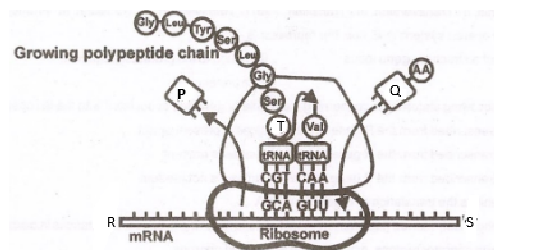
The given diagram refers to translation. In which of the four options P, Q, R, S and T are correctly identified.
Solution
P-Uncharged tRNA, Q-Charged/Aminoacylated tRNA, R-5'end, S-3'end, T-Alanine
Anticodon is present on _________.
Solution
tRNA
Flashcards
10 CardsClick to reveal answerTap the card to see answer

