

There are intermediate railway stations - RRB Mathematics
Watch Video


Study smarter with Pi Lens
Get Notes, PYQs, Quiz and more for any Youtube video!
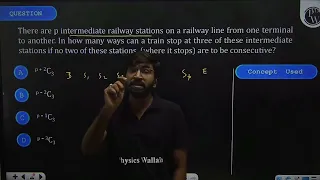
There are intermediate railway stations - RRB Mathematics
1 views

PW Solutions
Notes
Video Summary
Selection of Non-Consecutive Intermediate Railway Stations
A train travels from one terminal to another, passing through intermediate railway stations. The problem is to determine the number of ways the train can stop at exactly three of these intermediate stations, with the restriction that no two selected stations are consecutive. This scenario involves combinatorial selection under a non-consecutiveness constraint.
Problem Statement and Constraints
The task is to select three intermediate stations from a total of such that no two chosen stations are consecutive. The selection must be made from the intermediate stations only, not including the terminals…
Selection of Non-Consecutive Intermediate Railway Stations
A train travels from one terminal to another, passing through intermediate railway stations. The problem is to determine the number of ways the train can stop at exactly three of these intermediate stations, with the restriction that no two selected stations are consecutive. This scenario involves combinatorial selection under a non-consecutiveness constraint.
Problem Statement and Constraints
The task is to select three intermediate stations from a total of such that no two chosen stations are consecutive. The selection must be made from the intermediate stations only, not including the terminals at either end.
- Total intermediate stations:
- Stations to be selected:
- Restriction: No two selected stations are consecutive
Representation of Stations
The stations can be represented as a sequence, with the first and last being the terminals and the stations in between labeled as . The selection is to be made from to .
- Terminals: Not included in selection
- Intermediate stations:
Combinatorial Principle for Non-Consecutive Selection
When selecting items from such that no two are consecutive, a specific combinatorial formula is used. The transcript states the formula for such cases, which is essential for solving the problem.
- Formula for non-consecutive selection: If items are to be chosen from such that no two are consecutive, the number of ways is .
Application to the Given Problem
Applying the above principle to the current scenario, where and , the formula becomes:
- Number of ways: P - 3 + 1 \choose 3 = P - 2 \choose 3
Stepwise Reasoning
The reasoning behind the formula is based on ensuring that after selecting a station, at least one unselected station separates it from the next selected station. This reduces the effective number of available positions.
- After each selection: At least one station must remain unselected between any two selected stations.
- Effective positions: The formula accounts for the required gaps by reducing the total number of available positions.
Final Formula and Result
The final answer for the number of ways to select three non-consecutive intermediate stations from is:
Key Takeaways
Selecting items with a non-consecutiveness constraint reduces the effective pool of choices. The formula is directly applicable when no two selected items can be consecutive, as explicitly stated in the transcript.
- Direct application: Use for non-consecutive selection.
- For this problem: Substitute , to get .
Common Pitfall
A common mistake is to use the standard combination formula without accounting for the non-consecutiveness restriction. This leads to an overcount of cases where selected stations are consecutive, which is not allowed.
- Incorrect approach: Using ignores the restriction.
- Correct approach: Use as derived.
Answer Identification
The correct answer, as per the transcript, is option B, which corresponds to . This is the only answer that satisfies the non-consecutiveness condition for selecting three intermediate stations.
Quiz
15 QuestionsClick on an option to find the answer
Question 1 of 15
Solution
Solution
Solution

