

2026 Ka Full Roadmap For Start to Finish - Olympiad Biology
Watch Video


Study smarter with Pi Lens
Get Notes, PYQs, Quiz and more for any Youtube video!

2026 Ka Full Roadmap For Start to Finish - Olympiad Biology
22 views

Olympiad Wallah
Notes
Video Summary
Government Olympiads and Competitive Exams for Class 9
Government-aided Olympiads and competitive exams offer a structured pathway for Class 9 students to develop problem-solving skills, gain national and international recognition, and build a strong academic profile. These exams are distinct from private Olympiads and are supported by government or government-affiliated organizations. Participation in these exams not only enhances subject knowledge but also fosters a research-oriented attitude and prepares students for future competitive exams like JEE and NEET.
Importance of Early Preparation and Short-Term Goals
Early preparation in Class 9 is crucial as it is considered the least stressful…
Government Olympiads and Competitive Exams for Class 9
Government-aided Olympiads and competitive exams offer a structured pathway for Class 9 students to develop problem-solving skills, gain national and international recognition, and build a strong academic profile. These exams are distinct from private Olympiads and are supported by government or government-affiliated organizations. Participation in these exams not only enhances subject knowledge but also fosters a research-oriented attitude and prepares students for future competitive exams like JEE and NEET.
Importance of Early Preparation and Short-Term Goals
Early preparation in Class 9 is crucial as it is considered the least stressful academic year, allowing students to focus on foundational learning. Setting short-term goals alongside long-term ambitions helps maintain motivation and consistent effort. Students often lose momentum when exams seem distant, but breaking down the journey into achievable milestones ensures steady progress and reduces last-minute stress.
- Short-term goals provide immediate targets and help track progress.
- Early engagement in Olympiads builds competitive spirit and discipline.
- Consistent practice and completion of lecture notes, homework, and question practice are essential for mastery.
Key Government Olympiads for Class 9
Several government-aided Olympiads are available for Class 9 students, each focusing on different subjects and offering unique opportunities. The top five recommended Olympiads are:
- IOQM (Indian Olympiad Qualifier in Mathematics): Open to students from Class 8 to 12, organized by the Mathematics Teachers Association of India (MTAI).
- NSEJS (National Standard Examination in Junior Science): For students under 15 years, organized by the Indian Association of Physics Teachers (IAPT).
- NMTC (National Mathematics Talent Contest): Organized by the Association of Mathematics Teachers of India (AMTI), with various levels based on class.
- VVM (Vidyarathi Vigyan Manthan): NCERT-based exam organized by Vigyan Bharati and other government institutions.
- SEHSS (Standard Examination in High School Science): Introduced by IAPT, open to Class 9 and 10 students, covering Physics, Chemistry, Maths, and Biology.
Additional exams include JSTS (Junior Science Talent Search Examination) for Delhi students and state-specific contests like Bal Vaigyanik in Maharashtra.
Structure and Syllabus of Major Olympiads
Each Olympiad has a distinct structure, eligibility criteria, and subject focus. Understanding these details helps in targeted preparation.
- IOQM: Single common paper for Classes 8–12; main topics are Algebra, Geometry, Number Theory, and Combinatorics (including Permutation, Combination, and Probability). The exam is the first step towards selection in the Indian team for the International Mathematics Olympiad.
- NSEJS: For students under 15; covers Physics, Chemistry, and Biology. Each subject contributes equally to the total marks (216 marks, 72 per subject). State-wise quotas and cut-offs apply.
- SEHSS: No age barrier; open to Class 9 and 10. Covers Physics, Chemistry, Maths, and Biology equally. Top 25 students from each of five zones are selected for national camps.
- VVM: NCERT-based, class-wise exam with state and national camps.
- NMTC: Multiple levels (Primary, Sub-Junior, Junior, Senior) based on class; focuses on mathematics.
Benefits of Participation in Olympiads
Participation in government Olympiads offers several academic and career advantages. These exams strengthen foundational knowledge, enhance analytical skills, and provide recognition at national and international levels.
- Builds a strong academic profile for university admissions, including international institutions like MIT and Stanford.
- Develops research aptitude and problem-solving approach.
- Offers scholarships and stipends at advanced stages or through private institutions.
- Provides exposure to competitive environments, improving performance in future exams like JEE and NEET.
Exam Levels, Difficulty, and Strategic Choices
Olympiads vary in difficulty and scope. Strategic selection based on individual strengths and career goals is important.
- IOQM and NSEJS: Considered hard due to advanced content and competition with higher classes; require extra preparation beyond school curriculum.
- NMTC and VVM: Relatively easier as competition is within the same class; still above regular school exams.
- SEHSS and JSTS: Medium difficulty; suitable for students seeking balanced exposure in science.
- Subject Focus: Students strong in mathematics should prioritize IOQM and NMTC; those inclined towards science should opt for NSEJS, VVM, or SEHSS.
Cut-Offs, Selection, and Recognition
Cut-offs for these exams are generally not very high due to the challenging nature of the papers. Selection is often state or zone-wise, and qualifying does not require top scores.
- IOQM: 100 marks paper; cut-offs can be as low as 10–20 marks.
- NSEJS: 216 marks; cut-offs vary by state, ranging from 80 to 110 marks.
- SEHSS: Top 25 students per zone selected for national camps.
- Recognition: Qualifying at advanced stages leads to scholarships, national camps, and sometimes international representation.
Common Mistakes and Pitfalls
Students often make strategic errors that hinder their progress in Olympiads and competitive exams.
- Delaying preparation until higher classes, leading to a knowledge gap in Class 11.
- Ignoring Olympiads, assuming they are not essential for mainstream exams.
- Relying solely on school curriculum without extra practice or exposure to advanced problems.
- Underestimating the value of consistent, focused study and short-term goal setting.
Recommendations for First-Time and Repeat Participants
Approach to Olympiads should be tailored based on experience and subject interest.
- First-timers: Start with VVM for science or NMTC for mathematics to build confidence.
- Repeaters: Attempt harder exams like IOQM and NSEJS for deeper exposure.
- Scholarship Seekers: Focus on exams with camp selection or advanced stages, as these offer stipends or private scholarships.
- Subject Strategy: Choose exams aligned with strengths—mathematics or science.
Impact on Future Academic and Career Prospects
Success in government Olympiads significantly enhances future academic and career opportunities. It provides a head start for competitive exams and fosters a research-oriented mindset.
- Early exposure to advanced concepts aids in JEE/NEET preparation.
- Recognition in Olympiads strengthens university applications, both in India and abroad.
- Develops skills essential for research and innovation, contributing to national progress.
Action Plan and Further Resources
Students should select Olympiads based on their strengths and career goals, set short-term targets, and engage in consistent practice. Free resources, previous year questions, and detailed exam-specific content are available for further preparation. Engaging with these materials and seeking guidance ensures a strong foundation and competitive edge.
Quiz
40 QuestionsClick on an option to find the answer
Question 1 of 40
Which of the following equations are linear in two variable?
Solution
9x + 4y + 1 = 0
The sum of all probabilities equal to:
Solution
1
Solution
PYQs
49 QuestionsClick on an option to find the answer
Question 1 of 49
A circle has a centre O and radii OQ and OR. Two tangents, PQ and PR, are drawn from an external point, P. In addition to the above information, which of these must also be known to conclude that the quadrilateral PQOR is a square?
(i) OQ and OR are at an angle of 90°.
(ii) The tangents meet at an angle of 90°
Solution
both (i) and (ii)
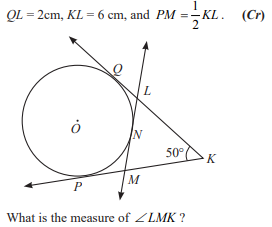
In a mathematics competition, students are given a problem involving a circle with center O. The problem states that three tangents KQ, KP, and LM are drawn from external points. Given that
Solution
80°
In two concentric circles, if a chord of the larger circle touches the smaller circle, which of the following statements cannot be said about the point of contact?
Solution
The radius of the smaller circle is half of the chord of the larger circle.
Flashcards
5 CardsClick to reveal answerTap the card to see answer

