

Bruta One Shot Geometry - Class 10 Odisha Board Odia
Watch Video


Study smarter with Pi Lens
Get Notes, PYQs, Quiz and more for any Youtube video!

Bruta One Shot Geometry - Class 10 Odisha Board Odia
48 views

PW Odisha 9th & 10th
Notes
Video Summary
Geometry: Circles and Cyclic Quadrilaterals
Definition and Basic Properties of a Circle
A circle is defined as the set of all points in a plane that are at a fixed distance from a fixed point called the center. The fixed distance from the center to any point on the circle is known as the radius. The diameter is the longest chord of the circle and passes through the center.
- Center: The fixed point from which all points on the circle are equidistant.
- Radius: The distance from the center to any point on the circle.
- Diameter:…
Geometry: Circles and Cyclic Quadrilaterals
Definition and Basic Properties of a Circle
A circle is defined as the set of all points in a plane that are at a fixed distance from a fixed point called the center. The fixed distance from the center to any point on the circle is known as the radius. The diameter is the longest chord of the circle and passes through the center.
- Center: The fixed point from which all points on the circle are equidistant.
- Radius: The distance from the center to any point on the circle.
- Diameter: The distance across the circle through the center; it is twice the radius.
- Formula: , where is the diameter and is the radius.
Chords, Arcs, and Segments
A chord is a line segment joining any two points on the circle. The diameter is a special chord that passes through the center and is the longest chord. An arc is a part of the circumference of the circle between two points.
- Chord: Any segment joining two points on the circle.
- Arc: The part of the circle between two points.
- Segment: The region between a chord and the corresponding arc.
Angles in a Circle
Angles in a circle can be formed at the center or at the circumference. The angle subtended by an arc at the center is called the central angle, while the angle subtended at the circumference is called the inscribed angle.
- Central Angle: Formed at the center by two radii.
- Inscribed Angle: Formed at the circumference by two chords meeting at a point on the circle.
- If a line segment joins two points on the circle, the angle it subtends at the center is twice the angle it subtends at the circumference on the same side.
Diameter and Its Properties
The diameter is a special chord that divides the circle into two equal parts. It is always the longest chord in the circle.
- Diameter as Longest Chord: No other chord in the circle is longer than the diameter.
- Relationship: Diameter radius.
Cyclic Quadrilaterals
A cyclic quadrilateral is a four-sided figure whose vertices all lie on a circle. If the angle subtended by a line segment joining two points at two other points on the same side of the segment are congruent, then all four points lie on a circle.
- Definition: All vertices of the quadrilateral lie on the circumference of a circle.
- Condition: If the sum of the opposite angles of a quadrilateral is , the quadrilateral is cyclic.
Angle Properties in Cyclic Quadrilaterals
In a cyclic quadrilateral, the sum of the measures of each pair of opposite angles is . This property is used to identify and prove that a quadrilateral is cyclic.
- Opposite Angles: The sum of the measures of opposite angles is .
- Angle Subtended by Same Arc: Angles subtended by the same arc at the circumference are equal.
Perpendiculars and Bisectors in Circles
Perpendiculars and bisectors play a key role in circle geometry. The perpendicular bisector of a chord passes through the center of the circle.
- Perpendicular Bisector: Any chord’s perpendicular bisector passes through the center.
- Application: Used to find the center or prove properties related to chords.
Circumcenter and Incenter
The circumcenter is the point where the perpendicular bisectors of the sides of a triangle meet and is the center of the circle passing through the triangle’s vertices. The incenter is the center of the circle inscribed within the triangle.
- Circumcenter: Intersection of perpendicular bisectors; center of the circumscribed circle.
- Incenter: Intersection of angle bisectors; center of the inscribed circle.
Problem-Solving and Practice
Solving problems related to circles and cyclic quadrilaterals involves applying the properties and theorems discussed. Practice is essential for mastering these concepts.
- Practice Recommendation: Solve at least 30 questions on circles and cyclic quadrilaterals for thorough understanding.
- Key Focus: Pay attention to properties of chords, angles, and cyclic quadrilaterals.
Important Formulas and Results
Certain formulas and results are directly stated and should be memorized for exams.
- Diameter Formula:
- Angle in Same Segment: Angles subtended by the same chord on the same side of the chord are equal.
- Cyclic Quadrilateral Angle Sum: Opposite angles sum to .
Exam Tips and Common Pitfalls
Understanding the properties and practicing problems helps avoid common mistakes in exams. Focus on the definitions, properties, and relationships between different elements of the circle.
- Tip: Always check if a quadrilateral is cyclic by verifying the sum of opposite angles.
- Pitfall: Do not assume all quadrilaterals are cyclic; check the necessary condition.
- Tip: Use the diameter as a reference for longest chord and for constructing perpendicular bisectors.
Application of Theorems
Theorems related to circles and cyclic quadrilaterals are frequently used in proofs and problem-solving.
- Angle at Center Theorem: The angle subtended by an arc at the center is twice the angle subtended at the circumference.
- Cyclic Quadrilateral Theorem: If a line segment joining two points subtends equal angles at two other points on the same side, all four points are concyclic.
Practice Questions and Strategies
Regular practice with a variety of questions strengthens understanding and application of circle theorems.
- Strategy: Attempt both direct and proof-based questions.
- Approach: Draw diagrams for clarity and mark all given information.
- Recommendation: Focus on step-by-step reasoning for proofs involving chords, angles, and cyclic quadrilaterals.
Summary of Key Points
Mastering the properties of circles and cyclic quadrilaterals is essential for geometry exams. Remember the definitions, key properties, and theorems, and reinforce learning through consistent practice.
- Circle: Set of points equidistant from a center.
- Diameter: Longest chord, .
- Cyclic Quadrilateral: Opposite angles sum to .
- Angle Properties: Central angle is twice the inscribed angle subtended by the same arc.
- Practice: Solve a variety of problems to ensure concept clarity and exam readiness.
Quiz
20 QuestionsClick on an option to find the answer
Question 1 of 20
If two or more circles have same Centre and different radii are called as
Solution
Concentric
Solution
The angle subtended by the diameter of semi-circle is
Solution
PYQs
4 QuestionsClick on an option to find the answer
Question 1 of 4
A circle has a centre O and radii OQ and OR. Two tangents, PQ and PR, are drawn from an external point, P. In addition to the above information, which of these must also be known to conclude that the quadrilateral PQOR is a square?
(i) OQ and OR are at an angle of 90°.
(ii) The tangents meet at an angle of 90°
Solution
both (i) and (ii)
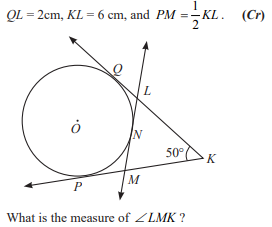
In a mathematics competition, students are given a problem involving a circle with center O. The problem states that three tangents KQ, KP, and LM are drawn from external points. Given that
Solution
80°
In two concentric circles, if a chord of the larger circle touches the smaller circle, which of the following statements cannot be said about the point of contact?
Solution
The radius of the smaller circle is half of the chord of the larger circle.
Flashcards
5 CardsClick to reveal answerTap the card to see answer

