

Ankana One Shot 10th - Class 10 Odisha Board Mathematics
Watch Video


Study smarter with Pi Lens
Get Notes, PYQs, Quiz and more for any Youtube video!

Ankana One Shot 10th - Class 10 Odisha Board Mathematics
46 views

PW Odisha 9th & 10th
Notes
Video Summary
Geometric Constructions and Properties of Triangles, Circles, and Polygons
Key Concepts in Geometric Construction
Geometric construction involves drawing shapes, angles, and lines accurately using only a compass, straightedge (ruler), and sometimes a protractor. Mastery of construction techniques is essential for solving problems related to triangles, circles, polygons, and their properties. Understanding the relationships between sides, angles, and special points is crucial for accurate construction and for answering exam questions.
- Tools Required: Compass, ruler, pencil, eraser, protractor (when needed).
- Importance: Used in architecture, engineering, and design for precise measurements and layouts.
- Exam Focus: Many questions require…
Geometric Constructions and Properties of Triangles, Circles, and Polygons
Key Concepts in Geometric Construction
Geometric construction involves drawing shapes, angles, and lines accurately using only a compass, straightedge (ruler), and sometimes a protractor. Mastery of construction techniques is essential for solving problems related to triangles, circles, polygons, and their properties. Understanding the relationships between sides, angles, and special points is crucial for accurate construction and for answering exam questions.
- Tools Required: Compass, ruler, pencil, eraser, protractor (when needed).
- Importance: Used in architecture, engineering, and design for precise measurements and layouts.
- Exam Focus: Many questions require stepwise construction and clear labeling of points and lines.
Construction of Triangles with Given Conditions
Constructing triangles based on given side lengths, angles, and medians is a fundamental skill. The process varies depending on the information provided, such as a side and its opposite angle, or a side and a median.
- Given a side and its opposite angle: Draw the base, construct the given angle at one endpoint, and use compass to mark the required length.
- Given a side and a median: Draw the base, find its midpoint, and use compass to construct the median from the opposite vertex.
- Special Case (Right Triangle): If the angle is , the side opposite is the diameter of the circumscribed circle.
Properties and Construction of Circles and Tangents
Circles are central to many geometric constructions, especially when constructing tangents, inscribed, and circumscribed figures. The tangent to a circle at a point is always perpendicular to the radius at that point.
- Constructing a circle with a given radius: Fix the center, set compass to the radius, and draw the circle.
- Drawing a tangent from a point on the circle: At the point, construct a angle to the radius.
- Drawing tangents from an external point: Join the external point to the center, find the midpoint, draw a circle with this as radius, and mark intersection points with the original circle to draw tangents.
Division of a Line Segment into Equal or Given Ratio Parts
Dividing a line segment into equal or specific ratio parts is a common construction. This is often required for constructing similar triangles or for proportional reasoning.
- Equal Division: Draw the segment, construct an angle at one endpoint, mark equal divisions along the angle, and join the last division to the other endpoint. Draw parallels through the other division points to the original segment.
- Division in a Given Ratio: Extend the segment, mark divisions according to the ratio, and use parallels to divide the original segment accordingly.
Construction of Regular Polygons (Equilateral Triangle, Square, Regular Hexagon, etc.)
Regular polygons can be inscribed or circumscribed about circles. The central angle for each polygon is determined by dividing by the number of sides.
- Equilateral Triangle: Central angle is ; divide the circle into three equal arcs.
- Square: Central angle is ; divide the circle into four equal arcs.
- Regular Hexagon: Central angle is ; divide the circle into six equal arcs.
- General Rule: For an -sided polygon, central angle .
Inscribed and Circumscribed Figures
Inscribed figures are drawn inside a circle, touching the circle at all vertices, while circumscribed figures have the circle passing through all vertices.
- Inscribing a triangle or square: Draw the circle, mark points at required central angles, and join them.
- Circumscribing a circle about a triangle: Construct the perpendicular bisectors of the sides; their intersection is the center of the circumscribed circle.
- Circumscribing a circle about a square: The intersection of the diagonals gives the center.
Special Angle and Segment Properties in Circles
Certain angle and segment properties are unique to circles and are frequently tested.
- Angle in a Semicircle: Always .
- Angles subtended by the same arc: Are equal.
- Tangent-Radius Property: The angle between a tangent and the radius at the point of contact is .
- Alternate Segment Theorem: The angle between the tangent and a chord through the point of contact equals the angle in the alternate segment.
Stepwise Construction Methods for Exam Problems
Accurate stepwise construction is essential for scoring in geometry. Each step must be justified and clearly labeled.
- Draw the given base or side.
- Construct the required angle at the specified point using a protractor or compass.
- Mark the required length using a compass.
- For medians, find the midpoint of the side and draw the median.
- For circles, set the compass to the given radius and draw from the center.
- For tangents, construct a angle at the point of contact.
- For dividing segments, use parallel lines to ensure equal or proportional division.
- For polygons, use the central angle to mark points on the circle and join them in order.
Exam-Focused Tips and Common Pitfalls
Success in geometric construction problems depends on precision, clarity, and following the correct sequence of steps.
- Always label all points and lines clearly.
- Use sharp pencils and accurate tools for neatness.
- Check all measurements twice before drawing final lines.
- Write stepwise explanations for each construction in the answer.
- Avoid skipping construction steps, as partial marks are awarded for correct intermediate steps.
- Be careful with angle measurements, especially when using a compass for arc-based constructions.
- For constructions involving medians or bisectors, ensure correct identification of midpoints.
- Practice drawing tangents from external points, as this is a frequent exam question.
- Remember that the sum of angles in a triangle is .
- For polygons, ensure all sides and angles are equal as required.
Sample Construction Scenarios from Transcript
Several specific construction scenarios are described, each with its own method:
Constructing with cm, , and median from to is cm:
- Draw cm.
- Construct at .
- Find midpoint of .
- With as center and cm, draw an arc to intersect the angle at .
- Join the intersection point to and to complete the triangle.
Constructing a tangent to a circle of radius cm from a point outside the circle:
- Draw the circle with center and radius cm.
- Mark external point at the given distance from .
- Join and find its midpoint .
- Draw a circle with as center and as radius.
- The intersection points with the original circle are the points of tangency.
- Draw tangents from to these points.
Dividing a cm line segment into four equal parts:
- Draw cm.
- At , draw an acute angle and mark four equal segments along it.
- Join the last division to .
- Draw parallels from the other division points to .
Constructing a regular hexagon inside a circle:
- Draw a circle with the given radius.
- Mark a point on the circle.
- Using the same radius, step off six points around the circle.
- Join consecutive points to form the hexagon.
Constructing a square inscribed in a circle:
- Draw the circle.
- Mark a point, use a right angle to find the next point, and repeat to get four points.
- Join the points in order to form the square.
Practice and Exam Readiness
Consistent practice of geometric constructions is emphasized for exam success. Each construction should be repeated until the steps are memorized and can be executed quickly and accurately.
- Practice constructing all types of triangles, circles, tangents, and polygons.
- Review and write out stepwise methods for each construction.
- Attempt previous exam questions and time yourself.
- Focus on clarity, accuracy, and proper labeling in all diagrams.
- Understand the reasoning behind each step, not just the mechanical process.
Summary Table: Central Angles for Regular Polygons
| Polygon Type | Number of Sides () | Central Angle () |
|---|---|---|
| Equilateral Triangle | 3 | 120 |
| Square | 4 | 90 |
| Regular Pentagon | 5 | 72 |
| Regular Hexagon | 6 | 60 |
| Regular Octagon | 8 | 45 |
- Use the formula: Central angle , where is the number of sides.
Final Exam Pointers
Precision in geometric construction, clear stepwise explanations, and correct use of tools are essential for scoring full marks. Focus on understanding the properties of triangles, circles, and polygons, and practice all standard constructions as described.
Quiz
60 QuestionsClick on an option to find the answer
Question 1 of 60
If there are two separate circles drawn apart from each other, then the maximum number of common points they have :
Solution
0
Equal _________ of the congruent circles subtend equal angles at the centre.
Solution
Chords
Solution
PYQs
8 QuestionsClick on an option to find the answer
Question 1 of 8
A circle has a centre O and radii OQ and OR. Two tangents, PQ and PR, are drawn from an external point, P. In addition to the above information, which of these must also be known to conclude that the quadrilateral PQOR is a square?
(i) OQ and OR are at an angle of 90°.
(ii) The tangents meet at an angle of 90°
Solution
both (i) and (ii)
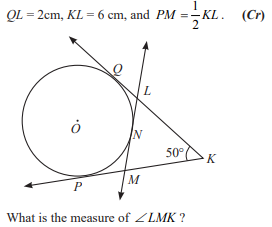
In a mathematics competition, students are given a problem involving a circle with center O. The problem states that three tangents KQ, KP, and LM are drawn from external points. Given that
Solution
80°
In two concentric circles, if a chord of the larger circle touches the smaller circle, which of the following statements cannot be said about the point of contact?
Solution
The radius of the smaller circle is half of the chord of the larger circle.
Flashcards
6 CardsClick to reveal answerTap the card to see answer

