

Breathing and Exchange of Gases in ONE SHOT - NEET Zoology
Watch Video


Study smarter with Pi Lens
Get Notes, PYQs, Quiz and more for any Youtube video!
Breathing and Exchange of Gases in ONE SHOT - NEET Zoology
748 views

PW NEET
Notes
Video Summary
Breathing and Exchange of Gases
Significance of Breathing and Cellular Respiration
Breathing supplies oxygen to cells and removes carbon dioxide, enabling cellular respiration and ATP production. Digested food is broken down into simple forms (glucose, amino acids, fatty acids, glycerol), which are absorbed and utilized by cells for energy. The breakdown of glucose in the presence of oxygen is a catabolic reaction, producing CO₂, H₂O, and ATP.
- Glucose formula:
- Cellular respiration: Glucose + O₂ → CO₂ + H₂O + ATP
Steps and Types of Respiration
Respiration involves a sequence of steps for gas exchange…
Breathing and Exchange of Gases
Significance of Breathing and Cellular Respiration
Breathing supplies oxygen to cells and removes carbon dioxide, enabling cellular respiration and ATP production. Digested food is broken down into simple forms (glucose, amino acids, fatty acids, glycerol), which are absorbed and utilized by cells for energy. The breakdown of glucose in the presence of oxygen is a catabolic reaction, producing CO₂, H₂O, and ATP.
- Glucose formula:
- Cellular respiration: Glucose + O₂ → CO₂ + H₂O + ATP
Steps and Types of Respiration
Respiration involves a sequence of steps for gas exchange and energy production. The process includes breathing (pulmonary ventilation), external respiration, gas transport, internal respiration, and cellular respiration.
- Breathing (Pulmonary Ventilation): Intake (inhalation) and expulsion (exhalation) of air.
- External Respiration: Exchange of gases between alveoli and pulmonary capillaries.
- Gas Transport: Movement of O₂ and CO₂ via blood.
- Internal Respiration: Exchange of gases between systemic capillaries and tissues.
- Cellular Respiration: Utilization of O₂ by cells to produce energy.
Types of respiration:
- External respiration: Gas exchange between alveoli and blood.
- Internal respiration: Gas exchange between blood and tissues.
- Cellular respiration: Biochemical utilization of O₂ in cells.
Respiratory Structures Across Organisms
Respiratory structures vary based on the level of organization and habitat. Simpler organisms use diffusion across body walls, while complex animals have specialized organs.
- Cellular/Tissue/Organ level: Diffusion across body wall (Porifera, Coelenterata, Platyhelminthes).
- Organ system level: Specialized structures:
- Annelida: Moist cuticle (e.g., earthworm)
- Arthropoda: Gills, book lungs, tracheal system
- Mollusca: Feather-like gills
- Echinodermata: Tube feet
- Hemichordata: Gills
- Chordata: Gills (fishes, amphibians), lungs (reptiles, birds, mammals)
- Respiratory modes:
- Branchial respiration: Gills (aquatic)
- Pulmonary respiration: Lungs (terrestrial)
Human Respiratory System: Structure and Zones
The human respiratory system consists of a sequential arrangement of passages and organs, divided into conducting and exchange zones.
- Pathway: External nostrils → Nasal passage → Nasal chamber → Internal nostrils → Pharynx (nasopharynx, oropharynx, laryngopharynx) → Larynx (voice box, 9 cartilages, includes epiglottis) → Trachea (windpipe, incomplete C-shaped cartilaginous rings, dorsally incomplete) → Primary bronchi → Secondary bronchi → Tertiary bronchi → Bronchioles (initial, terminal, respiratory) → Alveolar ducts → Alveoli
- Conducting zone: External nostrils to terminal bronchioles (air conduction, humidification, dust removal)
- Exchange (respiratory) zone: Respiratory bronchioles to alveoli (gas exchange)
- Lungs: Paired, covered by double-layered pleura (parietal and visceral), separated by pleural fluid
- Right lung: Slightly higher (due to liver), left lung has cardiac notch (for heart)
- Diaphragm: Dome-shaped muscle, major role in breathing
- Intercostal muscles: External (superficial), internal (deep), present between ribs
Mechanism of Breathing
Breathing is based on pressure gradients created by changes in thoracic volume, governed by Boyle’s law (pressure inversely proportional to volume).
- Inhalation (active):
- Diaphragm contracts (flattens), external intercostal muscles contract (ribs move outward/upward)
- Thoracic volume increases (anteroposterior and dorsoventral axes)
- Intrapulmonary pressure decreases below atmospheric pressure (760 mmHg)
- Air enters lungs
- Exhalation (passive):
- Diaphragm and external intercostal muscles relax (diaphragm domes, ribs move inward/downward)
- Thoracic volume decreases
- Intrapulmonary pressure increases above atmospheric
- Air exits lungs
- Forceful breathing: Involves abdominal and internal intercostal muscles (active process)
- Humans: Negative pressure breathing (air drawn in by lowering pressure inside lungs)
- Frogs: Positive pressure breathing (air pushed into lungs from buccal cavity)
Respiratory Volumes and Capacities
Respiratory volumes are the amounts of air exchanged in different conditions; capacities are combinations of volumes. Measured by spirometer (except residual volume).
- Tidal Volume (TV): Air inhaled/exhaled in normal breath (500 ml)
- Minute Respiratory Volume (MRV): TV × breathing rate (12–16/min) = 6000–8000 ml/min
- Inspiratory Reserve Volume (IRV): Extra air inhaled forcefully after normal inspiration (2500–3000 ml)
- Expiratory Reserve Volume (ERV): Extra air exhaled forcefully after normal expiration (1000–1100 ml)
- Residual Volume (RV): Air left in lungs after forceful expiration (1100–1200 ml)
- Inspiratory Capacity (IC): TV + IRV
- Expiratory Capacity (EC): TV + ERV
- Functional Residual Capacity (FRC): ERV + RV (air left after normal expiration)
- Vital Capacity (VC): IRV + TV + ERV (max air exhaled after max inhalation)
- Total Lung Capacity (TLC): VC + RV (total air after max inhalation)
- Note: RV and capacities containing RV cannot be measured by spirometer.
Factors Affecting Gas Exchange
Gas exchange depends on membrane thickness, solubility of gases, and partial pressure gradients.
- Diffusion membrane: Three layers—alveolar epithelium, capillary endothelium, and basement substance (overall thickness <1 mm)
- Partial pressure: Air moves from high to low partial pressure
- Solubility: CO₂ is 20–25 times more soluble than O₂, so diffuses faster
- Key partial pressures (mmHg):
- Atmospheric O₂: 159, CO₂: 0.3
- Alveoli O₂: 104, CO₂: 40
- Pulmonary capillary O₂: 40, CO₂: 45
- Oxygenated blood O₂: 95, CO₂: 40
- Tissues O₂: 40, CO₂: 45
Transport of Gases: Oxygen and Carbon Dioxide
Oxygen and carbon dioxide are transported in blood by different mechanisms.
- Oxygen:
- 3% dissolved in plasma
- 97% as oxyhemoglobin (HbO₂) in RBCs (each Hb binds 4 O₂ via Fe²⁺)
- 1 g Hb binds 1.34 ml O₂; 100 ml blood (15 g Hb) carries ~20 ml O₂
- At normal conditions, 5 ml O₂ delivered per 100 ml blood to tissues
- Oxygen dissociation curve: Sigmoid (S-shaped), plots % Hb saturation vs. PO₂
- At PO₂ ~100 mmHg (lungs): ~97–98% saturation
- At PO₂ ~40 mmHg (tissues): ~75% saturation (25% O₂ delivered)
- P₅₀ value: PO₂ at which Hb is 50% saturated (~25–26 mmHg)
- Curve shifts:
- Right (tissues): ↑CO₂, ↑H⁺, ↑temperature, ↓pH (Bohr effect, favors O₂ release)
- Left (lungs): ↓CO₂, ↓H⁺, ↓temperature, ↑pH (favors O₂ binding)
- Carbon Dioxide:
- 7% dissolved in plasma
- 20–25% as carbaminohemoglobin (HbCO₂, binds to globin part)
- 70% as bicarbonate (HCO₃⁻), formed in RBCs (CO₂ + H₂O → H₂CO₃ → H⁺ + HCO₃⁻, catalyzed by carbonic anhydrase)
- Bicarbonate diffuses into plasma; Cl⁻ shifts into RBCs (chloride shift/Hamburger phenomenon)
- In lungs, reverse reactions release CO₂ for exhalation
Regulation of Respiration
Respiration is regulated by neural and chemical mechanisms involving specific centers and receptors.
- Neural regulation:
- Respiratory rhythm center (RRC) in medulla: maintains rhythm of breathing
- Pneumotaxic center (PC) in pons: moderates RRC, reduces duration of inspiration (switch-off center), increases breathing rate
- Chemical regulation:
- Central chemoreceptors (medulla): sensitive to CO₂ and H⁺ in cerebrospinal fluid (CSF)
- Peripheral chemoreceptors: aortic bodies (aorta), carotid bodies (carotid artery); sensitive to CO₂ and H⁺ in blood
- Both send signals to RRC to adjust breathing rate; O₂ has insignificant role in regulation
Respiratory Disorders
Several disorders affect the respiratory system, impacting airflow and gas exchange.
- Asthma (asthma): Allergic inflammation of bronchi/bronchioles, narrowing airways, excessive mucus, wheezing sound, difficulty in breathing
- Emphysema: Chronic disorder, damage to alveolar walls, reduced surface area for gas exchange, associated with smoking, lungs feel "full of air"
- Occupational respiratory disorders: Due to exposure to pollutants (coal, stone, cement industries), fibrosis in upper lungs, called pneumoconiosis (e.g., silicosis, asbestosis)
- Carbon monoxide poisoning: CO binds Hb with 200–250 times higher affinity than O₂, forms carboxyhemoglobin, prevents O₂ transport, can be fatal
- High altitude sickness: Low PO₂ at high altitudes, less O₂ diffuses into blood, leads to hypoxia; body compensates by increasing RBC production (acclimatization)
Practice Questions and Key Exam Points
Understanding application and exceptions is crucial for exam success. Key points include:
- Relaxation of diaphragm and external intercostal muscles reduces thoracic volume (normal exhalation).
- Increase in thoracic volume decreases intrapulmonary pressure, allowing air entry.
- Spirometer measures all volumes except residual volume and capacities containing it.
- Exchange of gases is always by diffusion, driven by partial pressure gradients.
- At tissues and in deoxygenated blood, PO₂ = 40 mmHg, PCO₂ = 45 mmHg.
- Right shift in O₂ dissociation curve indicates increased O₂ delivery (tissue conditions).
- Asthma affects bronchi/bronchioles; emphysema affects alveoli.
- Central and peripheral chemoreceptors respond only to CO₂ and H⁺, not O₂.
- At high altitude, acclimatization involves increased RBC production to maximize O₂ transport.
Quiz
25 QuestionsClick on an option to find the answer
Question 1 of 25
Which of the following statements best describes the process of breathing in humans?
Solution
It is the exchange of oxygen from the atmosphere with carbon dioxide produced by cells, involving the movement of the chest during inhalation and exhalation.
What is the function of respiratory part of human respiratory system?
Solution
It exchanges O2 and CO2 between blood and atmospheric air
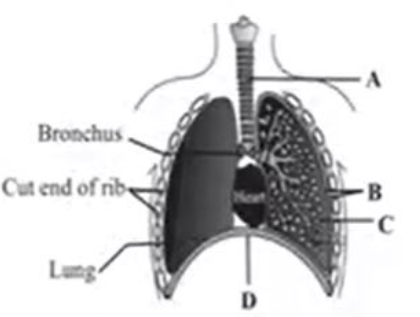
The figure shows a diagrammatic view of human respiratory system with labels A, B, C and D. Select the option which gives correct identification and main function and / or characteristic.
Solution
C - Alveoli - Thin walled vascular bag like structures for exchange of gases.
PYQs
9 QuestionsClick on an option to find the answer
Question 1 of 9
Select the sequence of steps in Respiration.
A. Diffusion of gases (O2 and CO2) across alveolar membrane.
B. Diffusion of O2 and CO2 between blood and tissues.
C. Transport of gases by the blood.
D. Pulmonary ventilation by which atmospheric air is drawn in and CO2 rich alveolar air is released out.
E. Utilisation of O2 by the cells for catabolic reactions and resultant release of CO2.
Choose the correct answer from the options given below:
(2023-Manipur)
Solution
(D), (A), (C), (B), (E)
Vital capacity of lung is ________.
(2023)
Solution
IRV + ERV + TV
Which of the following statements are correct with respect to vital capacity? (2022 Re)
A. It includes ERV, TV and IRV.
B. Total volume of air a person can inspire after a normal expiration.
C. The maximum volume of air a person can breathe in after forced expiration.
D. It includes ERV, RV and IRV.
E. The maximum volume of air a person can breathe out after a forced inspiration.
Choose the most appropriate answer from the options given below.
(2022 Re)
Solution
(A), (C) and (E)
Flashcards
16 CardsClick to reveal answerTap the card to see answer

