

How to Score 180 180 in Physics MR Sir NEET - NEET Physics
Watch Video


Study smarter with Pi Lens
Get Notes, PYQs, Quiz and more for any Youtube video!

How to Score 180 180 in Physics MR Sir NEET - NEET Physics
180 views

Yakeen
Notes
Video Summary
Physics NEET Preparation: High-Yield Strategy and Core Concepts
Physics in NEET carries 180 marks and is often seen as unpredictable in difficulty. Success depends on a focused, strategic approach tailored to individual progress, efficient resource use, and mastery of high-frequency topics. The following sections distill the essential guidance, topic priorities, and actionable methods for maximizing Physics scores.
Strategic Self-Assessment and Planning
Effective preparation begins with honest self-evaluation and goal setting. Each aspirant must define their current status, target, and available time to build a personalized plan.
- Three Key Questions:
- Where are you currently in your preparation?…
Physics NEET Preparation: High-Yield Strategy and Core Concepts
Physics in NEET carries 180 marks and is often seen as unpredictable in difficulty. Success depends on a focused, strategic approach tailored to individual progress, efficient resource use, and mastery of high-frequency topics. The following sections distill the essential guidance, topic priorities, and actionable methods for maximizing Physics scores.
Strategic Self-Assessment and Planning
Effective preparation begins with honest self-evaluation and goal setting. Each aspirant must define their current status, target, and available time to build a personalized plan.
- Three Key Questions:
- Where are you currently in your preparation?
- Where do you want to reach (target score/selection/rank)?
- How much time do you have left?
- Write answers to these on paper and use them to guide your strategy.
- Recognize that all preparation is relative—what matters is your progress from your starting point within your time frame.
NEET Subject Weightage and Focus
Understanding the subject-wise distribution and their strategic importance is crucial for prioritizing effort.
- Biology: 360 marks; considered the king and game-changer for NEET selection.
- Chemistry: 180 marks; stable and predictable.
- Physics: 180 marks; less predictable, can be a make-or-break subject.
- Focus on maximizing Biology and Chemistry but do not neglect Physics, as cut-offs can rise unexpectedly.
Resource Selection and Utilization
Limiting resources prevents confusion and maximizes depth of understanding. Consistency in practice and revision is more valuable than quantity of materials.
- Use only one book, one test series, and one set of video lectures.
- Attempt every test; do not skip.
- Practice NEET previous year questions (PYQ) from 2013 to 2025.
- For JEE Main PYQs, focus on selected years (2023–2025).
- Avoid over-reliance on multiple sources; depth in one is better than superficiality in many.
High-Yield Topics and Chapter Prioritization
Certain topics and chapters consistently yield questions and should be prioritized for thorough study and practice.
- Vectors: Essential for Laws of Motion, Electrostatics, Gravitation, AC, EM Waves, SHM, Magnetism, Work and Energy.
- Kinematics: Distance, displacement, speed, velocity, acceleration, variable and constant acceleration, motion under gravity, projectile motion, relative motion, circular motion.
- Laws of Motion: Problem types include lift problems, pseudo force, connected bodies, inclined plane.
- Friction: Highly important; at least two lectures recommended.
- Work, Energy, Power: Concepts of work, kinetic and potential energy, work-energy theorem, spring potential, gravitational potential, power, vertical circular motion, collision, center of mass.
- Graph Analysis: Graphs in basic math, differentiation, integration, and their application in Physics.
- High-Frequency Topics: GATE, diode, photoelectric effect, de Broglie wavelength, work and power, current electricity, ray optics, instruments.
Essential Formulas and Mathematical Tools
Mastery of certain mathematical tools and formulas is non-negotiable for problem-solving in Physics.
- Vector Operations: Dot product, cross product.
- Magnetic force:
- Torque:
- Work: Dot product application
- Potential energy: Dot product application
- Graph Interpretation: Ability to analyze and interpret graphs is critical across multiple chapters.
- Differentiation and Integration: Required for understanding motion, area under curves, and rate-based problems.
Practice and Test Strategy
Consistent practice and test-taking are essential for consolidating concepts and improving exam performance.
- Attempt every test; do not skip any.
- Practice NEET PYQs (2013–2025) and selected JEE Main PYQs (2023–2025).
- Focus on question framing: After learning a concept, think about what types of questions can be asked from it.
- Only 20% of questions should be included in notes; the rest should be practiced separately.
- Assignments and practice sheets should be completed according to individual requirements and available time.
Short Notes and Revision Techniques
Efficient note-making and revision are key to retaining concepts and quick recall during the exam.
- Make short notes daily based on what is studied.
- Include only essential theory and 20% of representative questions in notes.
- Mark important questions in notes for focused revision.
- Use class PPTs (if available) to identify which questions to include in notes.
- Regularly revise short notes to reinforce memory and understanding.
Levels of Preparation and Customization
Preparation must be adapted to the aspirant’s current stage and target rank.
- If 11th is complete but 12th is not, focus on completing 12th and revising 11th.
- If revision is done but question practice is pending, prioritize solving problems.
- If both revision and practice are done but tests are pending, focus on test-taking.
- For top 100 or 200 ranks, all assignments and advanced practice are mandatory.
- For selection, focus on core topics and essential practice; advanced practice is optional.
Efficiency and Time Management
Maximizing output in limited time is crucial for high scores.
- Dedicate three months of focused effort without worrying about results.
- Do not waste time on unnecessary resources or overthinking outcomes.
- Efficiency is achieved by focusing on high-yield topics, consistent practice, and regular testing.
- Adapt practice volume to available time and personal goals.
Concept Application and Calculation Skills
Success in Physics requires not just theoretical understanding but also the ability to apply concepts and perform calculations accurately.
- Learn to apply concepts to new problems, not just solve standard types.
- Calculation skills must be strong; practice full solutions, not just conceptual steps.
- Question framing: After learning a theory, actively think about possible question types and how to approach them.
- 30–40% of questions may be at JEE Advanced level in crash courses; 50–60% at JEE Main level.
- Efficiency in solving and accuracy in calculation are critical for maximizing marks.
Reality Check and Mindset
Understanding the real demands of the exam and one’s own capabilities is essential for effective preparation.
- Do not be overconfident or underestimate the unpredictability of the Physics section.
- Recognize that even less important topics can yield direct questions; do not skip them entirely.
- No one knows the exact pattern of the upcoming paper; comprehensive preparation is safest.
- Focus on what is necessary for your goal, not on what others are doing.
- Build your own strategy based on self-assessment, not on generic advice.
Table: Subject Weightage and Strategic Focus
| Subject | Marks | Strategic Role | Preparation Focus |
|---|---|---|---|
| Biology | 360 | King/Game-changer | Maximize score |
| Chemistry | 180 | Stable | Consistent preparation |
| Physics | 180 | Unpredictable/Decisive | Strategic, focused effort |
- Prioritize Biology for selection, but ensure Physics preparation is robust to avoid surprises in cut-off and maximize total score.
Quiz
30 QuestionsClick on an option to find the answer
Question 1 of 30
Acceleration versus x and potential energy versus x graph of a particle moving along x-axis is as shown in figure. Mass of the particle is 1 kg and velocity at x = 0 is 4 m/s. Match the following at x = 8 m.
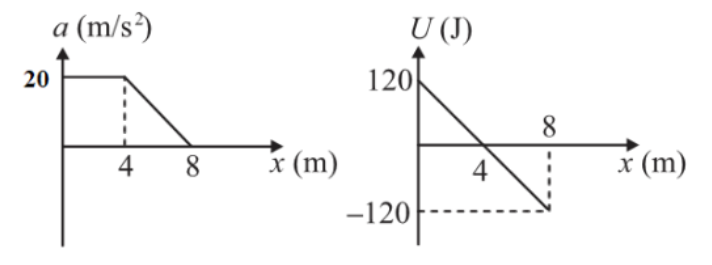
Solution
a→R, b→Q, c→P, d→T
A body of mass m starting from rest from origin moves along x-axis with constant power (P). Calculate relation between velocity and distance.
Solution
A small mass slides down an inclined plane of inclination with the horizontal. The coefficient of friction is , where is the distance through which the mass slides down and is a positive constant. Then, the distance covered by the mass before it stops is
Solution
PYQs
8 QuestionsClick on an option to find the answer
Question 1 of 8
A particle moving in a circle of radius R with a uniform speed takes a time T to complete one revolution. If this particle were projected with the same speed at an angle '' to the horizontal, the maximum height attained by it equals 4R. The angle of projection, , is then given by:
(2021)
Solution
A car starts from rest and accelerates at 5 m/s2. At t = 4 s, a ball is dropped out of a window by a person sitting in the car. What is the velocity and acceleration of the ball at t = 6s?
(2021)
Solution
A cricket ball is thrown by a player at a speed of 20 m/s in a direction 30° above the horizontal. The maximum height attained by the ball during its motion is: (g = 10 m/s2)
(2022 Re)
Solution
5 m
Flashcards
5 CardsClick to reveal answerTap the card to see answer

