

Physics: Magnetism One Shot Physics for 2026 - NDA Physics
Watch Video


Study smarter with Pi Lens
Get Notes, PYQs, Quiz and more for any Youtube video!
Physics: Magnetism One Shot Physics for 2026 - NDA Physics
15 views

Defence Wallah
Notes
Video Summary
Magnetism and Its Applications
Electromagnetism: Relationship Between Electricity and Magnetism
Electromagnetism describes the interdependence of electricity and magnetism. Electric current flowing through a conductor produces a magnetic field around it, and changing magnetic fields can induce electric currents. This duality is the basis for many practical devices and phenomena.
- Electric current in a wire generates a magnetic field in the surrounding space.
- Magnetic fields can induce electric currents, as described by Faraday’s Law of Electromagnetic Induction.
- Everyday examples include electric bells, electric motors, and the operation of metro trains.
Types of Magnets and Their…
Magnetism and Its Applications
Electromagnetism: Relationship Between Electricity and Magnetism
Electromagnetism describes the interdependence of electricity and magnetism. Electric current flowing through a conductor produces a magnetic field around it, and changing magnetic fields can induce electric currents. This duality is the basis for many practical devices and phenomena.
- Electric current in a wire generates a magnetic field in the surrounding space.
- Magnetic fields can induce electric currents, as described by Faraday’s Law of Electromagnetic Induction.
- Everyday examples include electric bells, electric motors, and the operation of metro trains.
Types of Magnets and Their Properties
Magnets are classified based on their origin and permanence. There are natural and artificial magnets, with artificial magnets further divided into temporary (electromagnets) and permanent magnets. The properties and examples of each type are important for identification and application.
- Natural Magnets: Found in nature, e.g., lodestone (Fe₃O₄), black in color.
- Artificial Magnets: Man-made by magnetizing materials, e.g., by placing iron in a magnetic field.
- Temporary Magnets (Electromagnets): Made of soft iron, easily magnetized and demagnetized, e.g., electric bell.
- Permanent Magnets: Made of steel, retain magnetism for a long time, e.g., bar magnet, horseshoe magnet, Alnico magnets.
- Shape-based Types: Bar magnet, horseshoe magnet, compass (used for direction finding).
Properties of Magnets
Magnets exhibit attractive and directive properties. These properties explain how magnets interact with materials and align themselves in the presence of the Earth’s magnetic field.
- Attractive Property: Magnets attract ferromagnetic materials, with the strongest attraction at the poles.
- Like poles repel, unlike poles attract.
- Breaking a magnet results in two magnets, each with a north and south pole.
- Directive Property (Earth Magnetism): A freely suspended magnet aligns itself along the geographic north-south direction due to the Earth’s magnetic field.
- The Earth acts as a giant magnet with a magnetic axis tilted relative to its geographic axis.
Magnetic Field and Magnetic Field Lines
The magnetic field is the region around a magnet where magnetic effects are observed. Magnetic field lines are imaginary lines used to represent the strength and direction of the magnetic field.
- Magnetic Field: The space around a magnet where magnetic forces can be detected.
- Magnetic Field Lines:
- Imaginary lines showing the direction and strength of the magnetic field.
- Outside a magnet, field lines run from north to south; inside, from south to north.
- Properties:
- Field lines never intersect.
- The tangent at any point gives the direction of the field.
- Closer lines indicate stronger fields (strongest at the poles).
- Field lines form closed and continuous loops.
Earth’s Magnetism: Declination and Inclination
The Earth’s magnetic field is characterized by certain angles that are important for navigation and understanding magnetic phenomena.
- Magnetic Declination (): The angle between the geographic meridian and the magnetic meridian at a place.
- Angle of Inclination/Dip (): The angle made by the total magnetic field of the Earth with the horizontal direction.
- ,
- (when the angle between and is )
- Earth’s Magnetic Field Strength: Tesla
Magnetic Flux and Units
Magnetic flux quantifies the number of magnetic field lines passing normally through a surface. It is a key concept in electromagnetic induction and magnetic measurements.
- Magnetic Flux (): Number of magnetic field lines passing normally through a surface.
- Units:
- SI: Weber (Wb)
- CGS: Maxwell ( Wb Maxwell)
- Magnetic Field (B):
- SI: Tesla (T), T Gauss
- Typical Values:
- Bar magnet: T
- Laboratory magnets: T
- Neutron star surface: T
- Interstellar space: T
Force and Torque in Magnetic Fields
Charged particles and current-carrying conductors experience force and torque in magnetic fields. The direction and magnitude depend on the orientation and magnitude of the field, current, and velocity.
- Force on a Moving Charge:
- if ; is maximum if
- Force on a Current-Carrying Conductor:
- Torque on a Current Loop:
- or (for turns)
- Magnetic Dipole Moment:
- (pole strength dipole length)
- (current area number of turns)
- Direction: from south to north pole
Rules for Direction: Fleming’s and Thumb Rule
The direction of force, field, and current is determined using specific hand rules. These are essential for solving problems involving motion in magnetic fields.
- Fleming’s Left-Hand Rule: Used for motors. Thumb (Force), First finger (Field), Middle finger (Current).
- Fleming’s Right-Hand Rule: Used for generators. Thumb (Motion), First finger (Field), Middle finger (Induced Current).
- Right-Hand Thumb Rule (Screw Rule): Thumb points in the direction of current, curled fingers show the direction of magnetic field lines around the conductor.
- Dot and Cross Notation:
- Dot (): Current coming out of the page.
- Cross (): Current going into the page.
Solenoid and Magnetic Field Inside
A solenoid is a coil of insulated wire wound in a helix, producing a uniform magnetic field when current passes through it. The field inside is parallel and uniform, resembling that of a bar magnet.
- Solenoid: Coil of insulated wire, wound in a helical structure.
- Magnetic Field Inside: Uniform and parallel to the axis.
- Behavior: Acts like a bar magnet with north and south poles at the ends.
- Direction Determination: Use right-hand thumb rule; if current flows clockwise at an end, that end is south pole; anticlockwise, north pole.
- Applications: Electric bells, motors, and electromagnetic devices.
Types of Magnetic Materials
Materials are classified based on their magnetic response into diamagnetic, paramagnetic, and ferromagnetic. Their behavior, alignment, and examples are important for identification.
- Diamagnetic: Weakly repelled by magnets, align perpendicular to field, e.g., copper, gold, silver, air, argon, hydrogen.
- Paramagnetic: Weakly attracted, align parallel to field, e.g., aluminum, chromium, alkali metals, platinum.
- Ferromagnetic: Strongly attracted, retain magnetism, align strongly parallel, e.g., iron, cobalt, nickel, steel, Alnico.
- Behavior on Magnet Removal: Diamagnetic and paramagnetic lose magnetism quickly; ferromagnetic retain for long.
| Property/Type | Diamagnetic | Paramagnetic | Ferromagnetic |
|---|---|---|---|
| Magnetic Response | Weakly repelled | Weakly attracted | Strongly attracted |
| Alignment | Perpendicular | Parallel (weak) | Parallel (strong) |
| Examples | Cu, Au, Ag, air | Al, Cr, Pt, Na | Fe, Co, Ni, steel |
Magnetic Field Intensity, Magnetization, Permeability, and Susceptibility
These quantities describe the ability of materials to be magnetized and the strength of the magnetic field produced.
- Magnetic Field Intensity (): Ability of a magnetizing field to magnetize a material; (ampere-turns per unit length).
- Intensity of Magnetization (): Magnetic moment per unit volume; .
- Magnetic Permeability (): Measure of how much a material allows magnetic field lines to penetrate; .
- Relative Permeability (): Ratio of permeability of medium to free space; .
- Magnetic Susceptibility (): Ability of a substance to be magnetized; .
- Curie’s Law: Susceptibility is inversely proportional to temperature; as temperature increases, magnetic character decreases.
Special Cases and Exam-Focused Points
Certain cases and formula manipulations are directly relevant for exam questions. These include the effect of cutting magnets, unit conversions, and direction conventions.
- Cutting a Magnet: Whether cut horizontally or vertically, the magnetic dipole moment becomes half.
- Units:
- Magnetic dipole moment: ampere-meter², newton-meter/tesla, joule/tesla.
- Direction Conventions:
- Clockwise current at an end of solenoid: south pole.
- Anticlockwise current: north pole.
- Lorentz Force: Total force on a charge in electric and magnetic fields: .
- Solenoid Field Direction: Use right-hand thumb rule to determine north and south poles based on current direction.
These points are frequently tested in multiple-choice and theoretical questions.
Quiz
20 QuestionsClick on an option to find the answer
Question 1 of 20
Which of the following is not attracted by a magnet?
Solution
Brass
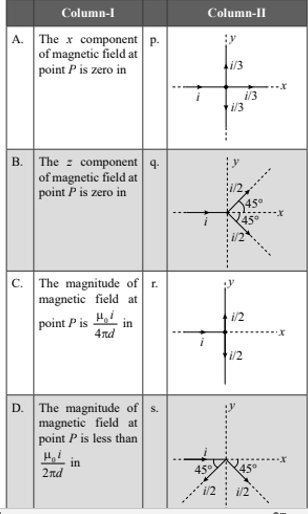
Column-II gives four situations in which three (in q, r, s) and four (in p) semi infinite current carrying wires are placed in xy - plane as shown. The magnitude and direction of current is shown in each figure. Column-I gives statements regarding the x and y components of magnetic field at a point P whose coordinates are P(0,0, d). Match the statements in Column-I with the corresponding figures in Column-II.
Solution
An electron is moving along the positive x -axis. If the uniform magnetic field is applied parallel to the negative -axis, then
A. The electron will experience magnetic force along positive y-axis
B. The electron will experience magnetic force along negative y-axis
C. The electron will not experience any force in magnetic field
D. The electron will continue to move along the positive x -axis
E. The electron will move along circular path in magnetic field
Choose the correct answer from the options given below:
Solution
B and E only
Flashcards
12 CardsClick to reveal answerTap the card to see answer

