

MP Maths Topper Copy - Class 10 MP Board Mathematics
Watch Video


Study smarter with Pi Lens
Get Notes, PYQs, Quiz and more for any Youtube video!

MP Maths Topper Copy - Class 10 MP Board Mathematics
8 views

MP Board Wallah
Notes
Video Summary
Answer Writing Techniques for Class 10 Mathematics
Effective answer writing in mathematics is crucial for scoring full marks. The structure, clarity, and presentation of solutions directly impact evaluation. These notes compile explicit strategies, formatting rules, and common pitfalls as demonstrated by top scorers, focusing on maximizing marks in both subjective and objective questions.
Copy Formatting and Margins
Maintaining a clean and organized answer sheet is essential. Use the provided margins wisely and ensure every answer is clearly separated and labeled.
- Margin Usage: Always utilize the left margin for numbering answers. Draw a margin line if not already…
Answer Writing Techniques for Class 10 Mathematics
Effective answer writing in mathematics is crucial for scoring full marks. The structure, clarity, and presentation of solutions directly impact evaluation. These notes compile explicit strategies, formatting rules, and common pitfalls as demonstrated by top scorers, focusing on maximizing marks in both subjective and objective questions.
Copy Formatting and Margins
Maintaining a clean and organized answer sheet is essential. Use the provided margins wisely and ensure every answer is clearly separated and labeled.
- Margin Usage: Always utilize the left margin for numbering answers. Draw a margin line if not already present.
- Answer Numbering: Write the answer number (e.g., उत्तर नंबर 04) clearly at the start of each solution. If solving an "और" (alternate) part, indicate it with an arrow and write "OR" in brackets.
- Separation: After completing an answer, draw a pencil line across the page to mark the end of the solution, especially if time permits.
Structured Answer Format
A consistent answer format helps examiners follow your logic and awards marks for each step. Use the following structure for most questions:
Stepwise Format:
- GIVEN: State all provided values and conditions.
- TO FIND: Clearly mention what needs to be calculated or proved.
- FORMULA USED: Write the formula applied, boxing it with a pencil.
- SOLUTION: Show all calculation steps.
- FINAL ANSWER: Box the final answer with a pencil for emphasis.
Underlining: Underline headings (GIVEN, TO FIND, FORMULA USED, SOLUTION, ANSWER) with a pencil for visibility.
Boxing: Box important equations, formulas, and final answers with a pencil.
Objective Questions (MCQs and Matchups)
For MCQs and match-the-following questions, clarity and precision are key. Write answers in a way that avoids confusion and maximizes space.
MCQ Answering:
- Write the answer number (e.g., उत्तर नंबर एक).
- State the correct option (A/B/C/D) followed by the answer value (e.g., C, ).
- If space is limited, do not leave extra lines between answers.
- If you write small, leave a line between answers for neatness.
Matchup Questions:
- Write the answer number and the corresponding option (e.g., आंसर नंबर पहले: C).
- For two-column matchups, list the question number and matched option side by side.
Highlighting Important Equations and Answers
Key equations and final answers must stand out for easy evaluation. Use only blue pen for writing and pencil for highlighting.
- Boxing: Box main equations (e.g., ) and final answers (e.g., , ) with a pencil.
- No Black Pen: Do not use black pen for headings or answers; only blue pen is allowed.
- Formula Highlighting: Box formulas like or when used.
Diagram and Value Presentation
Diagrams and values must be clear and accurate. Use pencil for diagrams and values unless pencil quality is poor, then use pen.
- Diagram Drawing: Always draw diagrams with a pencil. Label all parts and values.
- Value Writing: Write values inside diagrams with pencil or pen as needed.
- Boxing: Box main equations and final answers in diagrams.
Page Management and PTIO
Efficient use of pages prevents confusion and ensures neatness.
- New Question Placement: If only a few lines remain on a page, start the next question on a new page. Cross out unused lines with a pencil and write "PTIO" (Page Turn Over).
- Copy Length: With a 32-page copy and 23 questions (6 objective, 17 subjective), manage space so all answers fit comfortably.
Rough Work Handling
Rough work should be done lightly and in designated areas to avoid clutter and confusion during rechecking.
- Location: Use the top margin area of the page for rough work, writing lightly with a pencil.
- Erasing: If time allows, erase rough work after checking calculations.
- Avoid Last Page: Do not use the last page for rough work, as flipping back and forth causes confusion during rechecking.
Common Mistakes and How to Avoid Them
Avoiding frequent errors ensures maximum marks and a clean answer sheet.
- Double Answering: Do not solve the same question twice in different places; only the first attempt is evaluated.
- Crossing Out Mistakes: If an answer is incorrect, cross it out with a single pencil line. Do not scribble or use multiple lines.
- Calculation Errors: Perform calculations in rough work before writing the final answer to minimize cuttings.
Topper Copy Insights
Analyzing topper answer sheets reveals best practices for writing answers.
- Prime Factorization Example: State the question, list prime factors for each number, and write definitions (e.g., "Highest power of common prime factor").
- LCM/HCF: Write definitions and steps, box the final answer.
- Probability Questions: State total outcomes, favorable outcomes, write formulas, box and , and box the final probability answer.
- Conditional Probability: Write given, what to find, formula, box formula and answer, and write the final statement.
Subjective Question Writing
For long-answer questions, follow a detailed structure and include diagrams where necessary.
- Order: Write GIVEN, TO FIND, FORMULA USED, then draw the diagram, followed by solution steps.
- Formula Application: State formulas used (e.g., curved surface area of cone: , hemisphere: ), box them, and label equations (e.g., Equation 1).
- Value Substitution: Substitute values into equations, box substituted equations, and box final answers.
- Final Statement: Always write a concluding line stating the answer (e.g., "Height of tower is 20 cm").
Final Tips for Full Marks
Consistent application of these techniques maximizes marks and ensures clarity.
- Blue Pen Only: Use blue pen for all writing; pencil for underlining, boxing, and diagrams.
- Boxing: Box all important formulas, equations, and final answers.
- Headings: Underline headings with pencil for visibility.
- Separation: Draw lines after each answer if time permits.
- No Black Pen: Do not use black pen anywhere.
- PTIO: Mark unused lines and pages with PTIO as needed.
- Rough Work: Keep rough work light and in margins; avoid last page unless necessary.
- Final Line: Always write a final statement for each answer; missing this can result in mark deduction.
By following these explicit answer writing strategies, students can present their solutions in a manner that is clear, organized, and maximizes their chances of scoring full marks in mathematics.
Quiz
15 QuestionsClick on an option to find the answer
Question 1 of 15
Solution
Solution
Solution
PYQs
9 QuestionsClick on an option to find the answer
Question 1 of 9
Shreya collects the following data on the number of movies watched by her friends in the month of June.
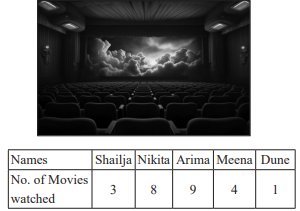
What is the average number of movies watched by Shreya’s friends in that particular month? (Ap)
Solution
5
The table below depicts the weight of the students of class 6 of Red Bricks Public School. There are 18 students in the class that weigh above the median weight.
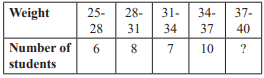
If there are no students with the same weight as median weight, how many students weigh between the range of 37-40 kgs?
Solution
5
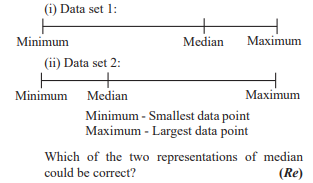
Shown below are number line representations of the medians of two different data sets.
Solution
both (i) and (ii)
Flashcards
5 CardsClick to reveal answerTap the card to see answer

