

SSLC ONAM EXAM 2026 STUDY - Class 10 Kerala Board History
Watch Video


Study smarter with Pi Lens
Get Notes, PYQs, Quiz and more for any Youtube video!

SSLC ONAM EXAM 2026 STUDY - Class 10 Kerala Board History
7 views

Xylem SSLC
Notes
Video Summary
SSLC Onam Exam Study Plan and Execution
The Onam Exam is the first major academic assessment for students in Class 10, serving as a foundation for future public exams. Success in this exam depends on systematic, consistent, and smart study strategies, especially during the crucial 10-day preparation window. The plan emphasizes prioritizing difficult subjects, leveraging available revision resources, and maintaining a disciplined approach to maximize scores.
Importance of Consistency and Smart Work
Consistent and systematic study is essential for achieving high marks in the Onam Exam. Hard work alone is not sufficient; combining it with smart strategies ensures…
SSLC Onam Exam Study Plan and Execution
The Onam Exam is the first major academic assessment for students in Class 10, serving as a foundation for future public exams. Success in this exam depends on systematic, consistent, and smart study strategies, especially during the crucial 10-day preparation window. The plan emphasizes prioritizing difficult subjects, leveraging available revision resources, and maintaining a disciplined approach to maximize scores.
Importance of Consistency and Smart Work
Consistent and systematic study is essential for achieving high marks in the Onam Exam. Hard work alone is not sufficient; combining it with smart strategies ensures better results. Students who previously invested time without seeing results must now focus on methods that directly impact their performance.
- Consistency: Daily study, even if only for 45 minutes, should be gradually increased to 4 hours.
- Smart Work: Prioritize topics based on difficulty and exam weightage, not just personal preference.
- Mindset: The Onam Exam sets the tone for future public exams; establishing a disciplined routine now is critical.
Subject and Chapter Prioritization
Effective preparation requires identifying and focusing on the most challenging subjects and chapters. Students should create a priority list based on their own strengths and weaknesses.
- Difficult Subjects: Mathematics, Hindi, and English are commonly cited as tough, but this varies by student.
- Chapter Selection: Start with the first chapters in each subject, as these are most likely to appear in the exam.
- List Creation: Write down all subjects and chapters, marking those already studied and those pending.
Daily Study Targets and Time Management
A structured daily plan is vital for covering the syllabus efficiently. Setting small, achievable targets helps build momentum and confidence.
- Recommended Study Time: Aim for at least 4 hours per day during the 10-day preparation period.
- Small Targets: Each day, set a goal to complete a portion of a chapter or a subject.
- Tracking Progress: Use a checklist or PDF format to mark completed chapters and monitor progress.
Revision Resources and Methods
Utilizing available revision resources enhances understanding and retention. Full-chapter revision sessions and one-shot revision videos are particularly effective.
- Full-Chapter Revision: Focus on comprehensive revision sessions for each subject, especially Mathematics, Physics, Chemistry, Biology, and Social Science.
- One-Shot Revision: Use condensed revision videos to cover entire chapters efficiently.
- Live Sessions: Attend scheduled live revision classes for real-time guidance and doubt clearing.
Exam Weightage and Question Patterns
Understanding the exam weightage and question patterns helps prioritize study efforts. The Onam Exam differs from the public exam in terms of chapter coverage and mark distribution.
- Chapter Weightage: For Onam Exam, the first two chapters in Biology, Physics, and Chemistry carry the majority of questions.
- Mark Distribution: Mathematics has 80 marks, with significant marks allocated to the first and third chapters.
- MCQ Focus: Multiple-choice questions are increasingly common and often tricky, requiring careful attention.
| Subject | Chapters for Onam Exam | Typical Mark Weightage |
|---|---|---|
| Mathematics | 5 chapters | 80 marks |
| English | 5 chapters | Variable |
| Hindi | 3 chapters | Variable |
| Physics | 2.5 chapters | Variable |
| Chemistry | 2.5 chapters | Variable |
| Biology | 2 chapters | Variable |
| Social Science | 6 chapters | Variable |
| Malayalam | 2 chapters | Variable |
10-Day Challenge Structure
A 10-day challenge is introduced to systematically cover the syllabus and ensure thorough revision. Each day is dedicated to specific subjects and chapters, with expert guidance.
- Day 1: Social Science – first two chapters (History and Geography)
- Day 2: Biology – second chapter
- Day 3: Physics – third chapter
- Day 4: Grammar – seven grammar topics revised in one session
- Day 5: Hindi – three chapters
- Day 6: Geography – two chapters
- Day 7-8: Mathematics – chapters four and five (Mathematics of Tans, Second Degree Equation)
- Day 9: Chemistry – remaining chapters
- Day 10: Final revision and exam readiness
Handling External Distractions and Pressure
Students face various pressures from family, peers, and teachers, as well as distractions from social media and entertainment. Managing these effectively is crucial for maintaining focus.
- Prioritization: Place academic preparation above distractions like social media and entertainment.
- Deliberate Time Creation: Actively carve out study time, rather than waiting for free time to appear.
- Pressure Management: Recognize and address internal and external pressures to avoid demotivation.
Utilizing Previous Year Questions and Model Papers
Practicing previous year questions and model papers is highly recommended for exam readiness. These resources are freely available and provide insight into question patterns.
- Previous Year Papers: Complete both Onam Exam and SRTP model question papers.
- Practice: Use these papers to identify important topics and question types.
- Access: Free access to previous year questions is provided through dedicated resources.
Foundation for Future Exams
The Onam Exam is the first step in a four-stage process leading to the SSLC public exam. Each stage builds upon the previous, making early success and systematic study essential.
- Four-Step Process:
- Onam Exam
- Christmas Exam
- Model Exam
- SSLC Public Exam (March 2027)
- Foundation: Strong performance in the Onam Exam lays the groundwork for subsequent exams.
- Syllabus Coverage: The chapters studied for Onam Exam are also relevant for future exams, ensuring continuity.
Scholarship and Further Opportunities
High performance in the Onam Exam opens opportunities for scholarships and admission to advanced academic programs. Registration for scholarship exams is free and accessible.
- Scholarship Exams: Next exam date is September 13; registration is free via QR code.
- Eligibility: Students scoring high marks in Onam Exam and covering additional topics from Class 9 are eligible.
- Benefits: Scholarships include free hostel facilities and tuition for higher secondary education.
Key Takeaways for Exam Success
Success in the Onam Exam requires a combination of consistent study, smart prioritization, effective revision, and disciplined time management. Students should leverage all available resources, set daily targets, and maintain focus despite external pressures.
- Start Immediately: Begin systematic study from today, not tomorrow.
- Use Revision Resources: Attend full-chapter and one-shot revision sessions.
- Practice MCQs: Pay special attention to multiple-choice questions, which are often tricky.
- Track Progress: Maintain a checklist of completed chapters and topics.
- Participate in Challenges: Engage in the 10-day challenge for structured revision.
- Seek Support: Help peers in need and stay safe during adverse conditions.
- Aim for Foundation: Treat the Onam Exam as the foundation for all future academic success.
Quiz
40 QuestionsClick on an option to find the answer
Question 1 of 40
The number of terms in the A.P. is :
Solution
37
Solution
Which of the following are quadratic equations?
(i)
(ii)
(iii)
Solution
(i) and (iii)
PYQs
4 QuestionsClick on an option to find the answer
Question 1 of 4
A circle has a centre O and radii OQ and OR. Two tangents, PQ and PR, are drawn from an external point, P. In addition to the above information, which of these must also be known to conclude that the quadrilateral PQOR is a square?
(i) OQ and OR are at an angle of 90°.
(ii) The tangents meet at an angle of 90°
Solution
both (i) and (ii)
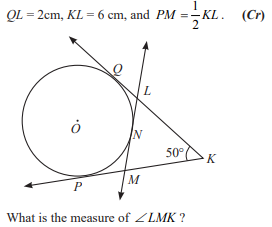
In a mathematics competition, students are given a problem involving a circle with center O. The problem states that three tangents KQ, KP, and LM are drawn from external points. Given that
Solution
80°
In two concentric circles, if a chord of the larger circle touches the smaller circle, which of the following statements cannot be said about the point of contact?
Solution
The radius of the smaller circle is half of the chord of the larger circle.
Flashcards
5 CardsClick to reveal answerTap the card to see answer

