

10th Maths 1.5 Hours-la 45 - Karnataka Board Mathematics
Watch Video


Study smarter with Pi Lens
Get Notes, PYQs, Quiz and more for any Youtube video!

10th Maths 1.5 Hours-la 45 - Karnataka Board Mathematics
7 views

PW Tamil Nadu 8, 9 &10
Notes
Video Summary
Key Revision Points for 10th Standard Mathematics (State Board)
Scoring Strategies and Exam Structure
Achieving 45+ marks in 1.5 hours is possible by focusing on high-yield topics, mastering construction-based questions, and practicing important short and long answer types. The exam typically includes one-mark, two-mark, and five-mark questions, with creative one-mark questions being crucial. Prioritize revision of provided important questions and formula sheets, and ensure familiarity with both standard and creative question formats.
- One-mark questions: Often include creative and direct formula-based items.
- Five-mark questions: Frequently involve constructions, especially from Chapter 4.1 (Similar Triangles).
- Eight-mark questions: Construction-based,…
Key Revision Points for 10th Standard Mathematics (State Board)
Scoring Strategies and Exam Structure
Achieving 45+ marks in 1.5 hours is possible by focusing on high-yield topics, mastering construction-based questions, and practicing important short and long answer types. The exam typically includes one-mark, two-mark, and five-mark questions, with creative one-mark questions being crucial. Prioritize revision of provided important questions and formula sheets, and ensure familiarity with both standard and creative question formats.
- One-mark questions: Often include creative and direct formula-based items.
- Five-mark questions: Frequently involve constructions, especially from Chapter 4.1 (Similar Triangles).
- Eight-mark questions: Construction-based, especially on similar triangles with given scale factors.
- PDFs and formula sheets: Provided for creative one-mark and construction questions; review thoroughly.
Construction of Similar Triangles
Construction of similar triangles is a high-weightage topic, especially for eight-mark questions. There are two main types based on the scale factor: less than one (proper fraction) and greater than one (improper fraction). The construction method varies depending on the scale factor.
- Type 1: Scale factor less than one (e.g., )
- Construct a triangle similar to with sides of the corresponding sides.
- Steps involve drawing the base triangle, dividing a ray into three equal parts, joining the third division to , and copying angles to construct the required triangle inside the original.
- Type 2: Scale factor greater than one (e.g., )
- Construct a triangle similar to with sides of the corresponding sides.
- Steps involve extending the base, dividing a ray into five equal parts, joining the fourth division to , and copying angles to construct the required triangle outside the original.
Key Steps for Both Types:
- Draw the base triangle with given or assumed dimensions.
- Draw a ray from one vertex at an acute angle.
- Mark equal divisions on the ray (denominator of the scale factor).
- Join the appropriate division (numerator or denominator) to the corresponding vertex.
- Copy the angle at the required division to construct the similar triangle.
- For scale factor , triangle lies inside; for , triangle lies outside.
Criteria for Similarity of Triangles
Triangles are similar if they have the same shape but not necessarily the same size. The criteria for similarity are based on angles and sides.
- AA (Angle-Angle) Similarity: If two angles of one triangle are equal to two angles of another, the triangles are similar.
- SAS (Side-Angle-Side) Similarity: If two sides of one triangle are in the same ratio as two sides of another triangle and the included angles are equal, the triangles are similar.
- SSS (Side-Side-Side) Similarity: If all three sides of one triangle are in the same ratio as all three sides of another triangle, the triangles are similar.
Important: Corresponding sides and angles must be correctly matched when writing similarity statements.
Useful Results and Properties of Similar Triangles
Several results are frequently tested, especially in one-mark and two-mark questions. These include properties of right triangles, altitudes, perimeters, and areas.
- Right Triangle with Perpendicular: In a right triangle, drawing a perpendicular from the right angle vertex to the hypotenuse creates three similar triangles.
- Altitudes: In similar triangles, the ratios of corresponding altitudes are equal to the ratios of corresponding sides.
- Perimeter Ratio: The ratio of the perimeters of two similar triangles equals the ratio of their corresponding sides.
- Area Ratio: The ratio of the areas of two similar triangles equals the square of the ratio of their corresponding sides.
- Triangles with Common Vertex and Collinear Bases: If two triangles share a vertex and their bases are collinear, the ratio of their areas equals the ratio of their bases.
Application of Similarity and Area/Perimeter Ratios
When two triangles are similar, the following relationships hold:
- Corresponding Sides:
- Perimeter:
- Area:
Example: If , , and area of , then area of is found by:
So, .
Sets, Cartesian Product, and Functions
Understanding sets, Cartesian products, and function evaluation is essential for short-answer questions.
- Extracting Sets from Ordered Pairs: Given , set consists of all first elements, set of all second elements.
- Function Evaluation: Substitute the given value into the function and simplify.
- Example: For , .
- Composition of Functions: Substitute one function into another as per the given operation.
- Example: If and , solve for .
Arithmetic Progression (AP) and Geometric Progression (GP)
Questions on AP and GP involve finding sums, terms, and solving for unknowns.
- AP Identification: Check if the difference between consecutive terms is constant.
- AP Sum Formula (when first and last terms are given):Where is the number of terms, is the first term, is the last term.
- Finding Number of Terms:
- GP Middle Term: For three consecutive terms in GP, .
- Sum to Terms of GP:
- Sum to Infinity (when ):
Prime Factorization and HCF/GCD of Polynomials
Prime factorization is used to express numbers in the form . For polynomials, the GCD is found using the division algorithm.
- Prime Factorization: Express the number as a product of prime powers; identify the values of and .
- GCD of Polynomials:
- Factor out common numerical coefficients.
- Use long division to divide the higher-degree polynomial by the lower-degree one.
- Continue until the remainder is zero; the last non-zero divisor is the GCD.
- For numerical coefficients, the GCD is the highest common factor.
Simultaneous Linear Equations in Three Variables
To solve three equations in three variables, use elimination by fixing one variable and reducing the system to two variables.
- Stepwise Method:
- Choose a variable to eliminate (e.g., ).
- Add or subtract equations to eliminate the chosen variable and form two equations in two variables.
- Solve the resulting two-variable system.
- Substitute back to find the third variable.
Special Series and Sums
Special series such as the sum of squares or cubes of natural numbers, and series with patterns, are tested.
- Sum of Squares of First Natural Numbers:
- Sum of Cubes of First Natural Numbers:
- For series not starting from 1: Find the sum up to the upper limit and subtract the sum up to one less than the lower limit.
Common Pitfalls and Exam Tips
Careful attention to question details, especially scale factors and order of operations, is essential. Misreading the scale factor or mislabeling corresponding sides/angles can lead to errors.
- Scale Factor: Always check if it is less than or greater than one; construction method changes accordingly.
- Correspondence: Write similarity statements with correct order of vertices.
- Creative One-Mark Questions: Practice from provided PDFs and formula sheets.
- Time Management: Allocate time for high-mark questions first, then move to short answers.
- Correction of Mistakes: If a construction is done with the wrong scale factor, erase and relabel as needed rather than starting over.
Practice and Revision Approach
Consistent practice of important questions, especially from provided materials, is crucial. Attempt previous years' questions, focus on construction and similarity, and review formula sheets regularly. For maximum marks, ensure all chapters in the syllabus are covered, with special attention to the most frequently tested topics.
Quiz
40 QuestionsClick on an option to find the answer
Question 1 of 40
In triangles ABC and PQR, AB = AC, . The two triangles are
Solution
Isosceles but not congruent
Solution
Find the value of n, if .
Solution
35
PYQs
31 QuestionsClick on an option to find the answer
Question 1 of 31
Shreya collects the following data on the number of movies watched by her friends in the month of June.
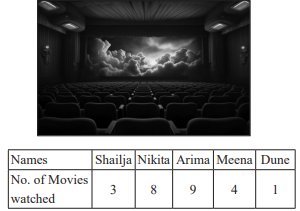
What is the average number of movies watched by Shreya’s friends in that particular month? (Ap)
Solution
5
The table below depicts the weight of the students of class 6 of Red Bricks Public School. There are 18 students in the class that weigh above the median weight.
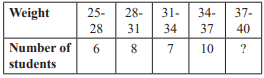
If there are no students with the same weight as median weight, how many students weigh between the range of 37-40 kgs?
Solution
5
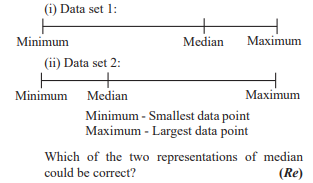
Shown below are number line representations of the medians of two different data sets.
Solution
both (i) and (ii)
Flashcards
6 CardsClick to reveal answerTap the card to see answer

