

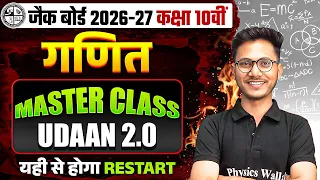
JAC Maths Master Class 2027 - Jharkhand Board Mathematics
Watch Video


Study smarter with Pi Lens
Get Notes, PYQs, Quiz and more for any Youtube video!
JAC Maths Master Class 2027 - Jharkhand Board Mathematics
4 views

PW JAC Board
Notes
Video Summary
Class 10 Mathematics Syllabus and Success Roadmap
The curriculum for Class 10 Mathematics consists of 14 chapters, each focusing on foundational concepts and problem-solving skills. The structure and approach to mastering these chapters are crucial for scoring high marks, including the possibility of achieving full marks. Consistent study, revision, and strategic practice are emphasized as the keys to success.
Complete List of Chapters
The syllabus is organized into 14 chapters, each with specific focus areas. Mastery of each chapter is essential for comprehensive preparation and high performance in board examinations.
- 1. Real Numbers: Understanding rational and irrational…
Class 10 Mathematics Syllabus and Success Roadmap
The curriculum for Class 10 Mathematics consists of 14 chapters, each focusing on foundational concepts and problem-solving skills. The structure and approach to mastering these chapters are crucial for scoring high marks, including the possibility of achieving full marks. Consistent study, revision, and strategic practice are emphasized as the keys to success.
Complete List of Chapters
The syllabus is organized into 14 chapters, each with specific focus areas. Mastery of each chapter is essential for comprehensive preparation and high performance in board examinations.
- 1. Real Numbers: Understanding rational and irrational numbers, their properties, and related questions.
- 2. Polynomials: Types of polynomials (monomial, binomial, trinomial, general polynomial), finding zeros, and constructing polynomials from given zeros (linear and quadratic).
- 3. Pair of Linear Equations in Two Variables: Methods to solve (graphical, substitution, elimination).
- 4. Quadratic Equations: Finding roots and determining the nature of roots; important for 5-mark questions.
- 5. Arithmetic Progression (AP): General term, sum of terms, and sum of first terms.
- 6. Triangles: Criteria for similarity, identifying similar triangles, and rules for similarity.
- 7. Coordinate Geometry: Calculating distance between two points, finding the midpoint, and using the section formula.
- 8. Introduction to Trigonometry: Basic trigonometric ratios and their applications.
- 9. Applications of Trigonometry: Using trigonometric ratios to find distances, heights, and angles.
- 10. Circles: Properties and theorems related to circles.
- 11. Areas Related to Circles: Area of sectors and segments.
- 12. Surface Areas and Volumes: Surface area and volume of cube, cuboid, cone, and related solids.
- 13. Statistics: Mean, median, and mode; frequently asked as 5-mark questions.
- 14. Probability: Basic probability concepts and problem-solving.
Key Focus Areas for Each Chapter
Each chapter contains specific concepts and types of questions that are frequently tested. Focusing on these areas ensures thorough preparation and maximizes scoring potential.
- Real Numbers: Identify rational and irrational numbers, understand their properties, and solve related problems.
- Polynomials: Recognize types of polynomials, find zeros, and construct polynomials from given zeros.
- Linear Equations: Solve using graphical, substitution, and elimination methods.
- Quadratic Equations: Calculate roots and analyze their nature.
- Arithmetic Progression: Derive and use formulas for the th term and sum of terms.
- Triangles: Apply similarity criteria and rules to solve problems.
- Coordinate Geometry: Use distance, midpoint, and section formulas.
- Trigonometry: Understand and apply basic ratios and their uses.
- Applications of Trigonometry: Solve problems involving heights, distances, and angles.
- Circles and Areas: Apply properties and calculate areas of sectors and segments.
- Surface Areas and Volumes: Compute surface area and volume for various solids.
- Statistics: Calculate mean, median, and mode.
- Probability: Solve basic probability questions.
Study and Revision Strategy
A disciplined and structured approach to study is essential. Regular self-study, revision, and practice tests are emphasized for effective learning and retention.
- Dedicate 5–6 hours daily for self-study, excluding school and coaching hours.
- Allocate at least one hour per subject for self-study, including homework and revision.
- Complete the entire syllabus within 3–4 months to allow ample time for revision.
- Prepare short notes for each subject to facilitate quick revision.
- Revise daily for at least one hour to reinforce concepts and identify weak areas.
Practice and Testing
Consistent practice and regular testing are critical for building confidence and identifying areas for improvement. Attempting previous years’ questions and mock tests is highly recommended.
- Take a full-length test every week to simulate exam conditions and track progress.
- Solve previous 5–10 years’ question papers to understand exam patterns and frequently asked questions.
- Focus on correcting mistakes identified during tests to improve performance.
- Attempt two challenging questions from each chapter daily during the last two months before the exam.
Time Management and Daily Planning
Effective time management and daily goal-setting are vital for covering the syllabus and ensuring consistent progress. Creating and following a daily planner helps maintain focus and discipline.
- Set a clear daily target (e.g., number of pages or topics to cover) and complete it before sleeping.
- Avoid wasting time on distractions such as excessive use of mobile phones and social media.
- Ensure 7 hours of sleep and balanced meals to maintain health and concentration.
- Adjust study hours to stay ahead of peers (e.g., study one hour more than others).
Tips for Becoming a Topper
Achieving top marks requires going beyond average effort and following specific strategies. Consistency, revision, and smart work are highlighted as the main pillars of success.
- Study more hours than the average student to stay ahead.
- Make and revise short notes for all subjects.
- Take regular tests and analyze mistakes.
- Focus on weak subjects without neglecting strong ones.
- Limit distractions and maintain a healthy routine.
- Set daily goals and do not sleep until they are achieved.
- Maintain continuity in study; avoid long breaks.
- Participate in all scheduled classes and tests for comprehensive preparation.
Importance of Consistency and Motivation
Maintaining regularity in study and staying motivated are essential for long-term success. Consistency ensures steady progress, while motivation helps overcome challenges.
- Study regularly without long gaps to retain concepts and build momentum.
- Remember the value of education and its role in achieving future goals.
- Stay inspired by success stories and aim for full marks in mathematics.
- Follow the guidance and strategies provided to maximize results.
Exam Preparation Timeline
A clear timeline for syllabus completion and revision is crucial. Completing the syllabus early allows for multiple rounds of revision and practice.
- Aim to finish the entire syllabus in 3–4 months.
- Use the remaining months for revision, practice tests, and solving previous years’ questions.
- Focus on revision and practice in the last two months, emphasizing difficult questions from each chapter.
Support and Resources
Access to live classes, doubt sessions, handwritten notes, and regular tests is available for comprehensive preparation. Both Hindi and English medium students have dedicated resources.
- Participate in live classes and doubt sessions for real-time support.
- Utilize handwritten notes and regular tests for effective revision.
- English medium students have access to dedicated batches and resources.
- Monthly tests and special sessions are conducted for continuous assessment.
Final Reminders for Success
Success in mathematics requires a combination of hard work, smart study, and disciplined routine. Following the outlined strategies and maintaining a positive attitude are essential.
- Do not delay preparation; start immediately and stay consistent.
- Use all available resources and support systems.
- Believe in your ability to achieve full marks with dedicated effort.
- Regularly review and adjust your study plan to stay on track.
- Stay motivated and focused on your goals throughout the preparation journey.
Quiz
40 QuestionsClick on an option to find the answer
Question 1 of 40
Which of the following statements is false?
Solution
General form of linear equation in two variables is ax + c = 0
What will happen to the volume of a cube, if its edge is
(i) halved
(ii) tripled?
Solution
1/8 times and 27 times
Solution
PYQs
49 QuestionsClick on an option to find the answer
Question 1 of 49
Point P divides the line segment joining the points A(4, –5) and B(1, 2) in the ratio 5 : 2 internally. Co-ordinates of point P are:
Solution
If the distance between the points (3, –5) and (x, –5) is 15 units, then the values of x are:
Solution
– 12, 18
The centre of a circle is at (2, 0). If one end of a diameter is at (6, 0), then the other end is at:
Solution
(– 2, 0)
Flashcards
5 CardsClick to reveal answerTap the card to see answer

