

SST Monthly TOP 30 - Class 10 Jharkhand Board History
Watch Video


Study smarter with Pi Lens
Get Notes, PYQs, Quiz and more for any Youtube video!
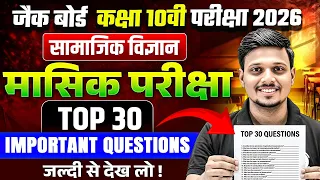
SST Monthly TOP 30 - Class 10 Jharkhand Board History
66 views

PW JAC Board
Notes
Video Summary
Key Questions and Concepts in Social Science (Class 10)
Foundational Figures and Events in European and Indian History
Several important personalities and events shaped modern Europe and India. Understanding their roles and the chronology of events is crucial for exam recall.
- Founder of Young Europe and Young Italy: Giuseppe Mazzini.
- "Sick Man of Europe": Turkey was referred to as the most backward country in Europe.
- First Geneva Convention: Held in 1864; the second in 1889 (25 years later).
- Vienna Congress: Took place in 1815.
- Jallianwala Bagh Massacre: Occurred on 13 April 1919 in…
Key Questions and Concepts in Social Science (Class 10)
Foundational Figures and Events in European and Indian History
Several important personalities and events shaped modern Europe and India. Understanding their roles and the chronology of events is crucial for exam recall.
- Founder of Young Europe and Young Italy: Giuseppe Mazzini.
- "Sick Man of Europe": Turkey was referred to as the most backward country in Europe.
- First Geneva Convention: Held in 1864; the second in 1889 (25 years later).
- Vienna Congress: Took place in 1815.
- Jallianwala Bagh Massacre: Occurred on 13 April 1919 in Amritsar, Punjab, during the Baisakhi fair; General O'Dwyer was the governor-general.
- Unification of Italy: Mazzini, Cavour, and Garibaldi were involved; Bismarck was not (he was associated with German unification).
- Unification of Germany: Completed after the Battle of Sedan; credit goes to Bismarck.
- Execution of Louis XVI: He was executed in 1793; his wife was Marie Antoinette, princess of Austria.
Important Laws, Acts, and Rights
Legal frameworks and rights have played a significant role in shaping society and governance in India.
- Reservation for Women in India: 33% reservation in Panchayati Raj institutions, started on 2 October 1959 in Nagaur, Rajasthan.
- Right to Information (RTI): Enforced in 2005, first in Rajasthan; it is a legal (statutory) right.
- Consumer Protection Act: Enacted in 1986; appeals can be heard by both State and National Commissions.
- Rowlatt Act (1919): Known as the "Black Act," allowed detention without trial for up to 2 years based on suspicion, with no right to lawyer or appeal.
Geography and Resources
Knowledge of India's geography and resource distribution is essential for understanding economic and environmental issues.
- Desert Soil in India: Predominantly found in Rajasthan.
- Wind and Solar Energy in Rajasthan: Both are abundant, with wind energy being significant.
- Govind Sagar Reservoir: Associated with Bhakra Nangal Dam.
- Jharia Region (Jharkhand): Known for coal deposits; Jadugoda is famous for uranium.
- European Civilization Cradle: Greece is called the cradle of European civilization.
Major Movements and Policies
Movements and policies have driven social and political change in India.
- Non-Cooperation Movement: Started in 1920, ended in February 1922 after the Chauri Chaura incident (Gorakhpur, UP), where 22 policemen died.
- Purna Swaraj Resolution: Passed at the Lahore session of the Congress.
- Dandi March: Started on 12 March 1930 from Sabarmati Ashram, covering 241 miles with 78 participants, to protest the salt tax imposed by the British.
- Nationalism: Defined as true loyalty and love for one's country, fostering unity among people.
Economic Structure and Sectors
Understanding the structure of the Indian economy and its sectors is vital for economic analysis.
- Highest Contribution to National Income: Tertiary (service) sector.
- Lowest Contribution: Primary (agriculture) sector.
- Economic Infrastructure: Transport is considered an economic infrastructure; education is not.
- First Bank in India: Punjab National Bank.
- Bankers' Bank: Reserve Bank of India (RBI), established in 1935, nationalized in 1949, headquartered in Mumbai.
Social and Environmental Issues
Social and environmental frameworks and their impacts are frequently tested.
- Negative Impact of Globalization: Most visible in agriculture and rural areas.
- Majority Rule (Majoritarianism): Leads to dissatisfaction among minorities, social conflict, and threatens national unity.
- Community Participation in Conservation: Delimitation does not involve direct community participation, unlike Joint Forest Management, Beej Bachao Andolan, and Chipko Movement.
Key Definitions and Concepts
Precise definitions and conceptual clarity are essential for scoring in theory-based questions.
- Napoleonic Code (1804): Abolished privileges based on birth; known as the Civil Code of Napoleon.
- Trade Barriers: Imposed to restrict or promote trade between regions, often to protect domestic products.
- Prime Minister Appointment in Italy: Count Cavour was appointed Prime Minister by Victor Emmanuel.
- Jadugoda (Jharkhand): Known for uranium deposits.
Exam-Oriented Recall Points
- Checkpoints When Buying Goods: Always check quality, quantity/weight, and price.
- Women’s Reservation: Implemented in Panchayati Raj, not in all institutions.
- RTI: Legal right, not traditional, religious, or voluntary.
- Govind Sagar: Linked to Bhakra Nangal Dam, not Hirakud, Rihand, or Narora.
- Jallianwala Bagh: Baisakhi fair was ongoing during the massacre.
- Unification Credits: Bismarck for Germany, not Italy.
- Rowlatt Act: Detention without trial, no lawyer or appeal.
- Dandi March: Protest against salt tax, led by Gandhi.
- Majoritarianism: Causes minority dissatisfaction and social unrest.
Chronology and Key Dates
Remembering key dates is crucial for objective questions.
- First Geneva Convention: 1864
- Vienna Congress: 1815
- Jallianwala Bagh Massacre: 13 April 1919
- Non-Cooperation Movement: 1920–1922
- Panchayati Raj Start: 2 October 1959
- Rowlatt Act: 1919
- Dandi March: 12 March 1930
- Execution of Louis XVI: 1793
- Napoleonic Code: 1804
- RBI Establishment: 1935, Nationalization: 1949
Causes and Effects of Major Events
Understanding the causes and effects of revolutions and acts is essential for subjective answers.
- 1848 Revolution Causes: Policies of Louis Philippe, appointment of Guizot as Prime Minister, support for aristocracy, widespread famine and unemployment, lack of effective policies to address crises.
- Rowlatt Act Effects: Suppression of civil liberties, arbitrary detention, no right to legal defense, widespread opposition.
- Majoritarianism Effects: Minority dissatisfaction, social conflict, threat to national unity.
Subjective Question Frameworks
For long-answer questions, structure responses with clear points.
- 1848 Revolution: Main cause was the policies of Louis Philippe and appointment of Guizot, leading to aristocratic dominance and public discontent due to famine and unemployment.
- Rowlatt Act: Known as the Black Act, allowed detention without trial, no right to lawyer or appeal, enacted by the British in 1919.
- Dandi March: Led by Gandhi to protest the salt tax, started from Sabarmati Ashram, covered 241 miles, involved 78 initial participants, triggered the Civil Disobedience Movement.
- Nationalism: Loyalty and love for the nation, promotes unity.
- Napoleonic Code: Abolished birth-based privileges, established equality before law.
Quick Reference Table: Key Associations
| Topic/Question | Key Fact/Answer |
|---|---|
| Young Europe/Italy Founder | Mazzini |
| Sick Man of Europe | Turkey |
| First Geneva Convention | 1864 |
| Vienna Congress | 1815 |
| Desert Soil | Rajasthan |
| Wind Energy | Rajasthan |
| Govind Sagar Reservoir | Bhakra Nangal Dam |
| Jharia (Jharkhand) | Coal |
| Jadugoda (Jharkhand) | Uranium |
| Jallianwala Bagh Massacre | 13 April 1919, Baisakhi Fair |
| Unification of Germany | Bismarck, Battle of Sedan |
| Unification of Italy | Mazzini, Cavour, Garibaldi |
| Non-Cooperation Movement | 1920–1922 |
| Purna Swaraj Resolution | Lahore Session |
| Dandi March | 12 March 1930 |
| RTI | Legal Right, 2005 |
| RBI | 1935 (Est.), 1949 (Nat.), Mumbai |
| Napoleonic Code | 1804, Ended birth privileges |
This table should be used for rapid revision of key associations and facts.
Quiz
40 QuestionsClick on an option to find the answer
Question 1 of 40
Which of the following will be counted while calculating the GDP?
Solution
Both A and B
Solution
Young Italy, a secret society was formed by -
Solution
Giuseppe Mazzini
Flashcards
5 CardsClick to reveal answerTap the card to see answer

