

Complete Physics Revision: Kinematics, Laws - JEE Physics
Watch Video


Study smarter with Pi Lens
Get Notes, PYQs, Quiz and more for any Youtube video!
Complete Physics Revision: Kinematics, Laws - JEE Physics
971 views

PW JEE
Notes
Video Summary
Complete Physics Revision: Kinematics, Laws of Motion, Friction, Work, Energy, Rotation, and Thermal Physics
Kinematics: 1D and 2D Motion
Kinematics covers the motion of particles in one and two dimensions, focusing on displacement, velocity, acceleration, and the relationships between them. Key concepts include the distinction between distance and displacement, and the use of calculus for non-uniform motion.
- Displacement: Change in position vector,
- Distance: Actual path length traveled
- Average speed: Total distance / total time
- Average velocity: Total displacement / total time
- Average acceleration: Change in velocity / total time -…
Complete Physics Revision: Kinematics, Laws of Motion, Friction, Work, Energy, Rotation, and Thermal Physics
Kinematics: 1D and 2D Motion
Kinematics covers the motion of particles in one and two dimensions, focusing on displacement, velocity, acceleration, and the relationships between them. Key concepts include the distinction between distance and displacement, and the use of calculus for non-uniform motion.
- Displacement: Change in position vector,
- Distance: Actual path length traveled
- Average speed: Total distance / total time
- Average velocity: Total displacement / total time
- Average acceleration: Change in velocity / total time
- Differentiation: Position to velocity, velocity to acceleration
- Integration: Acceleration to velocity, velocity to position
Key Equations (for constant acceleration):
- (displacement in the th second)
Graphical Interpretations:
- Area under - graph: Change in velocity
- Area under - graph: Displacement
- Slope of - graph: Velocity
- Slope of - graph: Acceleration
Projectile and Relative Motion
Projectile motion involves two-dimensional motion under gravity, with independent analysis along and axes. Relative motion problems often involve river-boat and rain-man scenarios.
- Projectile equations:
- Time of flight:
- Range:
- Maximum height:
- Equation of trajectory:
- Relative velocity:
- River-boat problems:
- Minimum time:
- Minimum distance:
Graphical and Multi-Stage Motion Analysis
Multi-stage motion and graphical methods are essential for analyzing journeys with changing acceleration or velocity.
- Multi-stage motion: Use area under - or - graphs for each segment
- Key result for constant acceleration from rest: Distances in successive seconds are in the ratio
- Tap water problem: Droplets at regular intervals, use ratios for positions
Laws of Motion and Free Body Diagrams
Newton’s Laws govern the dynamics of particles and systems. Free body diagrams (FBDs) are crucial for visualizing forces.
- Newton’s Second Law:
- FBD rules:
- always downwards
- Normal force perpendicular to surface
- Tension away from the body
- For pulleys:
- Spring force:
- Pseudo force: (for non-inertial frames)
Friction: Static, Kinetic, and Rolling
Friction opposes relative motion and is classified as static or kinetic. Rolling friction involves both translation and rotation.
- Static friction:
- Kinetic friction:
- Maximum static friction:
- Rolling friction: Always static in pure rolling
- Minimum force to move block:
- Horizontal:
- At angle:
- Inclined plane:
- (down the plane)
- (up the plane)
Work, Power, and Energy
Work-energy principles relate force, displacement, and energy changes. Power quantifies the rate of energy transfer.
- Work done:
- Work by spring:
- Work-energy theorem:
- Power:
- Stopping distance: (for constant )
- Conservation of mechanical energy: (if only conservative forces)
Rotation and Rolling Motion
Rotational dynamics involve torque, angular momentum, and moment of inertia. Rolling combines translation and rotation.
- Moment of inertia (I): Depends on mass distribution; for a disc about center,
- Parallel axis theorem:
- Perpendicular axis theorem:
- Torque:
- Angular momentum:
- Rolling without slipping:
- Acceleration on incline (rolling):
- Energy in rolling:
Collisions and Center of Mass
Collisions are analyzed using conservation of momentum and, for elastic collisions, kinetic energy. Center of mass (COM) is the weighted average position of mass.
- COM for discrete particles:
- COM for continuous bodies:
- Momentum conservation:
- Elastic collision: Both momentum and kinetic energy conserved
- Inelastic collision: Only momentum conserved
- Coefficient of restitution:
- Kinetic energy loss (inelastic):
Thermal Expansion and Calorimetry
Thermal expansion describes how materials change size with temperature. Calorimetry deals with heat transfer and phase changes.
- Linear expansion:
- Area expansion:
- Volume expansion:
- Heat required (no phase change):
- Heat for phase change:
- Water equivalent:
- Apparent expansion:
Heat Transfer: Conduction and Radiation
Heat transfer occurs via conduction, convection, and radiation. In conduction, heat flows through a material; in radiation, energy is emitted as electromagnetic waves.
- Conduction (steady state):
- Thermal resistance:
- Series/parallel analogy: Use resistances for composite rods
- Radiation (Stefan-Boltzmann law):
- Net heat exchange:
- Wien’s displacement law:
Key Problem-Solving Strategies and Pitfalls
Physics problems often require careful attention to conditions, correct application of formulas, and awareness of common traps.
Check for constant acceleration: Use kinematic equations only if is constant
Graph interpretation: Always check axes and what area/slope represents
Friction direction: In rolling, friction is static and direction depends on motion
Work by friction: For rolling without slipping, static friction does no net work
Collision type: Confirm if collision is elastic or inelastic before applying energy conservation
Thermal expansion: For composite rods, consider constraints and relative expansion
Heat transfer: In steady state, heat current is same through all series elements
Radiation: Use net power for temperature change, not just emission or absorption alone
Always verify units and conversions, especially in thermal and heat transfer problems.
For multi-stage or composite systems, break into segments and apply conservation laws or formulas to each.
In exam settings, use elimination and estimation when options allow, but always check for hidden conditions or exceptions.
Quiz
58 QuestionsClick on an option to find the answer
Question 1 of 58
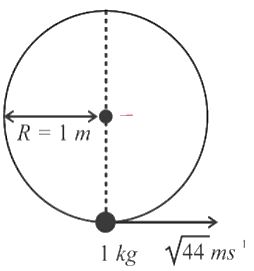
A ball of mass is given an initial velocity of at the bottom position as shown in the figure. Find and velocity of the projection when the ball leaves the circle. Also, find the maximum height, for the ball.
Solution
Statement-1: The trajectory of a projectile w.r.t. another projectile is a straight line.
Statement 2: The relative velocity of a projectile w.r.t. another projectile is constant.
Solution
Statement-1 is true, statement-2 is true and statement-2 is correct explanation for statement-1.
Two particles are projected simultaneously from the same point, with the same speed, in the same vertical plane, and at different angles with the horizontal in a uniform gravitational field acting vertically downwards. A frame of reference is fixed to one particle. The position vector of the other particle, as observed from this frame, is . Which of the following statements is correct?
Solution
The magnitude of increases linearly with time; its direction does not change.
PYQs
51 QuestionsClick on an option to find the answer
Question 1 of 51
A constant power delivering machine has towed a box, which was initially at rest, along a horizontal straight line. The distance moved by the box in time ' ' is proportional to:
[JEE Main 2021, 18 Mar (Shift 1)]
Solution
A body at rest is moved along a horizontal straight line by a machine delivering a constant power. The distance moved by the body in time ' ' is proportional to:
Solution
A body of mass ' ' dropped from a height ' ' reaches the ground with a speed of . The value of work done by the air-friction is:
[JEE Main 2021, 1 Sep (Shift 2)]
Solution
Flashcards
40 CardsClick to reveal answerTap the card to see answer

