

PHYSICS MID-TERM MARATHON Half-Yearly - Class 11 ISC Physics
Watch Video


Study smarter with Pi Lens
Get Notes, PYQs, Quiz and more for any Youtube video!
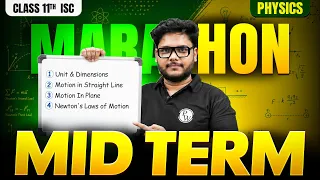
PHYSICS MID-TERM MARATHON Half-Yearly - Class 11 ISC Physics
114 views

ISC Wallah Class 11 & 12
Notes
Video Summary
Units, Dimensions, Motion, and Work: Core Physics for Class 11
Physical Quantities and Their Types
Physical quantities are measurable properties in physics, such as length, mass, temperature, speed, and force. They are characterized by a numerical value and a unit, and their product remains constant; increasing the unit decreases the numerical value and vice versa.
- Types of Physical Quantities:
- Fundamental Quantities: Self-explanatory, do not depend on other quantities. There are seven: length, mass, time, amount of substance, thermodynamic temperature, electric current, and luminous intensity. In class 11, focus is mainly on length, mass, time, and temperature.…
Units, Dimensions, Motion, and Work: Core Physics for Class 11
Physical Quantities and Their Types
Physical quantities are measurable properties in physics, such as length, mass, temperature, speed, and force. They are characterized by a numerical value and a unit, and their product remains constant; increasing the unit decreases the numerical value and vice versa.
- Types of Physical Quantities:
- Fundamental Quantities: Self-explanatory, do not depend on other quantities. There are seven: length, mass, time, amount of substance, thermodynamic temperature, electric current, and luminous intensity. In class 11, focus is mainly on length, mass, time, and temperature.
- Derived Quantities: Formed from fundamental quantities (e.g., area, volume, density, speed, acceleration, force, momentum, energy).
- Supplementary Quantities: Only two—plane angle (measured in radians) and solid angle (measured in steradians).
Units and Measurement
Units are standards for measuring physical quantities. The SI system is used, with base units for each fundamental quantity.
- Plane Angle: ; SI unit is radian.
- Solid Angle: ; SI unit is steradian.
- Total angle in a circle: radians; for a sphere, total solid angle is steradians.
- Numerical value and unit are inversely proportional. Example: ; as unit decreases, numerical value increases.
Dimensional Analysis
Dimensional analysis expresses physical quantities in terms of fundamental dimensions (mass , length , time , temperature , current , amount of substance ).
- Dimensional Formulas:
- Area:
- Volume:
- Density:
- Speed/Velocity:
- Acceleration:
- Momentum:
- Force:
- Work/Energy:
- Power:
- Pressure/Stress:
- Impulse:
- Strain: Dimensionless
- Modulus of Elasticity:
- Surface Tension:
- Dimensionless Quantities: May or may not have units (e.g., angle in radians is dimensionless but has a unit).
Applications and Limitations of Dimensional Analysis
Dimensional analysis is used for unit conversion, checking the correctness of equations, and deriving relationships between physical quantities.
- Applications:
- Conversion of Units: ; use dimensional formula to solve for missing values.
- Checking Equation Correctness: All terms added or equated must have the same dimensional formula (Principle of Homogeneity).
- Deriving Relations: Assume dependence, assign powers, equate dimensions, and solve for exponents.
- Limitations:
- Cannot determine dimensionless constants.
- Not valid if a quantity depends on more than three others.
- Cannot distinguish between sum/difference or handle trigonometric/logarithmic/exponential functions.
Significant Figures and Rounding Rules
Significant figures indicate the accuracy of a measurement. More significant figures mean higher accuracy.
- Rules:
- All non-zero digits are significant.
- Zeros between non-zero digits are significant.
- Leading zeros are not significant.
- Trailing zeros after a decimal point are significant.
- Trailing zeros without a decimal are not significant unless a unit is specified.
- Exponential terms do not affect significant figures.
- For addition/subtraction: answer has as many decimal places as the least precise measurement.
- For multiplication/division: answer has as many significant figures as the least precise measurement.
- Rounding: If the digit to be dropped is >5, increase the previous digit by 1; if <5, leave unchanged; if exactly 5, make the previous digit even.
Motion in a Straight Line
Motion is the change in position of an object with respect to its surroundings.
- Distance: Scalar, actual path length, always positive or zero.
- Displacement: Vector, straight line from initial to final position, can be positive, negative, or zero.
- Speed: Scalar, distance per unit time, always positive or zero.
- Velocity: Vector, displacement per unit time, can be positive, negative, or zero.
- Acceleration: Change in velocity per unit time; positive for increasing speed, negative (retardation) for decreasing speed.
- Equations of Motion (for constant acceleration):
- Average Speed: Total distance/total time.
- Average Velocity: Total displacement/total time.
- Relative Velocity: Velocity of one object with respect to another; subtract velocities if in the same direction, add if opposite.
Graphical Analysis of Motion
Graphs provide visual representation of motion and help extract key quantities.
- Slope of a graph: For vs , slope = .
- Area under the graph: For vs , area = .
- Displacement-Time Graph:
- Slope gives velocity.
- Straight line: constant velocity.
- Curved line: changing velocity.
- Velocity-Time Graph:
- Slope gives acceleration.
- Area under the curve gives displacement.
- Acceleration-Time Graph:
- Area under the curve gives change in velocity.
Vectors and Their Operations
Vectors have both magnitude and direction and follow vector addition laws.
- Types of Vectors:
- Equal vectors: same magnitude and direction.
- Negative vectors: same magnitude, opposite direction.
- Collinear vectors: along the same line.
- Coplanar vectors: in the same plane.
- Zero vector: magnitude zero, no fixed direction.
- Unit vector: magnitude one, direction specified.
- Position Vector: From origin to a point : .
- Displacement Vector: .
- Addition of Vectors:
- Triangle Law: Place tail of second at head of first; resultant from tail of first to head of second.
- Parallelogram Law: Resultant is the diagonal from the common tail.
- Polygon Law: For more than two vectors, connect head to tail; resultant from start to end.
- Resultant of Two Vectors:For perpendicular vectors (): , .
- Resolution of Vectors: Component along angle = , perpendicular = .
Projectile and Circular Motion
Projectile motion occurs when an object is thrown at an angle and follows a parabolic path under gravity.
- Key Results:
- Time of Flight:
- Maximum Height:
- Range:
- Horizontal velocity remains constant.
- Maximum range at .
- For two angles and , range is the same.
- Circular Motion:
- Uniform Circular Motion: Speed constant, direction changes, acceleration towards center (centripetal).
- Centripetal Acceleration:
- Centripetal Force:
- Angular velocity:
- Relation:
- Time period:
- Frequency:
Newton’s Laws of Motion and Applications
Newton’s laws explain the cause of motion and the relationship between force, mass, and acceleration.
- First Law (Law of Inertia): An object remains at rest or in uniform motion unless acted upon by a force.
- Second Law: ; for constant mass, .
- Third Law: Every action has an equal and opposite reaction.
- Impulse: Product of force and time interval; equals change in momentum.
- Conservation of Momentum: If net external force is zero, total momentum remains constant.
- Free Body Diagrams: Separate the body, show all external forces, apply equilibrium conditions (, ).
- Tension in Connected Bodies: Use ; tension calculated for each segment.
Work, Power, and Energy
Work is done when a force causes displacement. Power is the rate of doing work. Energy is the capacity to do work.
- Work by Constant Force: or .
- Work by Variable Force: .
- Power: .
- Efficiency:
- Kinetic Energy:
- Relation with Momentum:
- Work-Energy Theorem: Net work done equals change in kinetic energy.
- Potential Energy (Conservative Forces): Defined only for conservative forces; for gravity, ; for spring, .
- Force from Potential Energy:
- Conservation of Mechanical Energy: In absence of non-conservative forces, total mechanical energy (kinetic + potential) remains constant.
Friction and Related Concepts
Friction opposes relative motion and is characterized by the coefficient of friction.
- Types:
- Static Friction: Adjusts up to a maximum (limiting friction).
- Kinetic Friction: When body is moving, slightly less than limiting friction.
- Frictional Force:
- Angle of Friction:
- Angle of Repose: Inclined plane angle where body is in equilibrium; equal to angle of friction.
- Self-Adjusting Nature: Static friction matches applied force up to its maximum.
- Effect of Pulling vs. Pushing: Pulling reduces normal reaction and friction; pushing increases both.
Special Cases: Lifts, Springs, and Banking
- Lift Problems: Apparent weight changes with acceleration; (upward: , downward: ).
- Spring Force: , where is spring constant, is extension/compression.
- Banking of Roads: For safe turning, outer edge is raised; maximum speed for safe turn: (with friction: as derived).
- Cyclist Bending: Required for centripetal force; .
End of notes.
Quiz
10 QuestionsClick on an option to find the answer
Question 1 of 10
If g increases, range:
Solution
Decreases
Solution
Solution
Flashcards
24 CardsClick to reveal answerTap the card to see answer

