

Circles Complete Chapter in One Shot - Class 10 ICSE Physics
Watch Video


Study smarter with Pi Lens
Get Notes, PYQs, Quiz and more for any Youtube video!

Circles Complete Chapter in One Shot - Class 10 ICSE Physics
69 views

ICSE Wallah 9 & 10
Notes
Video Summary
Circles: Properties, Theorems, and Exam-Focused Applications
Definition and Basic Elements of a Circle
A circle is the locus of all points at a fixed distance (radius) from a fixed point (center). The boundary of the circle is called the circumference. The diameter is a line passing through the center and touching the circumference at two points, and is the longest chord in a circle.
- Radius: Distance from center to any point on circumference.
- Diameter: Twice the radius; longest chord.
- Chord: Line segment joining two points on the circumference.
- Arc: Part of the circumference between…
Circles: Properties, Theorems, and Exam-Focused Applications
Definition and Basic Elements of a Circle
A circle is the locus of all points at a fixed distance (radius) from a fixed point (center). The boundary of the circle is called the circumference. The diameter is a line passing through the center and touching the circumference at two points, and is the longest chord in a circle.
- Radius: Distance from center to any point on circumference.
- Diameter: Twice the radius; longest chord.
- Chord: Line segment joining two points on the circumference.
- Arc: Part of the circumference between two points.
- Minor/Major Arc: Smaller/larger part of the circumference.
- Sector: Region bounded by two radii and the arc.
- Segment: Region bounded by a chord and the arc.
Fundamental Properties and Theorems
Several key properties and theorems govern the relationships between angles, chords, arcs, and tangents in circles. These are essential for solving exam questions.
- Angle at Center vs. Angle at Segment: The angle subtended by an arc at the center is double the angle subtended at the segment.
- Angles in the Same Segment: All angles in the same segment are equal.
- Angle in a Semicircle: Always (right angle).
- Opposite Angles of a Cyclic Quadrilateral: Sum to (supplementary).
- Exterior Angle of Cyclic Quadrilateral: Equal to the interior opposite angle.
- Tangents from External Point: Tangents drawn from an external point to a circle are equal in length.
Angle Relationships and Calculations
Angles formed by arcs, chords, and tangents are central to circle geometry. Calculating these angles is a frequent exam requirement.
- If angle at center is , angle at segment is .
- In semicircle, angle at segment is .
- In cyclic quadrilateral, opposite angles add to .
- For tangents, the angle between radius and tangent at point of contact is .
Example:
- If angle at center is , angle at segment is .
Cyclic Quadrilaterals and Their Properties
A cyclic quadrilateral is a four-sided figure with all vertices on the circumference of a circle. Its properties are frequently tested.
- Definition: Quadrilateral with all vertices on the circle.
- Opposite Angles: Sum to .
- Exterior Angle: Equal to interior opposite angle.
- If one side is extended, the exterior angle equals the interior opposite angle.
Tangents and Secants: Properties and Formulas
Tangents and secants are lines interacting with circles in specific ways. Their properties are crucial for problem-solving.
- Tangent: Touches the circle at exactly one point.
- Secant: Intersects the circle at two points.
- Tangents from External Point: Both tangents are equal.
- Radius-Tangent Relationship: Radius at point of contact is perpendicular to tangent.
- Pythagoras in Tangent Problems: If is radius, is tangent, and is distance from center to tangent point:
- Tangents from External Point: If and are tangents from , .
Intersecting Chords and Segment Products
When two chords intersect inside or outside a circle, the products of their segments are equal.
- If chords and intersect at :
- For external intersection:
- Example: If , , then
- If , , then .
Alternate Segment Theorem
The angle between a tangent and a chord at the point of contact is equal to the angle in the alternate segment.
- If tangent and chord meet at , then angle between and at equals the angle in the segment opposite .
- This theorem is highly tested; expect questions involving tangents and chords.
Exam-Focused Problem Types and Sample Calculations
Exam questions often require application of circle properties, angle relationships, and segment products. Practice with sample types is essential.
- Finding Angles: Use properties like angle at center, angle in segment, cyclic quadrilateral, alternate segment theorem.
- Tangents and Lengths: Apply Pythagoras and tangent properties.
- Intersecting Chords: Use segment product formulas.
- Sample Calculation:
- If radius cm, diagonal of square formed by tangents and radii: cm.
- If two circles of radii cm and cm touch externally, distance between centers cm; if internally, cm.
Special Cases and Edge Conditions
Certain cases require attention to avoid mistakes.
- Diameter as Chord: Diameter is the longest chord.
- Tangents from Internal Point: No tangents can be drawn from a point inside the circle.
- Tangents from Point on Circle: Only one tangent can be drawn.
- Tangents from External Point: Two tangents, both equal.
- Segment vs. Sector: Segment is formed by chord and arc; sector by two radii and arc.
Common Pitfalls and Misconceptions
Misunderstandings often arise in distinguishing properties and applying theorems.
- Confusing angle at center with angle at segment.
- Applying alternate segment theorem when no tangent is present.
- Misidentifying cyclic quadrilaterals (all vertices must be on the circle).
- Forgetting that tangents from external point are equal.
- Incorrectly summing angles in quadrilaterals (cyclic vs. general).
Competency-Based and Sample Paper Questions
Recent exam trends emphasize competency-based questions, requiring application of concepts in varied formats.
MCQs: Often test angle relationships, tangent properties, segment products.
Sample Paper: Includes problems on tangents, cyclic quadrilaterals, alternate segment theorem, and intersecting chords.
Weightage: Circles chapter typically carries 8–10 marks in exams.
Practice with sample and previous year questions is critical for mastering circle geometry and scoring high marks.
Additional Notes

Class Slides_752.pdf
Quiz
25 QuestionsClick on an option to find the answer
Question 1 of 25
and are the three points on a circle. The tangent at point meet produced at point . Given that and that . Calculate the angle subtended by at the Centre of the circle.
Solution
Equal _________ of the congruent circles subtend equal angles at the centre.
Solution
Chords
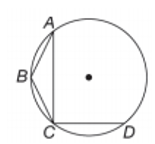
We have AB = BC, AC = CD . If the radius of the circle is 'r', find BC terms of r.
Solution
PYQs
8 QuestionsClick on an option to find the answer
Question 1 of 8
A circle has a centre O and radii OQ and OR. Two tangents, PQ and PR, are drawn from an external point, P. In addition to the above information, which of these must also be known to conclude that the quadrilateral PQOR is a square?
(i) OQ and OR are at an angle of 90°.
(ii) The tangents meet at an angle of 90°
Solution
both (i) and (ii)
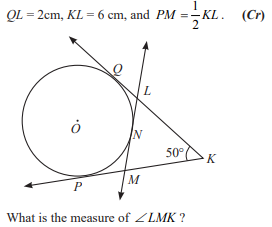
In a mathematics competition, students are given a problem involving a circle with center O. The problem states that three tangents KQ, KP, and LM are drawn from external points. Given that
Solution
80°
In two concentric circles, if a chord of the larger circle touches the smaller circle, which of the following statements cannot be said about the point of contact?
Solution
The radius of the smaller circle is half of the chord of the larger circle.
Flashcards
10 CardsClick to reveal answerTap the card to see answer

