

Natural Vegetation - Class 10 ICSE History and Civics
Watch Video


Study smarter with Pi Lens
Get Notes, PYQs, Quiz and more for any Youtube video!

Natural Vegetation - Class 10 ICSE History and Civics
66 views

ICSE Wallah 9 & 10
Notes
Video Summary
Natural Vegetation of India
Definition and Core Concepts
Natural vegetation refers to plant life that grows in a region without direct human intervention. It is shaped by climatic factors such as rainfall, temperature, and altitude. The transcript distinguishes between natural vegetation, flora (listed plant species), and forest (large areas with trees, shrubs, and animals).
- Natural vegetation: Plants growing naturally without human effort.
- Flora: Specific plant species in a region.
- Forest: Large area with diverse trees, shrubs, and wildlife.
Factors Influencing Vegetation
Vegetation in India is influenced by several environmental factors. These include temperature, rainfall,…
Natural Vegetation of India
Definition and Core Concepts
Natural vegetation refers to plant life that grows in a region without direct human intervention. It is shaped by climatic factors such as rainfall, temperature, and altitude. The transcript distinguishes between natural vegetation, flora (listed plant species), and forest (large areas with trees, shrubs, and animals).
- Natural vegetation: Plants growing naturally without human effort.
- Flora: Specific plant species in a region.
- Forest: Large area with diverse trees, shrubs, and wildlife.
Factors Influencing Vegetation
Vegetation in India is influenced by several environmental factors. These include temperature, rainfall, altitude, and relief features. Each factor determines the type and density of vegetation found in a region.
- Temperature: Higher altitudes have lower temperatures, affecting plant types.
- Rainfall: Regions with high rainfall support dense forests; low rainfall leads to desert vegetation.
- Altitude: Vegetation changes with increasing elevation, from tropical to alpine types.
- Relief: Landforms like mountains, plains, and coastal areas impact vegetation distribution.
Types of Natural Vegetation in India
India's diverse climate results in multiple vegetation types. The transcript explicitly lists and describes five main types: Tropical Evergreen Forests, Tropical Deciduous Forests, Tropical Desert Forests, Littoral (Swamp/Mangrove) Forests, and Mountain Forests.
- Tropical Evergreen Forests: Found in areas with rainfall above 200–250 cm, humid temperatures (25–27°C), no definite leaf shedding season, always green, very dense, trees up to 60 meters.
- Tropical Deciduous Forests: Most widespread, found where rainfall is 70–200 cm, divided into moist (100–200 cm) and dry (70–100 cm) types, definite leaf shedding season (6–8 weeks in summer), commercially exploited.
- Tropical Desert Forests: Occur in regions with less than 70 cm rainfall, high temperatures, stunted trees, thorny plants, deep roots, xerophytic adaptations.
- Littoral/Swamp/Mangrove Forests: Found in river deltas and coastal areas with marshy, saline conditions, evergreen, stilt roots, climbers, breathing roots (pneumatophores), act as coastal protectors.
- Mountain Forests: Located in hilly regions, vegetation changes with altitude, includes moist temperate, dry temperate, and alpine types, found in both northern and southern mountains.
Key Species and Their Uses
Each forest type is associated with specific tree species and their economic uses. The transcript details important species and their applications.
Tropical Evergreen Forests:
- Rosewood: Furniture, decorative items.
- Ebony: Decor, musical instruments, sports goods.
- Chaplas: Shipbuilding, packing boxes.
- Gurjan: Construction, tea boxes, flooring.
- Telsu: Bridges, boats.
- Sisu: Construction, furniture, agricultural tools.
- Toon: Toys, small furniture, tea boxes.
Tropical Deciduous Forests:
- Sal: Doors, windows, railway sleepers.
- Teak: Furniture, shipbuilding, bridges.
- Sheesham: Construction, furniture, agricultural tools, musical instruments.
- Mahua: Oil from fruit, liquor from flowers.
- Palash: Rearing silkworms.
- Semul: Toys, matchboxes, pillow filling.
- Sandalwood: Statues, ornamental objects, perfumes.
- Khair: Ploughs, knife handles.
- Axlewood: Kitchen cabinets, wardrobes, radio/TV cabinets.
Tropical Desert Forests:
- Babul: Medicinal gum, fuel.
- Date Palm: Syrup for treating cough.
- Neem: Medicinal uses for diabetes, allergies, skin diseases.
- Ber: Edible fruit, drinks, boat ribs, charcoal, agricultural tools.
Littoral/Mangrove Forests:
- Sundari: Boat making, construction.
- Kada, Amur, Bhara, Kesar: Fuel, construction.
Mountain Forests:
- Oak, Fir, Spruce, Deodar, Silver Fir, Maple, Birch: Construction, furniture, musical instruments, decorative items.
Climatic Conditions for Major Vegetation Types
Climatic requirements for each vegetation type are explicitly stated. These conditions are crucial for exam recall.
- Tropical Evergreen Forests: Rainfall > 200–250 cm, humid temperature (25–27°C).
- Tropical Deciduous Forests:
- Moist: Rainfall 100–200 cm.
- Dry: Rainfall 70–100 cm.
- Tropical Desert Forests: Rainfall < 70 cm, temperature 25–27°C.
- Mountain Forests:
- Moist temperate: Rainfall 100–300 cm, temperature 12–13°C.
- Dry temperate: Rainfall ~100 cm, elevation >1500 m.
- Alpine: Elevation 2800–4000 m.
Adaptations and Features of Vegetation Types
Vegetation types exhibit specific adaptations to their environment. The transcript highlights key features and mechanisms.
- Evergreen Forests: No definite leaf shedding season, multi-layered structure, dense canopy blocks sunlight.
- Deciduous Forests: Leaf shedding for 6–8 weeks in summer to conserve water, most commercially exploited.
- Desert Vegetation: Deep roots for water search, leaves reduced to spines, waxy thick leaves to minimize transpiration.
- Mangrove Forests: Stilt roots for support in marshy soil, breathing roots (pneumatophores) for oxygen exchange, act as coastal defense.
- Mountain Forests: Vegetation changes with altitude due to decreasing temperature, alpine regions dominated by grasslands, mosses, and lichens.
Distribution and Regional Examples
The transcript provides explicit regional distribution for each vegetation type.
- Tropical Evergreen Forests: Western Ghats (windward side), Lakshadweep, Andaman & Nicobar, Assam (upper parts), Tamil Nadu coast.
- Tropical Deciduous Forests: Odisha (western part), eastern slopes of Western Ghats, Chhattisgarh, Jharkhand, North-Eastern states, Central India.
- Tropical Desert Forests: Gujarat (dry regions), Rajasthan, Punjab, Haryana, UP, MP, Maharashtra (dry regions).
- Littoral/Mangrove Forests: River deltas (Ganga-Brahmaputra in Sundarbans, West Bengal), Andhra Pradesh, Odisha coastal areas.
- Mountain Forests: Kashmir to Arunachal Pradesh, Uttarakhand, Himachal Pradesh, Sikkim, North-East, Vindhyachal, Satpura, Mahadev hills, Nilgiris, Western/Eastern Ghats.
Conservation of Forests
Conservation methods are detailed, including government policies and community involvement.
- Afforestation: Planting more trees, programs like Van Mahotsav.
- Regulated Permits: Limiting timber extraction by contractors.
- Tribal Protection: Sacred groves protected by tribal communities.
- Joint Forest Management (JFM): Local communities restore degraded forests, started in Odisha, successful in Gujarat.
- Sustainable Development: Planting more trees than cut, using small dams, alternative energy sources (solar, wind, tidal) to reduce wood dependence.
- National Forest Policy (1952): Target of 33% forest cover, ecological balance, soil erosion prevention, people’s involvement, preservation of natural heritage.
Social and Agroforestry
Social forestry and agroforestry are approaches to involve communities and optimize land use.
- Social Forestry: Involves local communities in forest management, restoration of degraded lands, sharing forest products, promoting cottage industries, soil and water conservation.
- Agroforestry: Cultivating trees alongside crops on the same land, best use of resources, reduces pressure on natural forests, maintains ecological balance, scientific land management.
Exam-Focused Takeaways and PYQs
The transcript provides explicit exam pointers and previous year question types.
- Match the following: Tree species and their uses.
- Climatic conditions: Required for each forest type.
- Differentiation: Between evergreen, deciduous, and desert vegetation based on rainfall, features, and distribution.
- Reasoning: Why mountain vegetation varies with altitude (decreasing temperature).
- Conservation: Methods and objectives of social/agroforestry.
- National Forest Policy: 33% forest cover target.
- PYQ Examples:
- Identify vegetation type from picture (layered trees, dense canopy = tropical evergreen).
- State climatic conditions for tropical evergreen forests (rainfall, temperature).
- Three differences between tropical deciduous and desert vegetation.
- Two reasons for diversity of natural vegetation in India (climate, relief).
- How forests help maintain air quality (absorb CO₂).
- Main objective of social forestry (involve local communities in management/protection).
- Timber used for railway sleepers (Sal).
- Forest type found on leeward side of Western Ghats (dry deciduous or thorn forest).
Table: Rainfall Thresholds for Forest Types
| Forest Type | Rainfall (cm) |
|---|---|
| Tropical Evergreen | >200–250 |
| Moist Deciduous | 100–200 |
| Dry Deciduous | 70–100 |
| Desert/Thorn | <70 |
| Mountain (Moist Temperate) | 100–300 |
| Mountain (Dry Temperate) | ~100 |
| Alpine | 2800–4000 m elevation |
- Rainfall and altitude are primary criteria for forest classification and exam answers.
Additional Notes

Class Slides_74.pdf
Quiz
25 QuestionsClick on an option to find the answer
Question 1 of 25
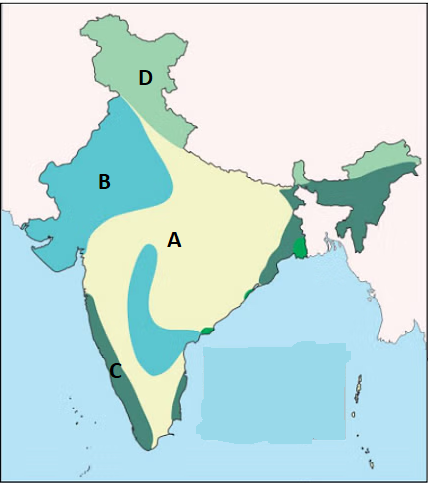
Identify the types of forests marked by A, B, C and D in the given map of India and choose the correct answer from the given options:
Solution
A-Tropical deciduous, B-Thorn Forest, C-Evergreen forests, D-Montane forests
To which one of the following types of vegetation does rubber belong to?
Solution
Tropical Evergreen
Which type of vegetation is found above 3600 m in the Himalayas?
Solution
Alpine vegetation
PYQs
7 QuestionsClick on an option to find the answer
Question 1 of 7
Which of the following types of vegetation does rubber belong to?
Solution
Tropical Evergreen
Which type of vegetation zone is found in the higher reaches of the Himalayas?
Solution
Alpine
Most Widespread forests in India are_______.
Solution
Tropical Deciduous Forest
Flashcards
14 CardsClick to reveal answerTap the card to see answer

