

Biology Mid-Term Marathon - Class 10 ICSE Biology
Watch Video


Study smarter with Pi Lens
Get Notes, PYQs, Quiz and more for any Youtube video!
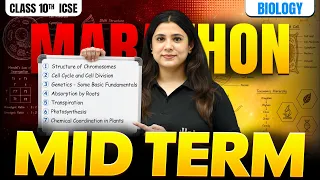
Biology Mid-Term Marathon - Class 10 ICSE Biology
404 views

ICSE Wallah 9 & 10
Notes
Video Summary
ICSE Class 10 Biology: Cell Structure, Genetics, Plant Physiology, and Circulatory & Excretory Systems
Structure and Function of Chromosomes and Nucleic Acids
Chromosomes are thread-like structures in the nucleus containing genetic material. In their uncoiled form, they are called chromatin; when highly coiled, they are termed chromosomes. Each human cell contains 46 chromosomes, arranged in 23 pairs. DNA (deoxyribonucleic acid) is the genetic material, coiled around histone proteins to form nucleosomes.
- Chromatin: Uncoiled, thread-like genetic material in the nucleus.
- Chromosome: Highly coiled form of chromatin, visible during cell division.
- Nucleosome: DNA coiled around a histone…
ICSE Class 10 Biology: Cell Structure, Genetics, Plant Physiology, and Circulatory & Excretory Systems
Structure and Function of Chromosomes and Nucleic Acids
Chromosomes are thread-like structures in the nucleus containing genetic material. In their uncoiled form, they are called chromatin; when highly coiled, they are termed chromosomes. Each human cell contains 46 chromosomes, arranged in 23 pairs. DNA (deoxyribonucleic acid) is the genetic material, coiled around histone proteins to form nucleosomes.
- Chromatin: Uncoiled, thread-like genetic material in the nucleus.
- Chromosome: Highly coiled form of chromatin, visible during cell division.
- Nucleosome: DNA coiled around a histone octamer (8 histone proteins).
- Gene: Functional segment of DNA responsible for coding proteins, enzymes, and hormones.
- DNA Structure: Double helix, large macromolecule (polymer) made of nucleotide monomers.
- Nucleotide: Basic unit of DNA/RNA, consisting of a pentose sugar, phosphate group, and nitrogenous base.
- Nitrogenous Bases: Purines (adenine, guanine), Pyrimidines (thymine, cytosine, uracil in RNA).
- Base Pairing in DNA: Adenine pairs with Thymine (2 hydrogen bonds), Guanine pairs with Cytosine (3 hydrogen bonds).
- RNA: Single-stranded, contains ribose sugar, uracil replaces thymine.
Cell Cycle and Cell Division
The cell cycle is a series of events leading to cell division and duplication. It consists of interphase (preparation) and M phase (mitosis or meiosis).
- Interphase: Preparation phase, includes G1 (growth), S (DNA synthesis/replication), G2 (final preparations).
- G1: Cell grows, synthesizes RNA and proteins, duplicates organelles.
- S: DNA replication, formation of sister chromatids.
- G2: Final growth, synthesis of proteins and RNA.
- Mitosis (M phase): Division of somatic cells, produces two identical daughter cells.
- Prophase: Chromatin condenses to chromosomes, nuclear envelope disappears, spindle fibers form.
- Metaphase: Chromosomes align at the equatorial plate.
- Anaphase: Sister chromatids separate to opposite poles.
- Telophase: Chromosomes decondense, nuclear envelope reforms.
- Cytokinesis: Division of cytoplasm, animal cells form cleavage furrow, plant cells form cell plate.
- Meiosis: Occurs in reproductive cells, reduces chromosome number by half, produces four non-identical gametes.
- Crossing over occurs between non-sister chromatids of homologous chromosomes, leading to genetic variation.
- Homologous chromosomes: Pairs with same structure, size, and gene loci (one from each parent).
- Diploid (2n): Cells with paired chromosomes (e.g., somatic cells).
- Haploid (n): Cells with half the chromosome number (e.g., gametes).
Mendelian Genetics and Laws of Inheritance
Genetics is the study of genes and heredity. Mendel’s experiments with pea plants established the basic laws of inheritance.
- Gene pairs (alleles): Each trait is controlled by two alleles, one from each parent.
- Dominant allele: Expressed in heterozygous condition (e.g., T for tall).
- Recessive allele: Expressed only in homozygous condition (e.g., t for short).
- Monohybrid Cross: Involves one trait; F2 generation shows 3:1 phenotypic ratio (dominant:recessive).
- Genotype: Genetic makeup (e.g., TT, Tt, tt).
- Phenotype: Observable trait (e.g., tall, short).
- Dihybrid Cross: Involves two traits; F2 generation shows 9:3:3:1 phenotypic ratio.
- Mendel’s Laws:
- Law of Segregation: Alleles separate during gamete formation.
- Law of Dominance: Dominant allele masks the effect of recessive in heterozygote.
- Law of Independent Assortment: Genes for different traits assort independently during gamete formation.
- Pedigree Analysis: Squares represent males, circles represent females; shaded shapes indicate affected individuals; half-shaded for carriers (females only in sex-linked traits).
Sex-linked Inheritance and Genetic Disorders
Some traits are linked to sex chromosomes, leading to specific inheritance patterns.
- Sex Chromosomes: XX in females, XY in males.
- Autosomes: Non-sex chromosomes (44 in humans).
- Sex-linked Disorders: Genes located on X chromosome, e.g., hemophilia, color blindness.
- Hemophilia: Recessive, X-linked; more common in males (XY), rare in females (XX, both alleles defective).
- Carrier female: One normal and one defective X chromosome; not affected but can pass the trait.
- Males cannot be carriers; if X is defective, they are affected.
- Mutation: Sudden change in DNA sequence; can cause disorders like sickle cell anemia (change in hemoglobin gene).
Plant Physiology: Absorption, Transpiration, and Photosynthesis
Plants absorb water and minerals, transport them, and perform photosynthesis to produce food.
- Absorption by Roots:
- Root hairs: Elongated epidermal cells, increase surface area.
- Cell sap in root hair is concentrated, draws water from soil by osmosis.
- Minerals absorbed by active transport (low to high concentration, requires energy).
- Osmosis: Movement of water from high to low concentration through a semi-permeable membrane.
- Endosmosis: Water enters cell.
- Exosmosis: Water leaves cell.
- Turgidity and Plasmolysis:
- Turgid cell: Swollen with water.
- Plasmolysis: Cell shrinks in hypertonic solution.
- Transpiration: Loss of water vapor from aerial parts, mainly through stomata.
- Types: Stomatal (major), cuticular, lenticular.
- Factors affecting transpiration: Light, temperature, wind, humidity, CO₂ concentration, atmospheric pressure.
- Adaptations to reduce transpiration: Thick cuticle, sunken stomata, reduced leaf area, spines.
- Significance of Transpiration: Cooling effect, creates transpiration pull for water movement.
- Photosynthesis:
- Occurs in green parts (chlorophyll present).
- Equation:
- Light-dependent reactions: Occur in thylakoids, produce ATP and NADPH, split water to release O₂.
- Light-independent (dark) reactions: Occur in stroma, use ATP and NADPH to fix CO₂ into glucose.
- Factors affecting photosynthesis: Light intensity, CO₂ concentration, temperature (optimum ~35°C).
- Experiments: Starch test with iodine, use of KOH to absorb CO₂, variegated leaf for chlorophyll necessity.
Plant Hormones and Tropic Movements
Plants use hormones (phytohormones) for growth and response to stimuli.
- Growth Promoters: Auxin (cell elongation, apical dominance), Gibberellin (stem elongation, seed germination, breaks dormancy), Cytokinin (cell division, lateral growth).
- Growth Inhibitors: Abscisic acid (leaf/fruit drop, dormancy, senescence), Ethylene (fruit ripening, senescence).
- Parthenocarpy: Fruit development without fertilization (e.g., seedless banana).
- Tropic Movements:
- Phototropism: Response to light (shoots positive, roots negative).
- Geotropism: Response to gravity (roots positive, shoots negative).
- Hydrotropism: Response to water (roots grow towards moisture).
- Thigmotropism: Response to touch (tendrils coil around support).
- Chemotropism: Response to chemicals (pollen tube growth towards ovule).
- Heliotropism: Sunflower head movement following the sun.
Human Circulatory System
The circulatory system consists of the heart, blood, and blood vessels, responsible for transport and protection.
- Blood Components:
- Plasma (55%): Water, proteins (albumin, globulin, fibrinogen), hormones, ions.
- Formed elements (45%): RBCs (erythrocytes, carry O₂ via hemoglobin), WBCs (leukocytes, immunity), platelets (thrombocytes, clotting).
- Blood Groups: O is universal donor, AB is universal recipient; Rh factor (+/-) important for compatibility.
- Blood Vessels:
- Arteries: Thick-walled, carry blood away from heart, high pressure, no valves.
- Veins: Thin-walled, carry blood to heart, low pressure, valves present.
- Capillaries: Single layer, site of exchange.
- Heart Structure:
- Four chambers: Right/left atria (upper), right/left ventricles (lower).
- Valves: Tricuspid (right), bicuspid/mitral (left), semilunar (exit).
- Pericardium: Double membrane with pericardial fluid for protection.
- Double Circulation:
- Pulmonary: Right ventricle → pulmonary artery → lungs → pulmonary vein → left atrium.
- Systemic: Left ventricle → aorta → body → vena cava → right atrium.
- Cardiac Cycle:
- Joint diastole (all chambers relaxed, filling with blood).
- Atrial systole (atria contract, blood to ventricles).
- Ventricular systole (ventricles contract, blood to arteries).
- Duration: 0.8 seconds per cycle.
- Heart sounds: "Lubb" (AV valves close), "Dubb" (semilunar valves close).
- Heart Disorders:
- Cardiac arrest: Sudden loss of heart function due to electrical signal failure.
- Heart attack (myocardial infarction): Blockage of coronary artery, reduced oxygen to heart muscle.
- Blood Pressure:
- Systolic: 120 mm Hg (ventricular contraction).
- Diastolic: 80 mm Hg (ventricular relaxation).
- Measured by sphygmomanometer.
Lymphatic System and Excretory System
The lymphatic system aids in fluid balance, immunity, and absorption of fats. The excretory system removes metabolic wastes and maintains homeostasis.
- Lymph:
- Formed from plasma that leaks out of capillaries.
- Contains water, ions, small proteins, lymphocytes.
- Functions: Nutrient transport, drainage of excess fluid, absorption of fats (lacteals), defense (lymph nodes, tonsils, spleen).
- Spleen: Reservoir and graveyard of RBCs, stores blood, destroys old RBCs.
- Excretory System:
- Kidneys: Paired, dorsal, protected by ribs and fat.
- Structure: Cortex (outer), medulla (inner, with pyramids), pelvis (collects urine), ureter (to bladder).
- Nephron: Functional unit (1 million per kidney).
- Bowman's capsule + glomerulus = Malpighian corpuscle.
- Filtration: High pressure in glomerulus forces plasma into Bowman's capsule (glomerular filtrate).
- Selective reabsorption: PCT, loop of Henle, DCT reabsorb water, glucose, amino acids, ions.
- Tubular secretion: DCT adds wastes (ammonia, H⁺, K⁺) to filtrate.
- Collecting duct: Final urine formation.
- Urine: 95% water, 2.3% urea, 1.5% creatinine, 0.7% uric acid, salts.
- Abnormal constituents: Blood (hematuria), glucose (glycosuria), albumin (albuminuria), bile pigments (jaundice).
- Disorders: Uremia (accumulation of urea), diabetes insipidus (ADH deficiency, excessive urination), temporary diuresis (after caffeine/alcohol).
- Osmoregulation: Kidneys regulate water and ion content of blood.
- Artificial kidney (dialysis): Used when both kidneys fail.
Key Experiments and Case Questions
Several classic experiments and case-based questions are essential for exams.
Osmosis Experiment: Thistle funnel with sugar solution and semi-permeable membrane in water; water enters funnel, level rises.
Transpiration Measurement: Weighing method, Ganong’s potometer, cobalt chloride paper (blue to pink with water).
Photosynthesis Tests: Iodine test for starch, KOH to absorb CO₂, variegated leaf for chlorophyll necessity, aquatic plant (Hydrilla) for O₂ release.
Case Questions:
- Injury healing: Mitosis responsible.
- Number of chromosomes in human cells: 46.
- Blood vessel with maximum urea: Renal artery; minimum urea: Renal vein.
- Excessive sweating and dizziness: Loss of water and electrolytes, corrected by ORS.
- Pulmonary circulation: Right atrium → right ventricle → pulmonary artery → lungs → pulmonary vein → left atrium.
Table: Blood Cell Abnormalities
| Cell Type | Decreased (–penia) | Increased (–cytosis) | Cancerous Increase |
|---|---|---|---|
| RBC (Erythro-) | Erythropenia | Erythrocytosis | Polycythemia |
| WBC (Leuko-) | Leukopenia | Leukocytosis | Leukemia |
| Platelets | Thrombopenia | Thrombocytosis | — |
Quiz
40 QuestionsClick on an option to find the answer
Question 1 of 40
Which out of the following is not a function of vacuole?
Solution
Locomotion
A student notes that plant cells have a large vacuole. What is its main function?
Solution
Storage and maintaining turgor
In plants, excess water is removed by:
Solution
Transpiration
Flashcards
32 CardsClick to reveal answerTap the card to see answer

