

Two forces and are applied - GATE Mechanical Engineering
Watch Video


Study smarter with Pi Lens
Get Notes, PYQs, Quiz and more for any Youtube video!
Two forces and are applied - GATE Mechanical Engineering
1 views

PW Solutions
Notes
Video Summary
Work-Energy Analysis of a Uniform Disk under Multiple Forces
Problem Statement and Physical Setup
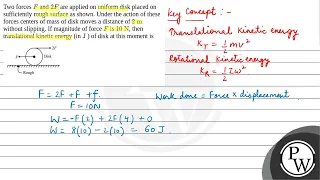
A uniform disk is subjected to two forces, and , on a sufficiently rough surface. The disk's center of mass moves a distance of without slipping. The magnitude of is given as . The task is to determine the translational kinetic energy of the disk at this moment.
- Disk: Uniform, placed on a rough surface to prevent slipping.
- Forces: and applied as shown (details of direction implied by context).
- Displacement: Center of mass moves . -…
Work-Energy Analysis of a Uniform Disk under Multiple Forces
Problem Statement and Physical Setup
A uniform disk is subjected to two forces, and , on a sufficiently rough surface. The disk's center of mass moves a distance of without slipping. The magnitude of is given as . The task is to determine the translational kinetic energy of the disk at this moment.
- Disk: Uniform, placed on a rough surface to prevent slipping.
- Forces: and applied as shown (details of direction implied by context).
- Displacement: Center of mass moves .
- Friction: Sufficient to prevent slipping; frictional force acts but does no work due to zero displacement at the point of contact.
Kinetic Energy Components
The total kinetic energy of the disk consists of translational and rotational components. Both must be considered due to the rolling motion.
- Translational Kinetic Energy: , where is mass and is linear velocity.
- Rotational Kinetic Energy: , where is moment of inertia and is angular velocity.
Work Done by Forces
The work done on the disk is calculated by considering the forces and the displacement of the center of mass. Friction does not contribute to work as the displacement at the point of contact is zero.
- Total Work Done: Only the applied forces and contribute to work.
- Frictional Force: Acts at the point of contact, but since there is no displacement at this point (no slipping), work done by friction is zero.
Calculation of Total Work
The total work done by the forces is determined by multiplying the net force by the displacement of the center of mass.
- Net Force: and act in the direction of motion.
- Displacement: .
- Given: .
Calculation:
- Work by :
- Work by :
- Total work:
- Substitute :
Energy Distribution: Translational and Rotational
The total kinetic energy at the end of the displacement is the sum of translational and rotational kinetic energies, equated to the total work done.
- Total Kinetic Energy:
Moment of Inertia and Velocity Relations
For a uniform disk, the moment of inertia about its center is used. The relationship between linear and angular velocity is also applied.
- Moment of Inertia (Disk):
- Relation:
Substitute into rotational kinetic energy:
Expressing Rotational Kinetic Energy in Terms of Translational
The rotational kinetic energy is found to be half of the translational kinetic energy for the disk.
Solving for Translational Kinetic Energy
Using the total kinetic energy equation and the relationship between and :
Final Results and Key Takeaways
The translational kinetic energy of the disk after moving under the given forces is . The remaining is in rotational kinetic energy.
- Translational Kinetic Energy:
- Rotational Kinetic Energy:
- Total Kinetic Energy:
Key points:
- For a rolling disk, rotational kinetic energy is half the translational kinetic energy.
- Work done by friction is zero if there is no displacement at the point of contact (no slipping).
- The sum of translational and rotational kinetic energies equals the total work done by external forces.
Quiz
40 QuestionsClick on an option to find the answer
Question 1 of 40
Solution
A uniform flywheel of radius 2 m and mass 8 kg rotates at an angular speed of 4 rad/s about an axis perpendicular to it through its centre. The kinetic energy of rotation is:
Solution
128 J
When a body starts to roll on an inclined plane, its potential energy is converted into
Solution
Translational and rotational kinetic energy

