

Two ideal batteries of emf V1 - GATE Electrical Engineering
Watch Video


Study smarter with Pi Lens
Get Notes, PYQs, Quiz and more for any Youtube video!
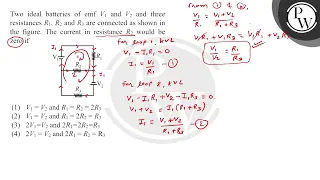
Two ideal batteries of emf V1 - GATE Electrical Engineering
2 views

PW Solutions
Notes
Video Summary
Condition for Zero Current in a Resistor in a Multi-Loop Circuit
In a circuit containing two ideal batteries with emfs and and three resistors , , and , the condition for zero current through resistor is analyzed. The arrangement and the relationships among the components are crucial for determining when the current through becomes zero. The analysis uses Kirchhoff’s Voltage Law (KVL) and logical elimination of branches to derive the required condition.
Circuit Configuration and Problem Statement
The circuit consists of two ideal batteries and three resistors connected in a specific configuration. The main…
Condition for Zero Current in a Resistor in a Multi-Loop Circuit
In a circuit containing two ideal batteries with emfs and and three resistors , , and , the condition for zero current through resistor is analyzed. The arrangement and the relationships among the components are crucial for determining when the current through becomes zero. The analysis uses Kirchhoff’s Voltage Law (KVL) and logical elimination of branches to derive the required condition.
Circuit Configuration and Problem Statement
The circuit consists of two ideal batteries and three resistors connected in a specific configuration. The main focus is to determine under what condition the current through is exactly zero, given the arrangement and the values of the emfs and resistances.
- Given: Two ideal batteries (, ), three resistors (, , ).
- Required: Condition for zero current in .
- Options: Four possible conditions involving , , , , are provided.
Logical Elimination of the Branch
If the current through is zero, it is as if the branch containing is not present in the circuit. This simplification allows the analysis to focus on the remaining loop(s) and the distribution of current through the other resistors.
- When carries zero current, the circuit can be redrawn without the branch.
- The current from the batteries flows only through and .
Application of Kirchhoff’s Voltage Law (KVL)
KVL is applied to the loops in the circuit to derive the relationships between the emfs and resistances. Two loops are considered: the upper loop (excluding ) and the entire loop including both batteries and resistors.
- Loop 1 (Upper loop): Only and are considered since has zero current.
- Loop 2 (Entire loop): Both batteries and all resistors except are included.
Derivation of Current Expressions
By applying KVL to the loops, expressions for the current in terms of the emfs and resistances are obtained.
- For Loop 1:
- The current through is given by .
- For Loop 2:
- The current is also given by .
Equating Currents and Deriving the Zero Current Condition
Since the same current flows through and when is bypassed, the two expressions for current must be equal. Setting them equal gives the condition for zero current in .
- Equate the two expressions:
- Cross-multiplied and simplified:
- This is the required condition for zero current in .
Analysis of Provided Options
The options are checked against the derived condition to determine which satisfy the requirement for zero current in . The value of does not affect the condition, as it is not present in the final expression.
- Option 1: (not matching the derived ratio, so incorrect).
- Option 2: and (satisfies , so correct).
- Option 3: and (satisfies , so correct).
- Option 4: and (satisfies the derived condition, so correct).
Key Takeaways and Exam-Focused Points
The critical insight is that the current through is zero only when the ratio of the emfs equals the ratio of the resistances and . The value of is irrelevant to this condition.
- Zero current in : Occurs when .
- value: Does not affect the condition; can be any value.
- Correct options: Those where the above ratio holds, regardless of .
Stepwise Method to Check for Zero Current in
To determine if the current through is zero in a given circuit:
- Remove the branch from the circuit.
- Apply KVL to the remaining loops to find the current expressions.
- Equate the current expressions from different loops.
- Derive the condition relating emfs and resistances.
- Check if the given values satisfy .
Common Pitfalls and Misconceptions
A frequent mistake is to assume that the value of affects the condition for zero current through it. In reality, as shown by the derivation, does not appear in the final condition.
- Misconception: must have a specific value for zero current.
- Correction: Any value of is permissible; only the ratio of emfs and resistances matters.
Summary Table of Option Analysis
| Option | Condition Given | Satisfies ? |
|---|---|---|
| 1 | No | |
| 2 | , | Yes |
| 3 | , | Yes |
| 4 | , | Yes |
Final Results and Exam Application
The condition for zero current in is strictly . In multi-correct type questions, all options that satisfy this ratio are correct, regardless of the value of . For the given problem, options 2, 3, and 4 are correct.
Quiz
40 QuestionsClick on an option to find the answer
Question 1 of 40
Solution
Resistors of 1,2,3 ohm are connected in the form of a triangle. If a volt cell of negligible internal resistance is connected across 3 ohm resistor, the current flowing through this resistance will be__________
Solution
The algebraic sum of changes in potential around any closed loop involving resistor and cells in the loop is
Solution
zero

