

Let be a real matrix such - GATE Computer Science and IT
Watch Video


Study smarter with Pi Lens
Get Notes, PYQs, Quiz and more for any Youtube video!
Let be a real matrix such - GATE Computer Science and IT
1 views

PW Solutions
Notes
Video Summary
Properties and Solution of a Real Matrix System
A real matrix is considered, with its action on various column matrices leading to specific results. The transcript explores the relationships between the entries of and the outcomes of its multiplication with different vectors, leading to a system of equations. The solution involves systematic matrix multiplication, comparison, and algebraic manipulation to determine unknowns and verify the correct answer among given options.
Structure of the Matrix and Associated Vectors
Matrix is defined as a real matrix with entries…
Properties and Solution of a Real Matrix System
A real matrix is considered, with its action on various column matrices leading to specific results. The transcript explores the relationships between the entries of and the outcomes of its multiplication with different vectors, leading to a system of equations. The solution involves systematic matrix multiplication, comparison, and algebraic manipulation to determine unknowns and verify the correct answer among given options.
Structure of the Matrix and Associated Vectors
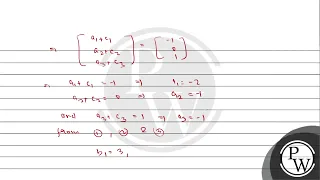
Matrix is defined as a real matrix with entries denoted as in the first column, in the second column, and in the third column. The transcript introduces three column vectors, each with three components, and examines the result of multiplying by these vectors.
- The general form of :
- The vectors considered are of the form , , and , as inferred from the context.
Matrix Multiplication and Resulting Equations
Multiplying by a column vector yields a new column vector, with each entry being a linear combination of the corresponding row of and the vector components. The transcript details the process and the resulting equations.
- For a vector , the product gives:
- Specific cases are considered where the result is set equal to another vector, leading to equations involving the entries of .
System of Equations from Matrix-Vector Products
By equating the results of matrix-vector products to given vectors, a system of equations is established. These equations relate the entries of to each other and to the components of the result vectors.
- For example, if , then:
- These equations are labeled for reference and used in subsequent steps.
Determination of Individual Matrix Entries
The transcript proceeds to isolate and solve for individual entries of by comparing equations and substituting known values. This involves algebraic manipulation and systematic elimination.
- By comparing equations, values such as , , are determined.
- Further, by considering the effect of on other vectors and equating to given results, values for , , , , , are found.
Construction of the Final Matrix
After determining the values of all entries, the final form of matrix is constructed. This matrix satisfies all the previously established equations and conditions.
- The entries are substituted back into the general form of to yield the explicit matrix.
- The matrix is then used for further calculations, such as finding minus another matrix or verifying solutions.
Verification through Substitution and Comparison
To ensure correctness, the transcript describes substituting the found values back into the original equations and comparing the results. This step confirms that the constructed matrix satisfies all given conditions.
- Substituting the values into the equations confirms that the left and right sides match.
- Any discrepancies are resolved by adjusting the values as per the algebraic manipulations shown.
Calculation of and Its Application
The matrix (where is the identity matrix) is computed by subtracting 1 from each diagonal entry of . This new matrix is then used in further calculations, such as multiplying by a vector to check for consistency with given results.
- The explicit form of is written out.
- Multiplication with a vector (e.g., ) is performed, and the result is compared to a given vector.
Solution of the Final System and Selection of the Correct Option
The transcript concludes by solving the final system of equations resulting from the multiplication of with a vector. The solution is checked against the options provided, and the correct option is identified.
- The equations are manipulated (e.g., subtracting one from another, multiplying by constants) to isolate variables.
- The final values are substituted back to verify which option matches the calculated result.
- The correct option is identified as option D.
Key Takeaways and Exam-Focused Points
The process demonstrates the systematic approach required to solve matrix equations in exam settings. Key steps include careful matrix multiplication, setting up and solving systems of equations, and verifying solutions through substitution.
- Always write out the explicit form of the matrix and vectors involved.
- Set up equations by equating the result of matrix-vector multiplication to the given vector.
- Use algebraic manipulation to solve for unknowns systematically.
- Verify the solution by substituting back into the original equations.
- Check the final answer against all given options to ensure correctness.
Quiz
40 QuestionsClick on an option to find the answer
Question 1 of 40
Matrix has rows and columns, matrix has rows and columns. If both and exist, then:
Solution
and are square matrices
If the system of equations
have a non-zero solution, then are in
Solution
HP
Product of two diagonal matrices is
Solution
both commutative and associative

