

Pure iron pyrite, FeS2, is burnt - GATE Chemical Engineering
Watch Video


Study smarter with Pi Lens
Get Notes, PYQs, Quiz and more for any Youtube video!
Pure iron pyrite, FeS2, is burnt - GATE Chemical Engineering
2 views

PW Solutions
Notes
Video Summary
Calculation of Mole Percent of Nitrogen in Gaseous Mixture from Combustion of Iron Pyrite
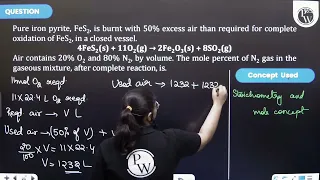
The problem involves the combustion of pure iron pyrite () with 50% excess air over the stoichiometric requirement for complete oxidation. The air composition is given as 20% and 80% by volume. The task is to determine the mole percent of nitrogen in the resulting gaseous mixture after the reaction.
Stoichiometry of Iron Pyrite Combustion
Combustion of iron pyrite requires a specific amount of oxygen for complete oxidation. The stoichiometric relationship between and is used to determine the required air…
Calculation of Mole Percent of Nitrogen in Gaseous Mixture from Combustion of Iron Pyrite
The problem involves the combustion of pure iron pyrite () with 50% excess air over the stoichiometric requirement for complete oxidation. The air composition is given as 20% and 80% by volume. The task is to determine the mole percent of nitrogen in the resulting gaseous mixture after the reaction.
Stoichiometry of Iron Pyrite Combustion
Combustion of iron pyrite requires a specific amount of oxygen for complete oxidation. The stoichiometric relationship between and is used to determine the required air volume.
- Stoichiometric oxygen required: 11 moles of are needed for the reaction.
- Volume of oxygen required: liters.
- Let be the required volume of air (in liters) for complete combustion.
Air Composition and Calculation of Required Air Volume
Air is composed of 20% and 80% by volume. The calculation of the required air volume is based on the oxygen content.
- Oxygen in air: 20% of is oxygen.
- Equation:
- Solving for : liters
Determination of Used Air Volume with Excess
Since 50% excess air is used, the total air supplied is greater than the stoichiometric requirement.
- Excess air supplied: 50% more than required.
- Total air used:
- Calculation: liters
Calculation of Nitrogen Moles in Supplied Air
The nitrogen content in the supplied air is determined by its percentage in air and the total air volume used.
- Nitrogen in air: 80% of the total air volume.
- Volume of nitrogen: liters
- Moles of nitrogen: moles
Moles of Other Gaseous Products
The reaction produces other gaseous products, including sulfur dioxide and excess oxygen. The moles of these gases are determined from the reaction and the air supplied.
- Moles of : 8 moles (from the reaction equation)
- Oxygen left after reaction: Only the excess oxygen remains, as the stoichiometric amount is consumed.
- Excess air volume: liters (excess air)
- Oxygen in excess air: 20% of 616 liters = liters
- Moles of excess oxygen: moles
Total Moles in the Gaseous Mixture
The total number of moles in the final gaseous mixture is the sum of moles of nitrogen, sulfur dioxide, and excess oxygen.
- Total moles: (N) (SO) (O) moles
Calculation of Mole Percent of Nitrogen
The mole percent of nitrogen in the final gaseous mixture is calculated using the total moles and the moles of nitrogen.
- Mole percent formula:
- Calculation:
Key Steps and Final Answer
The process involves several key steps, each critical for accurate calculation:
- Calculate the stoichiometric air required based on oxygen needs.
- Add 50% excess to determine total air supplied.
- Find the volume and moles of nitrogen in the supplied air.
- Determine moles of other gaseous products from the reaction and excess air.
- Sum all moles to get the total for the mixture.
- Compute the mole percent of nitrogen using the formula.
Final result: The mole percent of nitrogen in the gaseous mixture after combustion is 83%.
Exam-Focused Takeaways
Understanding the stoichiometry of combustion reactions and the composition of air is essential for such calculations. Always account for excess air and use the correct percentages for gas components. The stepwise approach ensures accuracy in determining the composition of the resulting gaseous mixture. The key formula for mole percent is crucial for similar problems:
- Mole percent of a component:
Quiz
40 QuestionsClick on an option to find the answer
Question 1 of 40
Carbon and oxygen react in ratio of by mass to form . What weight of carbon should be used to react completely with of oxygen?
Solution
The equation,
Solution
2 mole of reacts with mole of to produce 1 mole of
30g of magnesium and 30g of oxygen are reacted, then the residual mixture contains
Solution
50 g of Magnesium oxide and 10g of oxygen
Flashcards
5 CardsClick to reveal answerTap the card to see answer

