

UP 2026 Maha Marathon Art - Class 10 UP Board History
Watch Video


Study smarter with Pi Lens
Get Notes, PYQs, Quiz and more for any Youtube video!

UP 2026 Maha Marathon Art - Class 10 UP Board History
7 views

PW UP BOARD 9&10th
Notes
Video Summary
Art and Geometry: Key Concepts and Exam Questions
Core Definitions and Principles
Art as a subject combines visual creativity with geometric and mathematical concepts. Key terms include primary, secondary, and neutral colors, geometric shapes, and drawing techniques. Understanding these definitions is essential for scoring well in art exams.
- Primary Colors: Red, blue, yellow; cannot be created by mixing other colors.
- Secondary Colors: Created by mixing two primary colors (e.g., red + yellow = orange).
- Neutral Colors: Black and white; do not belong to primary or secondary groups.
- Geometric Shapes: Triangle, square, rectangle, circle, pentagon,…
Art and Geometry: Key Concepts and Exam Questions
Core Definitions and Principles
Art as a subject combines visual creativity with geometric and mathematical concepts. Key terms include primary, secondary, and neutral colors, geometric shapes, and drawing techniques. Understanding these definitions is essential for scoring well in art exams.
- Primary Colors: Red, blue, yellow; cannot be created by mixing other colors.
- Secondary Colors: Created by mixing two primary colors (e.g., red + yellow = orange).
- Neutral Colors: Black and white; do not belong to primary or secondary groups.
- Geometric Shapes: Triangle, square, rectangle, circle, pentagon, hexagon.
- Drawing Techniques: Use of watercolors, pencils, and specific papers for repetition and clarity.
Color Theory and Classification
Color theory is central to art, focusing on the classification and properties of colors. The exam often tests knowledge of color mixing, types, and their effects.
- Primary Colors: Red, blue, yellow.
- Secondary Colors: Orange, green, violet (formed by mixing two primary colors).
- Neutral Colors: Black and white; also called "tathasth" or "udaseen" colors.
- Warm Colors: Red, orange, yellow; appear vibrant and energetic.
- Cool Colors: Violet, indigo, blue, green; appear calm and soothing.
- Opposite Colors: For example, blue is the opposite of yellow.
- OSTWALD Color Chart: Contains 8 colors; Ostwald is the key figure in color theory.
Geometric Shapes and Properties
Art exams frequently include questions on geometric shapes and their properties, such as angles, sides, and area calculations.
- Triangle: Can have up to three acute angles; equilateral triangle has all angles of .
- Square: Four equal sides; each internal angle is ; sum of internal angles is .
- Rectangle: Four sides; opposite sides equal; each angle is .
- Circle: Only one center; maximum one center per circle.
- Polygon: Quadrilaterals have four sides; pentagons have five; hexagons have six.
Drawing Methods and Materials
Effective drawing requires knowledge of materials and methods. The exam may ask about suitable papers, brushes, and pencils for specific tasks.
- Tracing Paper: Used for repeating shapes.
- Watercolors: Allow transparency; must be given time to dry.
- Acrylic Colors: Best for fabric painting; dry quickly.
- Brushes: Number 0 or 1 for edges; specific brushes for different effects.
- Pencils: "H" pencils for light lines; "HB" for moderate; "B" for dark lines.
Mathematical Formulas and Calculations
Art exams include basic mathematical calculations related to shapes and measurements. Only formulas explicitly stated or derived in the transcript are included.
- Area of Rectangle: Length × Breadth ()
- Area of Square: Side × Side ()
- Conversion: 1 meter = 100 centimeters; 1 meter = 10 decimeters.
- Circle Radius: Largest inscribed circle in a square has radius equal to half the side of the square.
- Diameter of Circle: if radius is .
- Protractor (Chanda): Measures up to .
Types of Angles and Their Properties
Understanding angle types is crucial for both art and geometry sections of the exam. The transcript provides explicit definitions and properties.
- Acute Angle (Nyoon Kone): Less than .
- Right Angle (Samkone): Exactly .
- Obtuse Angle (Adhik Kone): Greater than but less than .
- Straight Angle (Saral Kone): Exactly .
- Reflex Angle (Prativarti Kone): Greater than .
- Complete Angle (Sampoorna Kone): .
Art History and Styles
Art history questions focus on regional styles, famous artists, and historical periods. These are often direct exam questions.
- Pahadi Painting: Associated with Himachal Pradesh; period 1600–1680.
- Bani Thani Painting: Linked to Kishangarh style.
- Jogimara Caves: Maurya period; located in Chhattisgarh, Sarguja.
- Ajanta Caves: Located in Maharashtra; famous for artistic achievements.
- Mahabharata: Mentions artist Chitralekha.
- Bengal Style: Ravindranath Tagore is a notable artist from Allahabad.
Drawing Techniques and Composition
Composition and arrangement are vital for creating effective art. The transcript emphasizes the importance of balance, rhythm, and clarity.
- Central Drawing: Best for decorating the center of ceilings or floors; circular or hexagonal patterns are suitable.
- Edge Drawing: Use specific brushes for borders.
- Combination: Good composition requires proper arrangement and color contrast.
- Rhythmic Lines: Curved lines are rhythmic; straight lines are rigid and not rhythmic.
Special Cases and Exam Traps
The transcript highlights common pitfalls and special cases that often appear in exams.
- Primary Colors: Cannot be created by mixing other colors.
- Secondary Colors: Only formed by mixing two primary colors.
- Neutral Colors: Only black and white; not red, green, or blue.
- Warm vs. Cool Colors: Red is warmer than orange; green is cool.
- Mixing Colors: Red + yellow = orange; red + blue = violet; black + white = slate (slate color).
- Protractor: Measures up to ; not .
- Circle Centers: Only one center per circle.
- Parallel Lines: Two straight lines that never meet.
Memory and Visual Perception in Art
Art exams may include questions on memory, perception, and the role of the brain in visual arts.
- Memory Storage (Smriti Bhandaran): Ability to retain and recall visual structures.
- Memory Drawing (Smriti Chitran): Drawing based on remembered objects or scenes.
- Visual Perception: Recognizing, understanding, and interpreting shapes and structures.
- Contribution: Memory drawing enhances expression, artistic interest, and memory awareness.
Regional and Cultural Art Questions
Questions about regional art, cultural contributions, and historical sites are common.
- Lalit Kala Academy: Location in Uttar Pradesh (answer to be provided as homework).
- Ajanta Caves: Famous for artistic achievements, not just tourism.
- Jogimara Caves: Maurya period, located in Chhattisgarh.
- Mahabharata Artists: Chitralekha is mentioned.
Summary Table: Color Types and Examples
| Color Type | Examples |
|---|---|
| Primary | Red, Blue, Yellow |
| Secondary | Orange, Green, Violet |
| Neutral | Black, White |
| Warm | Red, Orange, Yellow |
| Cool | Violet, Indigo, Blue, Green |
Additional Exam-Focused Points
- OSTWALD Color Chart: 8 colors; Ostwald is the key figure.
- Flag Placement: Flagpole is placed at to the ground.
- Drawing Repetition: Use tracing paper for repeating shapes.
- Protractor: Measures up to .
- Brushes: Use number 0 or 1 for edges.
- Pencils: "H" for light lines, "B" for dark lines, "HB" for moderate.
- Art Composition: Balance, rhythm, and clarity are essential.
- Memory Drawing: Enhances artistic expression and awareness.
These points cover the explicit content and exam-focused takeaways stated in the transcript, organized for efficient revision and recall.
Quiz
40 QuestionsClick on an option to find the answer
Question 1 of 40
Solution
In which of the following figures are the diagonals equal?
Solution
Rectangle
PQRS is a parallelogram, if the two diagonals are equal, then measure of ∠PQR is
Solution
90º
PYQs
4 QuestionsClick on an option to find the answer
Question 1 of 4
A circle has a centre O and radii OQ and OR. Two tangents, PQ and PR, are drawn from an external point, P. In addition to the above information, which of these must also be known to conclude that the quadrilateral PQOR is a square?
(i) OQ and OR are at an angle of 90°.
(ii) The tangents meet at an angle of 90°
Solution
both (i) and (ii)
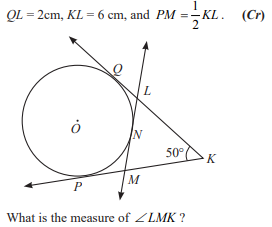
In a mathematics competition, students are given a problem involving a circle with center O. The problem states that three tangents KQ, KP, and LM are drawn from external points. Given that
Solution
80°
In two concentric circles, if a chord of the larger circle touches the smaller circle, which of the following statements cannot be said about the point of contact?
Solution
The radius of the smaller circle is half of the chord of the larger circle.
Flashcards
10 CardsClick to reveal answerTap the card to see answer

