

Hindi 50 Most Important Questions - Class 10 UP Board Hindi
Watch Video


Study smarter with Pi Lens
Get Notes, PYQs, Quiz and more for any Youtube video!
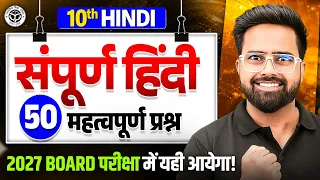
Hindi 50 Most Important Questions - Class 10 UP Board Hindi
442 views

PW UP BOARD 9&10th
Notes
Video Summary
Key Topics in Class 10 Hindi: High-Yield Exam Questions
Major Literary Periods and Their Features
Hindi literature is divided into distinct periods, each with unique characteristics, timeframes, and representative writers. Understanding these periods and their features is crucial for exam success.
- Rītikāl: Divided into three main streams—Rītibaddh, Rītimukt, and Rītisiddh. Not called "Suddhār Kāl."
- Shukla Yuga: Timeframe is 1918–1938.
- Pragativād: Timeframe is 1936–1943.
- Nayi Kavita: Begins from 1951.
- Dwiwedi Yuga: Named after Mahavir Prasad Dwivedi; timeframe is 1900–1918.
- Bhartendu Yuga: Known as "Navjagaran Kāl."
- Rītikāl alternate names: Alankrit Kāl, Shringār Kāl,…
Key Topics in Class 10 Hindi: High-Yield Exam Questions
Major Literary Periods and Their Features
Hindi literature is divided into distinct periods, each with unique characteristics, timeframes, and representative writers. Understanding these periods and their features is crucial for exam success.
- Rītikāl: Divided into three main streams—Rītibaddh, Rītimukt, and Rītisiddh. Not called "Suddhār Kāl."
- Shukla Yuga: Timeframe is 1918–1938.
- Pragativād: Timeframe is 1936–1943.
- Nayi Kavita: Begins from 1951.
- Dwiwedi Yuga: Named after Mahavir Prasad Dwivedi; timeframe is 1900–1918.
- Bhartendu Yuga: Known as "Navjagaran Kāl."
- Rītikāl alternate names: Alankrit Kāl, Shringār Kāl, Kala Kāl (not Suddhār Kāl).
Important Works and Their Authors
Knowledge of key works and their authors is frequently tested. Many questions focus on matching works to their creators or identifying the genre.
- Sadal Mishra: Author of "Nasiketu Pakhyān."
- Gosai Vitthalnath: Author of "Shringār Ras Mandan."
- Gang Kavi: Author of "Chhand Chhand Varnan ki Mahima."
- Mathili Sharan Gupt: Author of "Yashodhara."
- Suryakant Tripathi Nirala: Author of "Ram ki Shakti Pooja."
- Mahadevi Verma: Author of "Yama" (Kavya Sangrah) and "Ateet ke Chalchitra."
- Premchand: Known as "Upanyas Samrat," wrote "Seva Sadan," "Godan," "Gaban" (not "Tyagpatra").
- Jayashankar Prasad: Wrote "Chandragupṭ," "Skandgupt," "Dhruvswamini," "Azad Shatru" (not "Yama").
- Vrindavan Lal Verma: Author of "Virat ki Padmini."
- Agyeya: Published "Tar Saptak" (1943), called its poets "Rahōn ka Anveshi."
- Bhavani Prasad Mishra: Author of "Geet Farosh."
- Upendranath Ashk: Wrote "Jay Parajay."
- Ramkumar Verma: Known for "Badal ki Mrityu" (Ekanki).
- Mohandas Rakesh: Author of "Adhe Adhure."
- Kanhaiya Lal Mishra Prabhakar: Associated with "Parivarjak ki Katha."
- Sharad Chandra Sharma Gulehri: Noted for "Raja Bhoj ka Sapna."
- Chatur Sen Shastri: Wrote "Chitralekha."
- Ayyodhya Singh Upadhyay Harioud: Author of "Priy Pravas."
- Shri Lal Shukla: Wrote "Raag Darbari."
- Dev: Author of "Rasraj" (Rītikāl).
- Padmakar: Author of "Ganga Lahari."
- Suryadas: Wrote "Sahitya Lahari," "Sursagar," "Sur Saravali."
- Kabir: Associated with "Sohat Odhe Peet Par Shyam Salone Gat Mano Neel Mani Shail Par Aataparyo Prabhat."
Literary Genres and Forms
Understanding the classification of Hindi literary forms and their features is essential for answering genre-based questions.
- Gadya (Prose) Forms: Nātak (Drama), Kahani (Story), Alochana (Criticism). "Khandkavya" is not a prose form.
- Padya (Poetry) Forms: Mahakavya, Khandkavya.
- Upanyas (Novel): "Maila Anchal" by Phanishwar Nath Renu is a novel.
- Ekanki (One-act play): "Reshmi Tie" is an example.
- Yatra Sahitya: "Tantrōk se Yantrōk" is a travelogue.
- Kavya Sangrah: "Yama" by Mahadevi Verma.
Key Literary Devices and Figures of Speech
Questions often test identification and understanding of literary devices (alankars) and their application.
- Rūpak Alankar: Identified by two words with a connector (yojak chinh) between them.
- Upma Alankar: Marked by words like "sa," "si," "sam," "sarish."
- Utpreksha Alankar: Indicated by words like "man," "manav," "manhu," "janu," and expresses possibility.
- Anupras Alankar: Not in syllabus.
- Bhrantiman Alankar: Not in syllabus.
- Example: "Peepalpat saris mandola" uses Upma Alankar.
Grammar: Core Rules and Classifications
Hindi grammar is a high-yield area, with questions on word formation, sentence structure, and grammatical categories.
- Vākya (Sentence) Types:
- By structure (Rachna ke aadhar par): Three types—Saral, Sanyukt, Mishra.
- By meaning (Arth ke aadhar par): Eight types (cube of two).
- Vākya ke Tatva/Ang (Sentence Elements): Two—Uddeshya (Subject), Vidhey (Predicate).
- Vachya (Voice): Three types—Kartṛvachya (subject focus), Karmvachya (object focus, often marked by "dwara"), Bhāvavachya (action/feeling focus, often marked by "nahi").
- Samās (Compound Words): Four main types in syllabus—Dvandva, Dvigu, Bahuvrihi, Karmadhāraya. Use "priority method" for identification.
- Upasarg (Prefixes): Appear at the beginning of words and change meaning. Example: "Parichay"—prefix is "pari."
- Tatsam and Tadbhav: Tatsam words are directly from Sanskrit without change (e.g., "Aansoo" → "Ashru"). Tadbhav words are derived with changes.
- Sarvanām (Pronoun): Words used in place of nouns, e.g., "main."
- Kriya Visheshan (Adverb): Four types.
- Visheshan (Adjective): Not detailed in transcript.
- Vismayadibodhak (Interjection): Marked by exclamatory sign, e.g., "Aha!"
Poetic Forms and Metrical Structure
Questions on chhand (meter) and their structure are common, especially regarding syllable and matra counts.
- Chhand Types by Matra and Varna: Two—Mātrik and Varnik.
- Dohā Chhand: Four lines; 1st and 3rd lines have 13 matras, 2nd and 4th have 11 matras.
- Sōrṭhā Chhand: 1st and 3rd lines have 11 matras, 2nd and 4th have 13 matras.
- Rōlā Chhand: Not detailed, but asked for matra count.
- Tar Saptak: Four published volumes—1943, 1951, 1959, 1980.
Key Literary Terms and Their Application
Understanding and applying literary terms is essential for scoring full marks.
- Ras (Emotional Flavors):
- Hāsya Ras: Sthāyī Bhāv is "Hās."
- Karuṇ Ras: Sthāyī Bhāv is "Shok."
- Gāgar me Sāgar: Phrase associated with Bihari (Rītikāl, Rīti Siddh stream).
- Story and Drama in Chhayavād: "Premchand Yuga" for story, "Prasad Yuga" for drama.
- First Hindi Novel: "Pariksha Guru" considered the first original Hindi novel by Acharya Ramchandra Shukla; written by Lala Srinivas Das.
- Khadi Boli Gady: "Bhasha Yog Vashishtha" considered the initial work.
Exam Strategy and Common Pitfalls
Success in Hindi exams depends on methodical practice, awareness of question patterns, and avoiding common mistakes.
- Practice Only Recent Years: Focus on 2023, 2024, 2025, 2026 papers, as the pattern changed in 2022.
- Read Questions Carefully: Many errors occur due to not reading the full question or missing "not" in the question.
- Use Elimination Method: For multiple-choice, eliminate impossible options first.
- Screening for "Nahi": If "nahi" (not) appears in the question, be extra cautious.
- Tricks and Mnemonics: Use provided tricks for remembering authors, works, and classifications.
- Avoid Guesswork: Rely on logic and elimination rather than random guessing.
Notable Exam-Style Questions and Traps
Several questions are highlighted as high-frequency or commonly mistaken.
- "Rītikāl ki Kavyadhara nahi hai?": Correct answer is not "Rīti Riwāj."
- "Gadya ki Vidha nahi hai?": "Khandkavya" is not a prose form.
- "Dohā Chhand ke pehle aur teesre charan me matraen kitni hoti hain?": 13 matras.
- "Premchand ka upanyas nahi hai?": "Tyagpatra" is not by Premchand.
- "Shringār Ras Mandan ke lekhak kaun hai?": Gosai Vitthalnath.
- "Tar Saptak ka pratham prakashan kab hua?": 1943.
- "Dhruvswamini natak ke lekhak kaun hai?": Jayashankar Prasad.
- "Maila Anchal ki vidha kya hai?": Upanyas (novel).
- "Upanyas Samrat kise kaha jata hai?": Premchand.
- "Vākya ke kitne tatva hote hain?": Two—Uddeshya and Vidhey.
Additional High-Yield Facts
- "Ganga Lahari": Written by Padmakar.
- "Chand Chhand Varnan ki Mahima": By Gang Kavi.
- "Ateet ke Chalchitra": By Mahadevi Verma.
- "Adhe Adhure": By Mohan Rakesh.
- "Raag Darbari": By Shri Lal Shukla.
- "Reshmi Tie": Example of Ekanki (one-act play).
- "Priy Pravas": By Ayodhya Singh Upadhyay Harioud.
- "Chitralekha": By Chatur Sen Shastri.
- "Rasraj": By Dev (Rītikāl).
- "Shringār Ras Mandan": By Gosai Vitthalnath.
- "Gāgar me Sāgar": Associated with Bihari (Rītikāl).
These points cover the most critical, exam-relevant facts, rules, and pitfalls as explicitly stated in the content, focusing on high-yield recall and direct application for board exam preparation.
Quiz
30 QuestionsClick on an option to find the answer
Question 1 of 30
‘मुख चंद्र’ में कौन-सा अलंकार है?
Solution
रूपक
अलंकार के कितने भेद होते हैं?
Solution
तीन
'महर्षि' शब्द का सन्धि-विच्छेद है-
Solution
महा + ऋषि
Flashcards
10 CardsClick to reveal answerTap the card to see answer

