

Court Is Not God TNNLU Student Refuses - CUET Legal Studies
Watch Video


Study smarter with Pi Lens
Get Notes, PYQs, Quiz and more for any Youtube video!
Court Is Not God TNNLU Student Refuses - CUET Legal Studies
1 views

PW CLAT
Notes
Video Summary
Free Speech, Judicial Criticism, and Institutional Accountability
The Supreme Court and Judicial Supervision
The Supreme Court of India is recognized as the apex court and holds a position of judicial supremacy and activism. Its involvement in a wide range of matters is extensive, and its decisions have far-reaching consequences for the legal and social framework of the country. Criticizing the Supreme Court is not a trivial matter due to its central role in upholding constitutional values.
- Judicial Superiority: The judiciary is often seen as the final interpreter and guardian of the Constitution.
- Judicial Activism: The court…
Free Speech, Judicial Criticism, and Institutional Accountability
The Supreme Court and Judicial Supervision
The Supreme Court of India is recognized as the apex court and holds a position of judicial supremacy and activism. Its involvement in a wide range of matters is extensive, and its decisions have far-reaching consequences for the legal and social framework of the country. Criticizing the Supreme Court is not a trivial matter due to its central role in upholding constitutional values.
- Judicial Superiority: The judiciary is often seen as the final interpreter and guardian of the Constitution.
- Judicial Activism: The court frequently intervenes in matters of public interest and governance.
- Societal Perception: Statements against the Supreme Court, such as calling it "spineless," are considered bold and controversial.
The NCERT Judicial Corruption Controversy
A significant controversy arose when a chapter in an NCERT textbook discussed judicial corruption, leading to its removal after intervention by the Supreme Court. The issue highlighted tensions between academic freedom, institutional reputation, and the limits of criticism.
- NCERT Chapter: The textbook included a heading and two sentences asserting the existence of corruption in the judiciary, based on empirical data.
- Supreme Court's Action: The court demanded an apology from NCERT and ordered the deletion of the chapter, citing misrepresentation and potential harm to the judiciary's image.
- Access to Content: The chapter is no longer easily accessible, though it remains available on the internet.
The Case of Rishi Kumar and Institutional Pressure
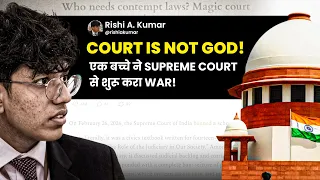
Rishi Kumar, a student at Tamil Nadu National Law University (TNNLU), wrote a blog post criticizing the Supreme Court's handling of the NCERT issue. His post became the center of institutional and national debate on free speech and academic independence.
- Blog Content: Rishi asserted that the Supreme Court had "lost its spine" and questioned the suppression of empirical data on judicial corruption.
- University Response: TNNLU faculty and administration faced pressure from judges and advocates to have the post removed.
- Student's Stand: Rishi refused to delete the post, stating "Court is not God," and emphasized his right to free expression under Article 19.
Article 19 and Freedom of Speech
Article 19 of the Indian Constitution guarantees the right to freedom of speech and expression. This right is central to the debate on whether criticism of the judiciary should be permitted or restricted.
- Constitutional Right: Every individual has the right to express their thoughts, including criticism of institutions.
- Limits and Balance: While transparency and accountability are essential, there is ongoing debate about balancing institutional credibility with the right to critique.
Empirical Data and Judicial Corruption
The NCERT chapter referenced empirical data from 2017 to 2021, highlighting complaints filed against the judiciary and issues of case pendency. The inclusion of such data was a focal point in the controversy.
- Data Mentioned: The chapter discussed the number of complaints and the backlog of cases, citing around 81,000 pending cases.
- Nature of Content: The majority of the chapter praised the judiciary, with only a small portion addressing corruption based on data.
- Misrepresentation Claim: Critics argued that the Supreme Court's order misrepresented the chapter's overall content.
Institutional Credibility vs. Transparency
A core issue is whether criticism of the judiciary undermines its credibility or enhances transparency. The debate centers on the need for trust in the judiciary versus the necessity of openness and accountability.
- Trust in Judiciary: The judiciary is seen as the protector of fundamental rights and the Constitution, requiring public trust.
- Transparency Needs: Lack of transparency, especially in judicial appointments and the collegium system, raises concerns about nepotism and accountability.
- Balanced Approach: There is a need for a balanced approach that allows for constructive criticism without eroding institutional trust.
The Collegium System and Judicial Appointments
The process of appointing judges through the collegium system has been criticized for its opacity and potential for nepotism. The National Judicial Appointments Commission (NJAC) was struck down by the Supreme Court, reinforcing the collegium's authority.
- Collegium Composition: The system involves the four senior-most judges and the Chief Justice of India.
- Criticisms: The process lacks transparency, and there are allegations of favoritism and familial appointments.
- NJAC Debate: The NJAC was removed in 2015 on the grounds that it violated the separation of powers and the basic structure of the Constitution.
- Calls for Reform: There are ongoing debates about reintroducing the NJAC and increasing executive involvement in appointments.
Institutional Pressures and Academic Freedom
The incident at TNNLU illustrates the pressures faced by academic institutions and individuals when expressing dissent or criticism of powerful institutions like the judiciary.
- External Pressure: University authorities acted under pressure from legal professionals to suppress critical content.
- Student Rights: The right to academic freedom and free expression is challenged by institutional interests.
- Precedent for Law Students: The case serves as an example for future law students about the complexities of exercising constitutional rights within institutional frameworks.
The Judiciary, Parliament, and Executive: Ongoing Tensions
There is a persistent tussle between the judiciary, parliament, and executive over the boundaries of power and accountability. These tensions are reflected in debates over judicial appointments, transparency, and the limits of criticism.
- Separation of Powers: The judiciary, parliament, and executive each seek to maintain their authority, leading to frequent conflicts.
- Impact on Governance: These institutional struggles affect the functioning and perception of the legal system.
- Public Debate: The controversy over the NCERT chapter and Rishi Kumar's blog post exemplifies the broader debate on institutional checks and balances.
Key Exam Takeaways
Understanding the balance between free speech, judicial accountability, and institutional credibility is crucial for law students and aspirants.
- Article 19: Guarantees freedom of speech and expression, subject to reasonable restrictions.
- Judicial Criticism: Not inherently contemptuous if based on empirical data and aimed at transparency.
- Institutional Trust: Essential for the judiciary's role as guardian of the Constitution, but should not preclude legitimate criticism.
- Collegium System: Central to judicial appointments; criticized for lack of transparency and potential nepotism.
- NJAC: Struck down for violating the basic structure; debate on its revival continues.
- Academic Freedom: Law students and academics may face institutional pressure when expressing dissent, highlighting the importance of constitutional protections.
- Case Pendency: Large backlog of cases and complaints against the judiciary are acknowledged issues.
- Balanced Approach: Essential to maintain both transparency and trust in judicial institutions for a healthy democracy.
Quiz
10 QuestionsClick on an option to find the answer
Question 1 of 10
Solution
Solution
Solution
Flashcards
5 CardsClick to reveal answerTap the card to see answer

