

English: Complete SVA, Tenses, Sentence - CDS English
Watch Video


Study smarter with Pi Lens
Get Notes, PYQs, Quiz and more for any Youtube video!
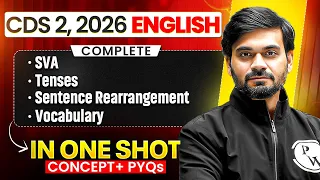
English: Complete SVA, Tenses, Sentence - CDS English
11 views

CDS Wallah
Notes
Video Summary
Subject-Verb Agreement, Tenses, Sentence Rearrangement, and Vocabulary for Competitive English Exams
Exam Pattern and Importance of English Section
The English section in competitive exams like CDS is considered one of the toughest among government job exams, with 120 questions focusing on advanced grammar, vocabulary, and comprehension. The level of English is higher compared to other exams, and consistent practice is essential for success. Key areas include Subject-Verb Agreement (SVA), Tenses, Sentence Rearrangement, and Vocabulary, each contributing a significant number of questions.
- Subject-Verb Agreement: 8–10 questions typically appear.
- Tenses: 5–10 questions are common.
- Sentence Rearrangement: 10…
Subject-Verb Agreement, Tenses, Sentence Rearrangement, and Vocabulary for Competitive English Exams
Exam Pattern and Importance of English Section
The English section in competitive exams like CDS is considered one of the toughest among government job exams, with 120 questions focusing on advanced grammar, vocabulary, and comprehension. The level of English is higher compared to other exams, and consistent practice is essential for success. Key areas include Subject-Verb Agreement (SVA), Tenses, Sentence Rearrangement, and Vocabulary, each contributing a significant number of questions.
- Subject-Verb Agreement: 8–10 questions typically appear.
- Tenses: 5–10 questions are common.
- Sentence Rearrangement: 10 questions are standard.
- Vocabulary: 50–60 words are covered per class for revision.
Core Principles of Subject-Verb Agreement (SVA)
Subject-Verb Agreement ensures that the verb in a sentence matches the subject in number and person. The basic rule is that singular subjects take singular verbs, and plural subjects take plural verbs. However, there are several exceptions and special cases that must be mastered for exam accuracy.
- Singular Subject → Singular Verb: "He loves," "She plays."
- Plural Subject → Plural Verb: "They love," "We play."
- 'I' as Subject: Although singular, 'I' takes plural verbs (e.g., "I love," "I eat").
- 'I' with 'am': "I am" is the correct form; "I is" or "I are" is incorrect.
- 'I' with 'have': "I have" is correct; "I has" is incorrect.
Special Cases and Exceptions in SVA
Certain structures and phrases require special attention in SVA. These include phrases with "one of," "either/neither of," "each of," "more than one," and parenthetical expressions.
- "One of the / Each of the / Either of the / Neither of the": The verb agrees with the main subject (one, each, either, neither), which is singular.
- Example: "One of the boys is absent."
- Relative Pronouns (who, whom, whose, that, which): The verb agrees with the antecedent (the noun before the pronoun).
- Example: "He is the man who loves children."
- Parenthetical Phrases (as well as, together with, along with, in addition to): The verb agrees with the first subject, not the parenthetical phrase.
- Example: "The principal, along with the teachers, was present."
- "More than one": Takes a singular noun and singular verb.
- Example: "More than one student has passed."
- "Neither...nor" / "Either...or": The verb agrees with the subject closer to the verb.
- Example: "Neither the teacher nor the students are present."
- "A number of": Takes a plural verb; "The number of" takes a singular verb.
- Example: "A number of cars are parked." / "The number of cars is 30."
- Fractional Expressions (half of, two-thirds of, etc.): The verb agrees with the noun following "of."
- Example: "Two-thirds of the committee was present." (committee = singular, non-count)
- Example: "Two-thirds of the recommendations were accepted." (recommendations = plural, count)
Rules for Tenses and Their Application
Tenses indicate the time of action and are tested through error spotting, sentence correction, and fill-in-the-blanks. Understanding when to use each tense is crucial.
- Past Indefinite (Simple Past): Used with past time words (yesterday, last night, ago, 1947, etc.).
- Structure: Subject + V2 (second form of verb)
- Example: "She left one minute ago."
- Present Perfect: Used for actions completed with present relevance, often with "since" or "for."
- Structure: Subject + has/have + V3
- Example: "I have eaten three bananas since morning."
- Past Perfect: Used for the "past of the past"—an action completed before another past action.
- Structure: Subject + had + V3
- Example: "When I proposed to her, she had already got three boyfriends."
- Future Perfect: Used for actions that will be completed before a specific future time.
- Structure: Subject + will/shall + have + V3
- Example: "By next week, the engineers will have completed the project."
- Continuous Tenses: Certain verbs (verbs of possession, senses, emotions, etc.) are not used in continuous forms.
- Example: Incorrect: "I am knowing." Correct: "I know."
- "Since" and "For": Used with perfect tenses to indicate duration from a point in the past to now.
- Example: "She has changed since she joined the army."
Sentence Rearrangement (PQRS/Parajumbles)
Sentence rearrangement questions test the ability to logically sequence sentences to form a coherent paragraph. These are reading-based and require understanding of connectors, pronouns, and logical flow.
- Identify the Theme: The central idea or topic sentence usually starts the paragraph.
- Mandatory Pairs: Some sentences naturally follow each other (e.g., cause-effect, definition-example).
- Connectors: Words like "however," "therefore," "consequently," "yet," "also" indicate logical links.
- Pronoun Reference: Pronouns (he, she, it, they) refer to nouns in previous sentences.
- Chronological/Logical Order: Events or arguments should be sequenced in a logical or time-based order.
Common Error Types and Traps
Competitive exams often test exceptions and tricky cases in grammar and usage. Awareness of these traps is essential.
- Plural-Looking Singular Nouns: Words like "politics," "mathematics," "news," "series," "species," "deer," "sheep" are singular unless contextually plural.
- Always Plural Nouns: "Police," "people," "cattle," "gentry," "infantry," "poultry," "children" always take plural verbs.
- Dual-Form Nouns: Words like "scissors," "pants," "trousers," "spectacles" are always plural.
- Many a / Many an: Followed by singular noun and singular verb.
- Example: "Many a student has succeeded."
- Collective Nouns: Treated as singular or plural based on context (singular for unit, plural for individuals).
- Example: "The committee has submitted its report." / "The committee are fighting among themselves."
- Parenthetical Expressions: Do not affect verb agreement; verb matches the main subject.
- Relative Pronouns: Verb agrees with the antecedent, not the noun after the preposition.
Vocabulary: High-Frequency Words and Synonyms
Vocabulary questions test knowledge of word meanings, synonyms, antonyms, and idiomatic expressions. Regular practice and note-making are recommended.
- Arbitrary: Random, despotic, dictatorial, erratic, unplanned, ad hoc, haphazard, aimless.
- Pragmatic: Practical, realistic, rational, judicious, commonsensical.
- Idealistic: Perfect, flawless, impeccable.
- Lenient: Tolerant, flexible, permissive, clement.
- Grim: Serious, stern, austere, critical, precarious (dangerous).
- Precarious: Dangerous, perilous, hazardous, deleterious, noxious.
- Obfuscate: Blur, make unclear, equivocal, nebulous, vague, foggy.
- Beat around the bush: To avoid the main topic, circumlocution.
- Taciturn: Reticent, reserved, uncommunicative (person who speaks less).
- Verbose: Talkative, garrulous, loquacious, wordy.
- Eloquent: Articulate, clear, explicit.
- Speculative: Tentative, theoretical, conjectural, surmised, deduced.
- Mitigate: Lessen, mollify, pacify, placate, palliate, attenuate, assuage.
- Dilapidated: Decaying, moribund, decadent, on the verge of death.
- Enervate: Weaken, diminish, enfeeble, debilitate, sap, undermine.
- Pejorate: Insult, degrade, belittle.
- Rebuke: Scold, reprimand, reprove, reproach, chastise.
- Grandiloquent: Bombastic, pompous, pretentious, ornate, decorated.
- Perfunctory: Superficial, mechanical, routine, cursory, half-hearted, slipshod, desultory.
- Thorough: Meticulous, careful, scrupulous, rigorous, conscientious.
- Dogmatic: Doctrinal, opinionated, authoritarian.
- Imperative: Important, necessary.
- Empirical: Based on observation, experimental, evidence-based, factual, inductive.
- Equanimity: Peace, composure, poise, calmness, sangfroid, phlegmatic.
- Circumvent: Evade, escape, avoid, outwit.
- Sanguine: Hopeful, optimistic, positive-minded.
- Laconic: Terse, short, brief, curt.
- Proliferate: Increase, multiply, propagate, accelerate, surge.
- Capricious: Whimsical, fickle, oscillating, fluctuating, volatile, mercurial.
- Gratified: Satisfied, complacent.
- Piecemeal: Incremental, partial, step-by-step, fragmented.
Strategies for Practice and Exam Preparation
Consistent practice is the key to mastering English for competitive exams. Understanding rules is not enough; application through solving questions is essential.
- Practice Previous Year Questions (PYQs): Analyze patterns and difficulty.
- Attempt Mock Tests: Simulate exam conditions and improve speed.
- Make Vocabulary Registers: Note down new words with meanings and synonyms.
- Read Diverse Themes: Improve comprehension and adaptability to various topics.
- Review Mistakes: Focus on error types and exceptions.
- Time Management: Practice under timed conditions to enhance accuracy and speed.
Reading Comprehension and Parajumbles: Approach and Tips
Reading comprehension and sentence rearrangement require strong reading habits and exposure to diverse topics. Thematic familiarity and logical sequencing are crucial.
- Read Regularly: Engage with varied subjects—economy, philosophy, science, etc.
- Identify Theme and Tone: Recognize the central idea and flow.
- Spot Connectors and Pronouns: Use them to link sentences logically.
- Practice with Exam-Level Material: Use questions from previous years and higher difficulty for better preparation.
Common Student Pitfalls and Mindset
Many aspirants struggle due to lack of practice, overthinking, or focusing on the wrong resources. Discipline and consistency are more important than the quantity of material covered.
- Avoid Overthinking Cut-offs: Focus on maximizing your score, not just clearing the cut-off.
- Do Not Rely on Luck: Competitive exams are merit-based; only top scorers succeed.
- Stay Disciplined: Consistency and regular practice yield better results than sporadic intense study.
- Manage Distractions: Stay conscious of time spent and avoid daydreaming during study sessions.
- Use Free Resources: Utilize available practice batches and free content for regular revision.
Exam-Focused Takeaways
Success in competitive English exams requires a blend of conceptual clarity, application through practice, and strategic preparation. Mastery of SVA, tenses, sentence rearrangement, and vocabulary is non-negotiable.
- Prioritize Practice: Application of rules through questions is essential.
- Master Exceptions: Focus on special cases and exceptions in grammar.
- Build Vocabulary: Regularly update and revise word lists.
- Develop Reading Skills: Read widely to handle comprehension and parajumbles.
- Review and Reflect: Analyze mistakes and learn from them.
- Stay Consistent: Regular, disciplined study outperforms last-minute cramming.
By adhering to these principles and focusing on high-yield areas, aspirants can significantly improve their performance in the English section of competitive exams.
Quiz
40 QuestionsClick on an option to find the answer
Question 1 of 40
Passage 20
To truly grasp the essence of a thing, immerse yourself in the realm of its opposite. This is the profound wisdom echoed across time, urging seekers of knowledge to embrace the interplay of light and shadow, of creation and destruction. Within the dance of opposites, clarity emerges. Just as darkness reveals the brilliance of light, and destruction underscores the miracle of creation, so too do opposing forces illuminate the nature of all things. To embark on this path of understanding, one must actively seek the essence of contrasts. Merely accepting them as given truths is not enough. Delve into their depths, unravel their intricacies, and witness how they shape and define one another. For concepts are not solitary islands, but threads woven into a tapestry of meaning. To grasp one thread is to perceive its connection to its opposite, and to the broader tapestry of knowledge itself.
Which of the following statements best reflects the message of the author of the passage?
Solution
The nature of things can be understood through their opposites.
Passage 40
In India's bustling bazaars and hidden workshops, artisans and traders have preserved invaluable skills and crafts, yet faced economic vulnerability and limited growth opportunities. To empower these custodians of tradition, PM Vishwakarma 2023, launched in September 2023, aims to reinvigorate India's informal sector. This ambitious scheme promises holistic support, encompassing skill development, financial assistance, and market access for traditional craftsmen, weavers, carpenters, and other skilled workers. PM Vishwakarma's strength lies in its multi-faceted approach. A formal "Vishwakarma" identification card recognizes artisans' expertise, granting access to various benefits. Skilling programs equip them with modern techniques, enhancing their employability and income potential. Microloans and credit support schemes break down financial barriers, enabling artisans to invest in tools and expand their businesses. The scheme also focuses on promoting traditional crafts through branding, marketing initiatives, and participation in trade fairs, fostering economic self-sufficiency. Challenges include ensuring inclusive participation across regions and crafts, bridging the digital divide for remote artisans, and addressing supply chain disruptions and fluctuating demand. Despite hurdles, PM Vishwakarma represents a significant step towards a brighter future for India's informal sector. By nurturing traditional skills, promoting entrepreneurship, and fostering market linkages, the scheme has the potential to empower millions, driving economic growth and preserving cultural heritage. Success, however, requires a nuanced understanding of sector challenges and a long-term commitment to sustained support beyond initial interventions.
Based on the passage's arguments, which of the following assumptions most rationally underpins the author's main point?
Solution
By fostering entrepreneurship and small-scale businesses within the informal sector, the scheme can potentially contribute to a shift towards a more decentralised and equitable economic model in India.
Passage 31
Three years into the Jal Jeevan Mission (JJM), India faces the challenge of water scarcity in its water-stressed regions. Despite aiming to provide tap water to every rural household by 2024, nearly 60% of India's groundwater blocks are categorized as "critical" or "over-exploited." JJM employs a multi-pronged strategy, emphasizing community participation, with Gram Panchayats taking ownership of local resources. Rainwater harvesting, greywater recycling, and water-efficient practices are crucial. The mission explores sustainable water sources, including surface water and groundwater recharge. Critics advocate for stricter regulations on water-intensive industries and agriculture, emphasising responsible water management. Questions linger about long-term sustainability amidst climate change and population growth. Despite challenges, JJM has seen successes in states where communities implemented innovative water conservation measures. The mission's focus on empowering Gram Panchayats and raising awareness has fostered a sense of responsibility in rural communities. The path forward requires a delicate balance, emphasising equitable access, infrastructure development, and a robust water management framework to fulfil JJM's promise of water security for all in water-stressed regions.
The most logical message implied by the passage regarding the long-term success of the Jal Jeevan Mission (JJM) in water-stressed regions of India is:
Solution
JJM's long-term viability in water-stressed areas hinges on achieving a shift towards community-driven, sustainable water management practices.
Flashcards
12 CardsClick to reveal answerTap the card to see answer

