

In a group of 50 students - CAT Quantitative Aptitude
Watch Video


Study smarter with Pi Lens
Get Notes, PYQs, Quiz and more for any Youtube video!
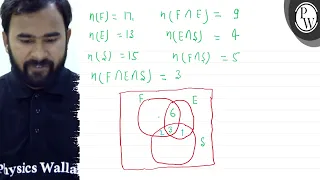
In a group of 50 students - CAT Quantitative Aptitude
2 views

PW Solutions
Notes
Video Summary
Set Theory Application: Students Studying Multiple Languages
This problem involves analyzing a group of 50 students, each studying one or more of three languages: French, English, and Sanskrit. The numbers of students studying each language, as well as their overlaps, are provided. The goal is to determine the number of students in various exclusive and overlapping categories using set theory and Venn diagram analysis.
Given Data and Set Definitions
The group consists of 50 students with the following distribution across three languages. Let , , and represent the sets of students studying French, English, and Sanskrit, respectively.…
Set Theory Application: Students Studying Multiple Languages
This problem involves analyzing a group of 50 students, each studying one or more of three languages: French, English, and Sanskrit. The numbers of students studying each language, as well as their overlaps, are provided. The goal is to determine the number of students in various exclusive and overlapping categories using set theory and Venn diagram analysis.
Given Data and Set Definitions
The group consists of 50 students with the following distribution across three languages. Let , , and represent the sets of students studying French, English, and Sanskrit, respectively.
- Total students:
- French ():
- English ():
- Sanskrit ():
- French and English ():
- English and Sanskrit ():
- French and Sanskrit ():
- All three languages ():
These values are used to fill a Venn diagram and calculate the required exclusive and overlapping student counts.
Venn Diagram Filling Strategy
To solve the problem, the Venn diagram is filled starting from the innermost intersection (students studying all three languages) and working outward. This ensures that overlapping counts are correctly assigned and no student is counted more than once in any category.
- Step 1: Assign to the intersection of all three sets ().
- Step 2: For each pairwise intersection, subtract the number already assigned to the triple intersection.
- Step 3: For each single set, subtract all numbers already assigned to its intersections.
Calculation of Exclusive Categories
Each exclusive category is determined by subtracting the relevant overlaps from the total for each set or intersection.
- French only: Students studying only French, not English or Sanskrit.
- English only: Students studying only English, not French or Sanskrit.
- Sanskrit only: Students studying only Sanskrit, not French or English.
- English and Sanskrit only: Students studying both English and Sanskrit, but not French.
- French and Sanskrit only: Students studying both French and Sanskrit, but not English.
- French and English only: Students studying both French and English, but not Sanskrit.
Stepwise Calculation of Each Region
The numbers for each region of the Venn diagram are calculated as follows:
- All three languages ():
- French and English only:
- English and Sanskrit only:
- French and Sanskrit only:
- French only:
- English only:
- Sanskrit only:
Summary Table of Student Distribution
The following table summarizes the number of students in each exclusive and overlapping category:
| Category | Number of Students |
|---|---|
| French only | 6 |
| English only | 3 |
| Sanskrit only | 9 |
| French and English only | 6 |
| English and Sanskrit only | 1 |
| French and Sanskrit only | 2 |
| All three languages | 3 |
Calculation of "At Least One" and "None" Categories
To find the number of students studying at least one language, sum all the exclusive and overlapping categories. To find those studying none, subtract this sum from the total number of students.
- At least one language:
- None of the three languages:
Answers to Specific Questions
The following answers are derived directly from the Venn diagram analysis and calculations:
- Number of students studying only French:
- Number of students studying only English:
- Number of students studying only Sanskrit:
- Number of students studying both English and Sanskrit only (not French):
- Number of students studying both French and Sanskrit only (not English):
- Number of students studying both French and English only (not Sanskrit):
- Number of students studying all three languages:
- Number of students studying at least one language:
- Number of students studying none of the three languages:
Method for Solving Similar Problems
To solve similar set theory problems involving three sets:
- Assign the number of students to the intersection of all three sets.
- For each pairwise intersection, subtract the number already assigned to the triple intersection.
- For each single set, subtract all numbers already assigned to its intersections.
- Sum all exclusive and overlapping categories to find the total studying at least one subject.
- Subtract this sum from the total to find the number studying none.
Key Takeaways for Exams
- Always start filling the Venn diagram from the innermost intersection (all three sets).
- For each pairwise intersection, subtract the triple intersection to avoid double-counting.
- For exclusive categories, subtract all relevant overlaps from the total for each set.
- The sum of all exclusive and overlapping categories should not exceed the total number of students.
- The number of students studying none is the total minus those studying at least one.
Common Pitfalls
- Double-counting students in overlapping regions if the Venn diagram is not filled systematically.
- Forgetting to subtract the triple intersection from pairwise intersections.
- Not checking that the sum of all regions plus the "none" category equals the total number of students.
Final Results
- French only:
- English only:
- Sanskrit only:
- French and English only:
- English and Sanskrit only:
- French and Sanskrit only:
- All three languages:
- At least one language:
- None of the three languages:
Quiz
10 QuestionsClick on an option to find the answer
Question 1 of 10
Solution
Solution
Solution
Flashcards
5 CardsClick to reveal answerTap the card to see answer

