

Triangles: Core Theorems - Class 10 Boards Mathematics
Watch Video


Study smarter with Pi Lens
Get Notes, PYQs, Quiz and more for any Youtube video!

Triangles: Core Theorems - Class 10 Boards Mathematics
1.7K views

Ritik Mishra - 9th & 10th
Notes
Video Summary
Triangles: Core Theorems and Similarity
Basic Proportionality Theorem (BPT) / Thales Theorem
The Basic Proportionality Theorem states that if a line is drawn parallel to one side of a triangle, intersecting the other two sides, it divides those sides in the same ratio. This theorem is fundamental for solving many triangle problems and is frequently asked in exams.
- If in triangle , then .
- The theorem is also known as Thales Theorem.
- The proof involves constructing perpendiculars and using the area formula for triangles multiple times.
Proof of BPT…
Triangles: Core Theorems and Similarity
Basic Proportionality Theorem (BPT) / Thales Theorem
The Basic Proportionality Theorem states that if a line is drawn parallel to one side of a triangle, intersecting the other two sides, it divides those sides in the same ratio. This theorem is fundamental for solving many triangle problems and is frequently asked in exams.
- If in triangle , then .
- The theorem is also known as Thales Theorem.
- The proof involves constructing perpendiculars and using the area formula for triangles multiple times.
Proof of BPT
The proof of BPT is exam-critical and involves using triangle areas and perpendiculars. It is repeatedly asked in board exams.
- Construct perpendiculars and from points and .
- Join and .
- Use area formulas: for triangles and .
- Divide the area equations to get .
- The proof relies on the fact that triangles on the same base and between the same parallels have equal areas.
Converse of BPT
The converse states that if a line divides two sides of a triangle in the same ratio, then it is parallel to the third side. This is also frequently tested.
- If , then .
- The proof involves assuming is not parallel, constructing another parallel, and showing the ratios force and to coincide, thus .
Types of BPT Applications
BPT can be applied in three forms depending on the question's requirements. Recognizing which ratio to use is essential for solving problems efficiently.
- Small/Small Ratio:
- Small/Big Ratio (Upper):
- Small/Big Ratio (Lower):
- The choice depends on which sides are given and what needs to be proved.
Solving BPT-Based Questions
Questions often provide parallel lines and ask for unknown side lengths or ratios. The method is to set up the appropriate ratio and solve for the variable.
- If , and , , , , set up and solve for .
- For checking parallelism, compare ratios: if , then is not parallel to .
Similarity of Triangles
Similarity means triangles have the same shape, but not necessarily the same size. All corresponding angles are equal, and corresponding sides are in proportion.
- If , then , , .
- The ratios of corresponding sides are equal: .
- Congruent triangles are always similar, but similar triangles are not always congruent.
Criteria for Similarity
There are three main criteria for proving triangles are similar. Each criterion is based on specific equalities of angles and/or side ratios.
- AA (Angle-Angle): If two angles of one triangle are equal to two angles of another, triangles are similar.
- SAS (Side-Angle-Side): If two sides are in proportion and the included angle is equal, triangles are similar.
- SSS (Side-Side-Side): If all three sides are in proportion, triangles are similar.
- The pattern of correspondence must be maintained when writing similarity.
Corresponding Parts of Similar Triangles (CPST)
Once triangles are proven similar, all corresponding parts (angles and sides) are equal or proportional. This is used to deduce further relationships.
- If triangles are similar, use CPST to write ratios and equalities for sides and angles.
- For example, if , then .
Special Properties and Cases
Certain shapes and segments always exhibit similarity. Recognizing these helps in quick problem-solving.
- Any two line segments are always similar.
- Any two circles are always similar.
- Any two squares are always similar.
- Any two equilateral triangles are always similar.
- For polygons other than triangles, both angles and side ratios must be equal for similarity.
Ratio Properties in Similar Triangles
In similar triangles, ratios extend beyond sides to medians, altitudes, angle bisectors, and perimeters.
- Ratio of corresponding medians, altitudes, and angle bisectors equals the ratio of corresponding sides.
- Ratio of perimeters equals the ratio of corresponding sides.
- If side ratio is , perimeter ratio is also .
Area Ratio in Similar Triangles
The ratio of areas of similar triangles is the square of the ratio of corresponding sides.
- If side ratio is , then area ratio is .
- For example, if side ratio is , area ratio is .
Exam-Focused Takeaways
Mastering BPT, its converse, and similarity criteria is essential for solving triangle problems in exams. Recognize which theorem or criterion applies, maintain correct correspondence, and use CPST for deducing unknowns.
- Always check for parallel lines to apply BPT.
- For similarity, look for angle equalities or side ratios.
- Use medians, altitudes, and angle bisectors ratios only if triangles are similar.
- Area and perimeter ratios follow side ratios in similar triangles.
- Practice constructing diagrams and identifying which triangles to compare for similarity or proportionality.
Word count: 1197
Quiz
45 QuestionsClick on an option to find the answer
Question 1 of 45
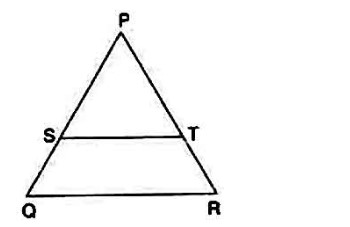
Statement I: If P and Q are the points on the sides DE and DF of a triangle DEF such that DP = 5cm, DE = 15cm, DQ = 6cm and QF = 18cm, then PQ||EF.
Statement II: In given figure, and There is an equilateral triangle.
Solution
Both Statement-I and Statement-II are false.
The ratio of the areas of two similar triangles is equal to
Solution
square of the ratio of their corresponding sides
The point of intersection of all the altitudes of a triangle is called the
Solution
Orthocentre
PYQs
24 QuestionsClick on an option to find the answer
Question 1 of 24
The perimeters of two similar triangles ABC and PQR are 56 cm and 48 cm respectively. is equal to
Solution
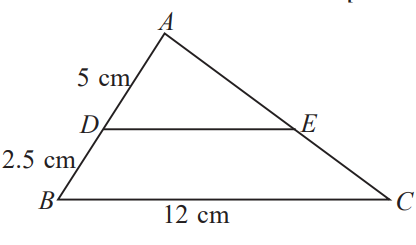
In the given figure ABC is shown. DE is parallel to BC. If AD = 5 cm, DB = 2.5 cm and BC = 12 cm, then DE is equal to:
Solution
8 cm
If the diagonals of a quadrilateral divide each other proportionally, then it is a:
Solution
trapezium
Flashcards
18 CardsClick to reveal answerTap the card to see answer

