

Smart Trick to Solve Order - Banking Exams Reasoning Ability
Watch Video


Study smarter with Pi Lens
Get Notes, PYQs, Quiz and more for any Youtube video!
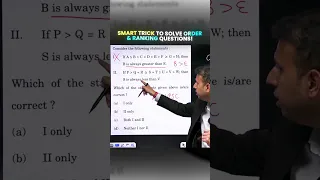
Smart Trick to Solve Order - Banking Exams Reasoning Ability
1 views

OnlyIAS Extended
Notes
Video Summary
Order and Ranking Reasoning: Open Face and Close Face Approach
Order and ranking questions require a clear understanding of the directionality of relational expressions and the priority of comparison operators. The open face and close face method provides a systematic way to analyze and solve such questions efficiently, especially when multiple relational signs are involved.
Key Concepts: Open Face and Close Face
In order and ranking problems, each relational expression has an open face and a close face, which determine the direction of logical movement. The open face points towards the element with the greater or lesser value,…
Order and Ranking Reasoning: Open Face and Close Face Approach
Order and ranking questions require a clear understanding of the directionality of relational expressions and the priority of comparison operators. The open face and close face method provides a systematic way to analyze and solve such questions efficiently, especially when multiple relational signs are involved.
Key Concepts: Open Face and Close Face
In order and ranking problems, each relational expression has an open face and a close face, which determine the direction of logical movement. The open face points towards the element with the greater or lesser value, while the close face points towards the element being compared.
- Open Face: The side of the relational sign that is "open" (e.g., in , the open face is towards ).
- Close Face: The side of the relational sign that is "closed" (e.g., in , the close face is towards ).
- Always start analysis from the open face and move towards the close face to determine the validity of a relational statement.
Priority Order of Comparison Signs
When multiple comparison signs are present in a chain of relations, each sign has a specific priority that must be respected to avoid errors in interpretation.
- The priority order for comparison signs is:
- Greater than ()
- Greater than or equal to ()
- Equal to ()
- The highest priority is given to the strictest inequality, followed by inclusive inequalities, and finally equality.
Method to Analyze Relational Chains
To determine the validity of a relational statement within a chain, follow a systematic approach starting from the open face and moving towards the close face, respecting the priority of signs.
- Identify the open face of the target relational statement.
- Start from the element at the open face and attempt to reach the element at the close face by following the chain of relations.
- If the path is blocked by a close face before reaching the target, the relation cannot be established.
- If the path is continuous, determine the correct sign to use based on the highest priority sign encountered.
Example Analysis: Step-by-Step Application
Applying the open face and close face method to sample statements clarifies the process and highlights common pitfalls.
- For the expression , the open face is towards and the close face is towards .
- To check if can be established from a given chain:
- Start from (open face) and attempt to reach .
- If a close face is encountered before reaching , the relation cannot be established.
- For the statement "S is always less than V":
- The open face is towards , and the close face is towards .
- Start from and attempt to reach through the chain.
- If the path is continuous, check the signs in between to determine the correct relational operator.
Determining the Correct Sign in a Chain
When traversing a chain of relations, the sign that ultimately connects the two elements is determined by the highest priority sign encountered along the path.
- If the chain includes , , and , the final relation is governed by the highest priority sign.
- For example, if the path from to includes and , the correct relation is , not simply .
Common Mistakes and Traps
Misinterpretation of the directionality of faces and the priority of signs leads to incorrect answers. Avoid these pitfalls by adhering strictly to the method.
- Starting from the wrong face (e.g., close face instead of open face) leads to invalid conclusions.
- Ignoring the priority order of signs can result in using the wrong relational operator.
- Assuming a relation exists without verifying the path through the chain is a common error.
Application to Multiple Statements
When evaluating multiple statements for validity, each must be checked independently using the open face and close face method and the priority order of signs.
- If neither statement can be established due to a blocked path or incorrect sign, the correct answer is "Neither one nor two."
- Always verify both the path and the sign before concluding the validity of a statement.
Exam-Focused Takeaways
Efficiently solving order and ranking questions depends on mastering the open face and close face approach and respecting the priority of comparison signs.
- Always start from the open face and move towards the close face.
- Use the priority order: , , .
- Do not assume a relation unless the path is unbroken and the sign is correct.
- Double-check each statement independently for both path and sign.
Summary Table: Priority of Comparison Signs
| Sign | Priority (High to Low) |
|---|---|
| 1 | |
| 2 | |
| 3 |
Final Tips for Order and Ranking Questions
A disciplined approach using open face and close face analysis, combined with strict adherence to sign priority, ensures accuracy and speed in solving order and ranking problems.
- Visualize the chain and mark open and close faces for clarity.
- Practice tracing paths from open to close face in sample questions.
- Memorize the priority order to avoid sign confusion under exam pressure.
Quiz
20 QuestionsClick on an option to find the answer
Question 1 of 20
If X > Y, Y < Z, and Z = W, which of the following statements is always true?
Solution
Y < W
Solution
Solution

