

Number Systems - Class 9 Assam Board Mathematics
Watch Video


Study smarter with Pi Lens
Get Notes, PYQs, Quiz and more for any Youtube video!

Number Systems - Class 9 Assam Board Mathematics
112 views

PW Assam 9 & 10
Notes
Video Summary
Number Systems and Geometry: Key Concepts and Exam Strategies
Rational and Irrational Numbers
Rational numbers are numbers that can be expressed as the ratio of two integers, where the denominator is not zero. Irrational numbers cannot be written as such a ratio and have non-terminating, non-repeating decimal expansions. Both rational and irrational numbers together form the set of real numbers.
- Rational Number: Can be written as , where and are integers, .
- Irrational Number: Cannot be written as ; decimal expansion is non-terminating and non-repeating.
- Between any two rational numbers, there…
Number Systems and Geometry: Key Concepts and Exam Strategies
Rational and Irrational Numbers
Rational numbers are numbers that can be expressed as the ratio of two integers, where the denominator is not zero. Irrational numbers cannot be written as such a ratio and have non-terminating, non-repeating decimal expansions. Both rational and irrational numbers together form the set of real numbers.
- Rational Number: Can be written as , where and are integers, .
- Irrational Number: Cannot be written as ; decimal expansion is non-terminating and non-repeating.
- Between any two rational numbers, there are infinitely many rational numbers.
- The decimal representation of a rational number can be terminating or non-terminating repeating.
- and are examples of irrational numbers.
- The product of two irrational numbers can be rational or irrational, depending on the numbers.
Properties of Exponents and Roots
Exponents and roots are fundamental in simplifying expressions and solving equations. The transcript provides several examples and properties related to exponents and roots.
- Example: because .
- Rationalizing denominators: Multiply numerator and denominator by the conjugate to remove roots from the denominator.
Polynomials and Their Properties
A polynomial is an algebraic expression consisting of variables and coefficients, involving only non-negative integer powers of variables. The degree of a polynomial is the highest power of the variable.
- Linear Polynomial: Degree 1 (e.g., )
- Quadratic Polynomial: Degree 2 (e.g., )
- Constant Polynomial: Degree 0 (e.g., )
- Zero Polynomial: Degree is undefined or not defined.
- Coefficient: The numerical factor of a term (e.g., in , coefficient of is 2).
- Degree of a non-zero constant polynomial is 0.
- Degree of the zero polynomial is not defined.
- A polynomial is linear if the highest power of is 1.
Factorization and Roots of Polynomials
Factorization is the process of expressing a polynomial as a product of its factors. The roots (or zeros) of a polynomial are the values of the variable that make the polynomial zero.
- If is a root of , then .
- To find the value of for which is a factor of , substitute and solve for .
- Middle term factorization: Split the middle term to factor quadratic polynomials.
- Example:
Coordinate Geometry Basics
Coordinate geometry deals with the position of points on the plane using ordered pairs (coordinates). The origin is the point .
- Origin:
- Abscissa: -coordinate of a point.
- Ordinate: -coordinate of a point.
- A point on the -axis has ordinate 0; a point on the -axis has abscissa 0.
- Quadrants:
- I:
- II:
- III:
- IV:
- Distance from a point to the -axis is ; to the -axis is .
Linear Equations in Two Variables
A linear equation in two variables represents a straight line in the coordinate plane. The general form is .
- Standard form: , where and are not both zero.
- Condition for a linear equation: or .
- The graph of a linear equation is a straight line.
- Equation of -axis: .
- Equation of -axis: .
- A line parallel to -axis: (where is a constant).
- A line parallel to -axis: .
- Intersection point of -axis and -axis is the origin.
- A system of two linear equations can have one solution, infinitely many solutions, or no solution.
- If two lines are parallel, the system has no solution.
- If two lines coincide, the system has infinitely many solutions.
Euclidean Geometry and Postulates
Euclidean geometry is based on definitions, postulates (axioms), and theorems. The word "geometry" comes from the Greek words "geo" (earth) and "metron" (measurement).
- Euclid was a mathematician from Egypt.
- Euclid's Elements is divided into 13 books.
- A point has no dimension.
- A line has length but no breadth.
- A plane surface has length and breadth but no thickness.
- A solid has length, breadth, and thickness.
- Boundary of a solid is called a surface.
- Boundary of a surface is a line.
- Boundary of a line is a point.
- Through two distinct points, only one straight line can be drawn.
- If equals are added to equals, the wholes are equal.
- If equals are subtracted from equals, the remainders are equal.
- Things which coincide with one another are equal to one another.
- All right angles are equal to one another.
- A terminated line can be produced indefinitely.
Angles and Their Properties
Angles are formed when two rays meet at a common endpoint. There are various types of angles based on their measures.
- Acute angle: Greater than and less than .
- Right angle: Exactly .
- Obtuse angle: Greater than and less than .
- Straight angle: Exactly .
- Reflex angle: Greater than and less than .
- Complementary angles: Two angles whose sum is .
- Supplementary angles: Two angles whose sum is .
- Vertically opposite angles: When two lines intersect, the opposite angles are equal.
- Adjacent angles on a straight line are supplementary.
- Sum of angles around a point is .
- Sum of angles on one side of a straight line at a point is .
Triangles: Types, Congruence, and Properties
A triangle is a polygon with three sides and three angles. Triangles can be classified based on sides and angles.
- Equilateral triangle: All sides and angles are equal; each angle is .
- Isosceles triangle: Two sides and two angles are equal.
- Scalene triangle: All sides and angles are different.
- Congruent triangles: Triangles that are identical in shape and size.
- Criteria for congruence:
- SSS (Side-Side-Side)
- SAS (Side-Angle-Side)
- ASA (Angle-Side-Angle)
- AAS (Angle-Angle-Side)
- RHS (Right angle-Hypotenuse-Side) for right-angled triangles
- If two angles and the included side of one triangle are equal to two angles and the included side of another triangle, the triangles are congruent (ASA).
- In an isosceles triangle, angles opposite equal sides are equal.
- In a triangle, the side opposite the largest angle is the longest.
- Sum of the angles of a triangle is .
- C.P.C.T. stands for Corresponding Parts of Congruent Triangles.
Exam-Focused Problem Types and Strategies
The transcript emphasizes the importance of practicing MCQs and understanding concepts through previous year questions and chapter-wise revision. Key strategies include:
- Revise chapter-wise and focus on concept clarity.
- Practice previous year questions for pattern recognition.
- Pay attention to definitions, properties, and exceptions as they are frequently tested.
- Use shortcut methods for calculations where possible, especially for MCQs.
- Understand the logic behind each answer, not just memorization.
- Be cautious with common traps, such as confusing complementary and supplementary angles, or misidentifying the degree of polynomials.
- Draw diagrams for geometry questions to visualize relationships.
- For coordinate geometry, always check the sign of coordinates to determine the correct quadrant.
- In algebra, factorization and substitution are key tools for solving equations and finding roots.
- For congruence, match sides and angles carefully according to the given criteria.
Common Pitfalls and Misconceptions
Students often make mistakes by misapplying definitions or confusing similar concepts. The transcript highlights several areas to watch out for:
- Confusing rational and irrational numbers based on decimal expansion.
- Assuming the product of two irrational numbers is always irrational (it can be rational).
- Misidentifying the degree of the zero polynomial (it is not defined).
- Mixing up abscissa and ordinate in coordinate geometry.
- Forgetting that the sum of angles on a straight line at a point is , not .
- Incorrectly applying congruence criteria; ensure the correct correspondence of sides and angles.
- Not recognizing that in isosceles triangles, the angles opposite equal sides are equal.
- Overlooking that the sum of the angles of a triangle is always .
- Misapplying the properties of exponents, especially when dealing with fractional and negative exponents.
- Neglecting to rationalize denominators properly in surd expressions.
By focusing on these key concepts, properties, and strategies, students can effectively prepare for mathematics exams and avoid common errors.
Quiz
40 QuestionsClick on an option to find the answer
Question 1 of 40
Section-A
Multiple Choice Type Question(Q1-Q3)-3marks each
The combination of Rational and Irrational numbers is called
Solution
Real Numbers
Which of the following is a rational number?
Solution
0
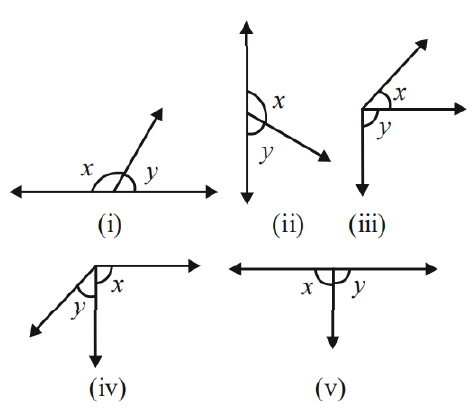
In which of the given figures, pairs of angles represent a linear pair?
Solution
(i), (ii) and (v) only
PYQs
36 QuestionsClick on an option to find the answer
Question 1 of 36
The perimeters of two similar triangles ABC and PQR are 56 cm and 48 cm respectively. is equal to
Solution
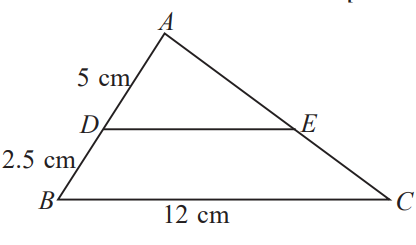
In the given figure ABC is shown. DE is parallel to BC. If AD = 5 cm, DB = 2.5 cm and BC = 12 cm, then DE is equal to:
Solution
8 cm
If the diagonals of a quadrilateral divide each other proportionally, then it is a:
Solution
trapezium
Flashcards
10 CardsClick to reveal answerTap the card to see answer

